




Vietnam Enforces REACH Proof for PCR Plastic Imports
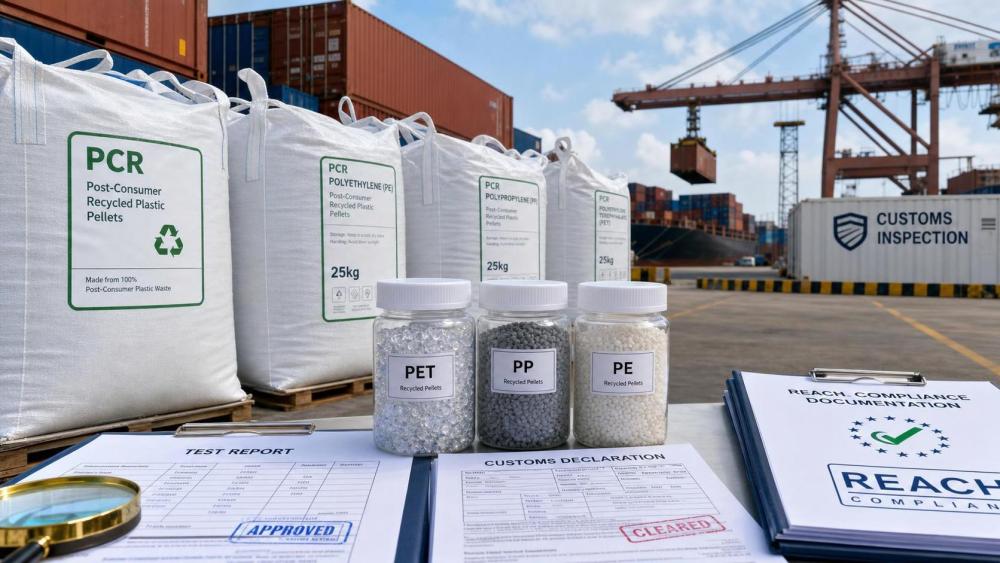
Effective July 16, 2026, Vietnam will require importers of PCR Plastic Washing & Pelleting products to submit REACH compliance documentation for their overseas suppliers, including recycled material producers in China. The change matters because it shifts compliance from a commercial preference to a customs-facing entry requirement, directly affecting recycled plastic trade, procurement planning, shipment release, and delivery reliability across PET, PP, and PE PCR pellet flows.
What the New Import Requirement Confirms
According to a joint notice from Vietnam’s Ministry of Industry and Trade and the General Department of Customs, from July 16, 2026, importers must submit a REACH declaration of conformity and third-party test reports for all imported PCR Plastic Washing & Pelleting products supplied by overseas vendors. The required testing scope covers SVHC screening, heavy metals, and phthalates.
The measure applies across the full range of PCR pellets in the PET, PP, and PE categories. The notice also states that cargo without the required documentation will be intercepted by the system and held at Ho Chi Minh City and Hai Phong ports, with average port delay extended to 14 working days.
Where the Pressure Will Appear First
Trade and export transactions will face a documentation gate
From an industry perspective, exporters and direct trading companies are likely to feel the impact first because the rule is tied to import clearance rather than only to downstream product use. What deserves closer attention is that overseas suppliers are not simply being asked for general quality papers; they now need documentation that can support the importer’s formal submission at entry.
For companies shipping PCR pellets into Vietnam, the practical exposure is concentrated in pre-shipment paperwork readiness, alignment between supplier files and importer filings, and the risk of shipment delay where documents are missing or incomplete.
Procurement teams will need to screen suppliers more tightly
For raw material buyers and procurement teams, the rule raises the importance of supplier qualification before booking cargo. Analysis shows that the affected point is not only price or availability, but whether a supplier can provide a REACH conformity statement together with third-party reports covering SVHC screening, heavy metals, and phthalates.
This means purchasing decisions for PET, PP, and PE PCR pellets may increasingly depend on document availability, report timeliness, and consistency between commercial orders and compliance files.
Logistics and delivery commitments may become less predictable
Supply chain service providers and import-side operations teams may need to account for a higher clearance risk for undocumented cargo. The confirmed consequence in the notice is system interception and detention at Ho Chi Minh City and Hai Phong ports, with average dwell time extended to 14 working days.
Observably, that makes delivery scheduling, inventory planning, and handover commitments more sensitive to documentation timing, especially where shipments are arranged close to production or resale deadlines.
What Companies Should Check Now
Match compliance files to the declared product scope
Companies involved in PCR pellet exports or imports should first verify whether their traded materials fall within the stated PET, PP, and PE PCR categories and whether the related files are prepared in a form usable for importer submission. This is particularly relevant where the same supplier serves multiple grades or product descriptions.
Review testing coverage before cargo moves
Analysis shows that the most immediate practical issue is whether existing third-party reports actually cover the screening items named in the notice: SVHC, heavy metals, and phthalates. Where reports are partial, outdated, or prepared for another customer context, businesses may need to reassess whether those papers are sufficient for shipment release.
Rebuild lead-time assumptions around port hold risk
Importers, exporters, and planners should pay closer attention to the stated detention consequence for undocumented shipments. Even without adding further assumptions, the notice already indicates that non-compliant cargo may face system blocking and a longer port stay, which can affect booking windows, order timing, and customer delivery commitments.
Watch for further execution language and document expectations
Because the available information confirms the filing requirement and the detention consequence, but does not provide fuller operational detail in the input, companies should continue monitoring how the requirement is expressed in customs practice, buyer documentation requests, and transaction paperwork. This is especially relevant for supplier declarations, test report presentation, and any consistency checks between product identity and submitted files.
Why This Looks Like an Execution Signal
It is more appropriate to understand this as an executed compliance signal rather than a distant policy discussion, because the measure comes with a defined effective date, a stated documentation package, named test scope, identified port enforcement points, and a direct customs consequence for missing proof.
At the same time, analysis shows that the market still needs to observe how strictly supporting documents are reviewed in practice and whether commercial buyers begin to convert this requirement into standard procurement terms, tender documentation, or supplier onboarding conditions.
How the Market Should Read the Change
The core significance of this development is that REACH-related proof is being positioned as a practical trade access requirement for imported PCR pellets covered by PET, PP, and PE categories in Vietnam. For the industry, the immediate issue is less about abstract regulatory direction and more about whether supply chains can provide complete, shipment-ready compliance evidence before cargo reaches port.
For now, the most balanced reading is that this is a landed rule change with clear operational consequences, while some aspects of day-to-day enforcement and market response still warrant continued observation.
Basis of This Article and What Still Needs Verification
This article is based on the user-provided news title, event date, and event summary. For developments of this kind, commonly relevant source types may include official notices, releases from regulatory authorities, customs or trade administration information, industry association updates, standard-setting documents, and reporting by authoritative media.
No specific official source link was provided in the input, so the exact official publication path still requires follow-up verification. Observably, the areas that remain worth tracking include detailed implementation language, certification and testing interpretation in practice, changes in tender or procurement documents, market feedback, and how affected companies execute the requirement in live shipments.
Have questions about this sector analysis, or seeking best practices specific to your niche? Drop us a line below and let the senior consultants at APIM assist you.
We respect your privacy. Your information is strictly confidential.
Related News
- 00
0000-00
How does washing affect contamination in post-consumer recycled PP resins? - 00
0000-00
How does feedstock affect depolymerization equipment selection? - 00
0000-00
US Sets 213.44% Preliminary Antidumping Deposit on Chinese PTMEG - 00
0000-00
When should epoxy be used as a thermal interface material for semiconductors? - 00
0000-00
US Midterm Results Unlikely to Quickly Shift Recycled Plastics Market or Legislation