




Mechanical Recycling Market Outlook: Key Shifts in 2026
The mechanical recycling market enters 2026 with more pressure and more maturity at the same time.
Recycled polymers are no longer discussed only as sustainability targets.
They are becoming practical supply options for packaging, automotive parts, electronics housings, industrial products, films, and compounds.
That shift matters because material quality, process consistency, and regulatory acceptance now shape commercial decisions as much as price.
For companies evaluating circular materials, the mechanical recycling market is increasingly a question of reliability, traceability, and fit-for-use performance.
Why 2026 looks different
The direction of travel is clear, even if regional speed differs.
Brands want higher recycled content.
Governments want measurable circularity.
Processors want materials that run without unstable melt flow, odor issues, contamination, or color drift.
This is why the mechanical recycling market is moving beyond volume headlines.
In 2026, the real differentiator is not just how much waste can be collected.
It is how much of that waste can be turned into repeatable industrial feedstock.
That creates a more technical conversation around sorting purity, washing efficiency, decontamination, pellet quality, and downstream processing behavior.
What mechanical recycling really means in business terms
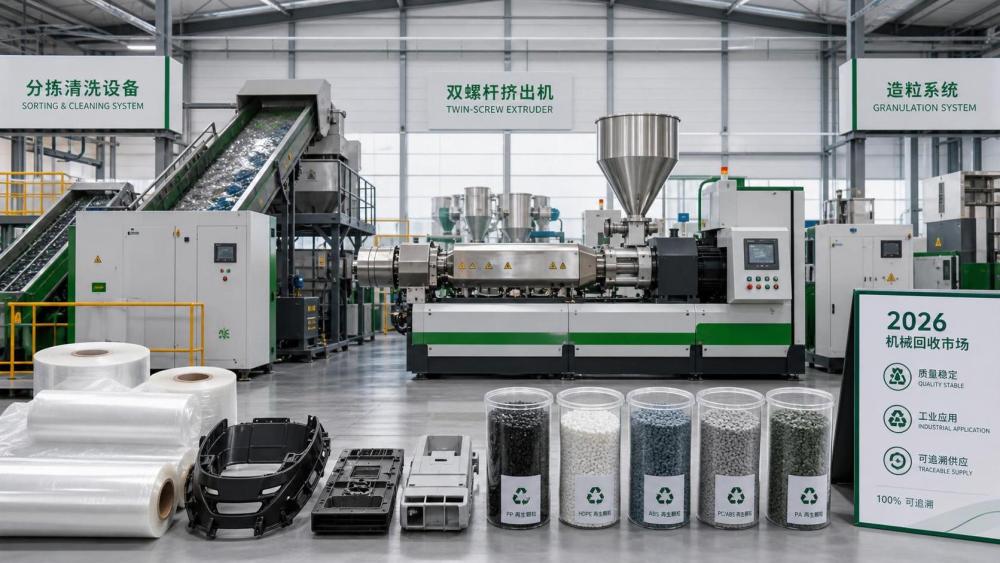
Mechanical recycling refers to collecting, sorting, cleaning, shredding, melting, and reprocessing plastic waste into usable material.
Unlike chemical recovery routes, it keeps the polymer chain largely intact.
That makes it commercially attractive where cost, scale, and energy intensity matter.
It also comes with constraints.
Feedstock variation can reduce performance.
Repeated thermal history can affect viscosity, impact strength, appearance, and long-term stability.
So the mechanical recycling market should not be viewed as a simple replacement pool for virgin resin.
A better view is this: it is a growing material category with its own processing logic, performance windows, and qualification requirements.
That perspective is especially relevant across advanced polymers, compounds, films, and industrial components, where application demands are rarely generic.
The signals reshaping the mechanical recycling market
Several shifts are now converging.
Together, they explain why the mechanical recycling market is becoming more structured and more selective.
Quality is moving to the center
Buyers increasingly ask for melt flow consistency, contamination data, odor control, moisture limits, ash content, and color tolerance.
This is particularly important for recycled PET, recycled PP, recycled PE, and engineering polymer blends.
Compounding capability matters more
Recycled polymers often need stabilization, filtration, reinforcement, or impact modification before they can enter demanding applications.
That links the mechanical recycling market directly with twin-screw extrusion, pelletizing systems, dosing accuracy, and process control.
Regulation is getting more operational
Policy pressure is no longer abstract.
Recycled content mandates, packaging rules, traceability expectations, and reporting obligations are changing sourcing strategies.
End-use suitability is replacing generic claims
A recycled resin may work well in trays, transport packaging, appliance parts, or non-visible automotive components.
The same grade may fail in optical films, precision housings, or high-heat electrical parts.
Where value is showing up first
Not every polymer application will adopt recycled content at the same pace.
The most active parts of the mechanical recycling market are still those with clearer economics and manageable performance demands.
- Packaging formats that can tolerate controlled variation, especially non-food and transport uses.
- Consumer and industrial housings where appearance can be engineered through color control or textured surfaces.
- Automotive interior and under-the-hood parts using compounded recycled PP, PA, or PET blends.
- Construction and infrastructure products where durability and cost balance matter more than optical perfection.
- Film and sheet applications using mono-material structures that improve both recyclability and supply clarity.
More demanding segments are also participating, but usually through blended solutions.
Virgin resin may still carry the critical properties, while recycled content supports cost and circularity targets.
That blended model is likely to remain important across the mechanical recycling market in 2026.
Why process knowledge now matters as much as material sourcing
A recycled pellet is not the end of the story.
Its performance depends heavily on how it was processed and how it will be converted.
This is where structured technical intelligence becomes valuable.
In APIM’s coverage areas, material behavior is connected to formulation design, extrusion settings, filtration, degassing, residence time, and cooling control.
That matters in the mechanical recycling market because process instability can turn a promising recycled grade into a costly production problem.
For example, recycled compounds used in sheet extrusion or film applications may need tighter control over gels, black specks, and thickness variation.
Recycled engineering plastics for electronics or machinery parts may require better stabilization against heat and hydrolysis.
Adhesive bonding systems and multilayer structures also affect the recyclability of downstream products, which feeds back into future waste stream quality.
In other words, the mechanical recycling market is not isolated from the wider material ecosystem.
It is influenced by product design, additives, converting methods, and end-of-life planning.
How to evaluate opportunity without underestimating risk
The strongest decisions usually start with application requirements, not recycled content targets alone.
A useful evaluation framework is to test the mechanical recycling market against four practical questions.
Is the feedstock stream stable?
Consistency in source material often predicts consistency in finished pellets.
Does the recycled grade match the process window?
Injection molding, extrusion, thermoforming, and blow molding all respond differently to viscosity and contamination shifts.
Can the part still meet performance and compliance needs?
This includes thermal resistance, dimensional stability, odor, migration limits, flame behavior, and documentation quality.
Is the economics case durable?
Short-term price advantages can disappear if scrap rates, qualification delays, or supply interruptions are ignored.
- Map each target application by visual, mechanical, thermal, and regulatory sensitivity.
- Request property data across multiple lots, not just one sample.
- Compare recycled content strategies by total conversion cost, not resin price alone.
- Review whether additives, pigments, fillers, or multilayer designs will complicate future recyclability.
What to watch next
The mechanical recycling market will likely keep expanding, but not evenly.
Capacity announcements alone will not tell the whole story.
The more useful signals are qualification success, feedstock access, sorting technology upgrades, and the ability to serve application-specific compounds.
That is where platforms such as APIM become relevant.
Clear information about recycled polymers, compounding systems, extrusion technologies, specialty films, and material performance helps reduce guesswork.
The next step is not to treat the mechanical recycling market as a single trend line.
It is better understood as a set of material pathways, each with different technical limits and commercial potential.
A sound 2026 strategy starts by ranking applications, defining acceptable property ranges, and comparing suppliers through process and traceability evidence.
That approach makes the mechanical recycling market easier to navigate and more useful as a long-term industrial decision.
Have questions about this sector analysis, or seeking best practices specific to your niche? Drop us a line below and let the senior consultants at APIM assist you.
We respect your privacy. Your information is strictly confidential.
Related News
- 00
0000-00
NAPCOR Report: US PET Bottle Recycling Rate Fell to 29% in 2025 - 00
0000-00
How does washing affect contamination in post-consumer recycled PP resins? - 00
0000-00
How does feedstock affect depolymerization equipment selection? - 00
0000-00
US Sets 213.44% Preliminary Antidumping Deposit on Chinese PTMEG - 00
0000-00
When should epoxy be used as a thermal interface material for semiconductors?