




How to size a plastic extrusion line for recycling output targets
A recycling extrusion line should be sized from the required saleable output, not from the nominal capacity printed on an extruder data sheet. A line rated at 1,000 kg/h does not necessarily deliver 1,000 kg/h of on-spec recycled pellets. Feedstock moisture, contamination, bulk density, filtration losses, volatile removal, melt instability, grade-change time, and pelletizing constraints all reduce the throughput that can be sustained while meeting quality requirements.
The practical sizing question is therefore: how much material must enter each processing stage to produce the required quantity of qualified pellets over the available operating time? The answer determines not only extruder diameter and motor power, but also washing, drying, feeding, screen changing, vacuum degassing, melt pumping, filtration, and pelletizing capacity. A plastic extrusion line for recycling is correctly sized only when these subsystems work at compatible rates under the worst expected feedstock condition—not merely when the extruder can process clean, dry resin at a short-term maximum rate.
Start with net qualified output and real operating hours
Define the target as tonnes of pellets accepted into finished-goods inventory per month or per year. Avoid defining the project only as “X kg/h,” because hourly output is meaningful only when linked to operating availability, planned maintenance, material changes, and quality holds.
A useful starting relationship is:
Required net pellet rate = required qualified production ÷ effective annual operating hours
Effective hours are not calendar hours. They exclude scheduled shutdowns, cleaning, screen changes, screw or die maintenance, startup stabilization, product transitions, and the time required to manage off-spec material. The resulting figure is the average qualified output needed while the line is genuinely producing. The line must then be selected with enough operating margin to achieve this average without remaining at its upper mechanical or thermal limit.
For example, a plant requiring 6,000 tonnes of qualified pellets annually cannot select a 750 kg/h line simply because 6,000 tonnes divided by 8,000 calendar hours equals 750 kg/h. If effective production time is 6,500 hours after normal losses, the required qualified rate is about 923 kg/h. If the process must retain operating margin for feedstock variation and filtration loading, the selected extrusion and downstream system may need a stable demonstrated rate above that value rather than a nominal nameplate of 1,000 kg/h.
Capacity should be expressed in at least three ways during technical evaluation:
- Nameplate capacity: the supplier’s declared maximum under stated conditions.
- Sustainable gross throughput: the incoming material rate that can be processed continuously with the intended feedstock and configuration.
- Net qualified output: pellets meeting agreed quality specifications after process losses, rejects, and internal rework.
Confusing these figures is one of the most consequential sizing errors. A high nameplate number may have limited value if the line cannot hold melt pressure, moisture, odor, gel level, pellet geometry, or contamination targets at that rate.
Build the mass balance before choosing screw diameter
The required feed rate must account for all mass that does not become approved pellets. Depending on the recycling route, losses may include residual water, fines, labels and paper, metals, sand, incompatible polymers removed by sorting, screen-pack residue, devolatilized compounds, purging material, and pellets rejected during quality inspection.
The basic calculation is:
Required incoming feed rate = net qualified pellet rate ÷ overall yield
Overall yield must reflect the boundary of the project. If the line begins with washed, dry flakes delivered to a silo, washing and sorting losses may belong upstream. If the project receives baled post-consumer material, the balance must include the entire preparation process. Keeping these boundaries explicit prevents an extrusion line from being sized correctly in isolation while the front end cannot deliver enough usable feedstock.
Consider a target of 1,000 kg/h of approved recycled PP pellets. If the extrusion, filtration, pelletizing, and quality process gives a 96% yield from dry prepared feedstock, the line requires roughly 1,042 kg/h of usable material. If upstream sorting and washing recover only 82% of incoming bales, more than 1,270 kg/h of baled feed is required before allowing for operational interruptions. Each value refers to a different process point; treating them as interchangeable leads to incorrect equipment capacities.
Mass balance also clarifies where a bottleneck belongs. If the output deficit results from high reject levels after filtration, increasing extruder diameter may not solve it. The corrective action may instead be better sorting, more effective washing, improved drying, a different screen configuration, or a feedstock specification that separates highly contaminated lots.
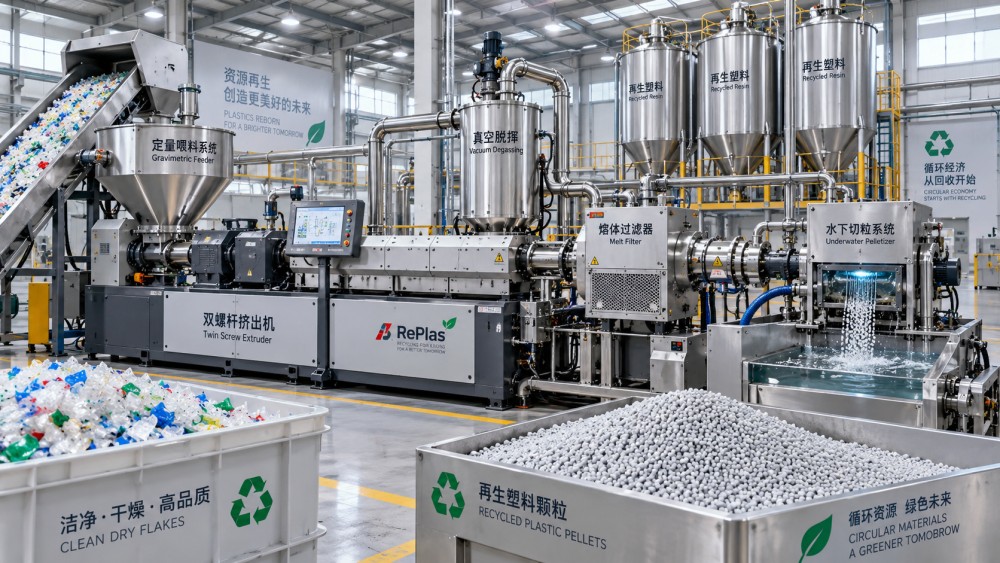
Feedstock condition determines usable extruder capacity
Two materials described as “recycled HDPE flakes” or “recycled PP regrind” can impose very different loads on the same machine. Bulk density affects feeder volume and solids conveying. Particle size distribution affects bridging and feed consistency. Moisture affects venting and hydrolytic degradation risk for moisture-sensitive polymers. Printed residues, adhesives, paper, wood, aluminum, and incompatible polymers affect filtration frequency, melt pressure, odor, black specks, gels, and die build-up.
For this reason, the feedstock specification should be treated as a sizing document, not a purchasing description. It should define, as applicable:
- polymer family and expected grade mix;
- form of input: flakes, film scraps, regrind, agglomerate, densified film, or pellets;
- bulk density range and particle-size range;
- moisture at extruder feed;
- contamination type and concentration limits;
- ash, paper, metal, wood, elastomer, and non-target polymer content;
- residual inks, adhesives, oils, cleaning chemicals, and volatile compounds;
- melt flow range and permitted variability;
- required finished-pellet quality and downstream application.
A line processing rigid flakes can often use a relatively direct gravimetric feeding arrangement when material is dry and free-flowing. Lightweight film flakes may require cutter-compaction, crammer feeding, force feeding, densification, or specialized hopper geometry because apparent volume, not mass alone, becomes limiting. A screw can have adequate melting and torque capacity yet remain underfed because the feeding system cannot provide a stable solids flow.
Material density changes should be evaluated at the feeder and extruder inlet. A volumetric feeder may appear stable by speed but deliver a fluctuating mass rate as bulk density changes. For recycling applications with variable feedstock, gravimetric control is generally more informative because it measures the quantity that matters: actual mass entering the process. This is especially important where additives, virgin resin, compatibilizers, fillers, or masterbatch must be dosed at controlled ratios.
Choose the extrusion platform around the process duty
Single-screw and twin-screw systems are not interchangeable capacity choices. Their suitability depends on whether the task is primarily melting and homogenizing a relatively clean stream, or whether it includes intensive mixing, devolatilization, reactive modification, filler addition, odor reduction, or dispersion of multiple components.
A single-screw recycling extruder may be appropriate for a reasonably uniform, preconditioned feedstock where the principal duty is melt generation, filtration, and pelletizing. Its performance depends heavily on screw geometry, feeding stability, melt temperature control, and the pressure demand created by filtration and die design. Adding a melt pump can decouple some pressure generation from the extruder, improving pressure stability and allowing the screw to focus more on melting and conveying. It does not, however, compensate for poor feedstock preparation or inadequate melt filtration.
A co-rotating twin-screw extruder provides stronger distributive and dispersive mixing, more flexible feeding positions, and effective venting options. It is often considered when a recycled stream requires compatibilization, additive incorporation, mineral filling, color correction, chain extension, or controlled blending with virgin material. Yet a twin-screw line should not be selected merely because it is more versatile. Its specific mechanical energy, residence-time distribution, screw configuration, and venting arrangement must fit the resin and additives. Excessive shear or residence time can worsen degradation, discoloration, odor formation, or molecular-weight loss.
Diameter alone is an incomplete basis for comparison. Output depends on screw speed, torque limit, motor power, screw design, feed characteristics, barrel configuration, melt temperature constraints, and downstream backpressure. Supplier proposals should state the feedstock and process assumptions behind any output guarantee. A capacity claim for clean, dry industrial regrind should not be used to size a line intended for mixed post-consumer flakes.
Moisture and volatiles can set the true line limit
Moisture is not simply a drying issue. In PET, PA, PC, and other hydrolysis-sensitive polymers, excessive moisture can reduce molecular weight during melt processing and impair mechanical performance, viscosity, appearance, or subsequent processing behavior. For polyolefins, water may not produce the same hydrolytic effect, but it can still cause vent flooding, bubbles, unstable strand formation, steam-related pressure variation, and poor pellet quality.
Evaluate moisture at the point immediately before melting, rather than relying only on a supplier’s incoming-material certificate. Open storage, pneumatic transport, washing variation, and seasonal conditions can change the actual condition seen by the extruder. Where the feed is washed flake, mechanical dewatering, thermal drying, and hopper residence time must be considered as a connected system.
Vacuum degassing should be sized for the expected vapor and volatile load, not installed as a generic feature. Its effectiveness depends on melt seal design before the vent, available free volume, fill level, vent location, vacuum level, condenser performance, and whether the material carries entrained water, printing solvents, low-molecular-weight compounds, oils, or degradation products. A larger vacuum pump alone cannot correct an overloaded or poorly sealed vent section.
Odor-sensitive recycled resin creates a related but distinct challenge. Standard devolatilization can reduce some volatile compounds, but its result depends on the chemical nature of odor-causing substances and the residence conditions available. If odor limits are central to the product specification, they must be evaluated through representative trials rather than inferred from the presence of a vacuum port.
Filtration capacity is a throughput and quality decision
Melt filtration is often where a recycling line’s theoretical throughput becomes an operating constraint. Fine screens improve contaminant removal but increase pressure drop, raise melt temperature through shear, and shorten screen life when contamination is high. Coarser filtration supports throughput and longer intervals, but may allow gels, paper fibers, aluminum fragments, char, or unmelted polymer through to the pelletizer and downstream converter.
The correct screen changer depends on contamination loading, allowable pressure fluctuation, product sensitivity, required continuity, and the tolerance for material loss during screen changes. Continuous or backflush filtration systems can support steadier operation in demanding streams, but they also require a clear understanding of purge losses, maintenance needs, and the contamination types they can handle. A screen changer is not a substitute for magnetic separation, metal detection, washing, sorting, or appropriate feedstock controls.
When reviewing a proposal, require a filtration duty statement: screen area, mesh arrangement, expected differential-pressure range, changeover method, acceptable contamination level, estimated screen-pack life under defined feedstock conditions, and the line response if pressure rises beyond limits. Without those conditions, a filtration throughput figure has little decision value.
Downstream equipment must accept the melt stream without becoming the bottleneck
Pelletizing is frequently under-specified. Strand pelletizing depends on stable strand formation, predictable melt strength, water-bath cooling capacity, strand handling, and cutter throughput. It can be unsuitable for melts that are too soft, tacky, low-viscosity, or unstable to form consistent strands. Underwater pelletizing handles different melt behaviors and can support high outputs, but demands stable melt pressure, carefully matched die-face conditions, water-system control, and pellet drying capacity.
The pelletizer should be selected from the polymer’s melt behavior and the required pellet specification, not from throughput alone. Pellet shape, fines generation, residual moisture, temperature at discharge, and cooling-water management can affect packaging, bulk handling, dosing, and downstream molding or film extrusion. A pelletizing system that reaches the target mass rate but generates excessive fines may shift the problem into conveying, storage, or customer processing.
Conveying, classification, metal detection, storage silos, and bagging or bulk-loading systems also need to match the net output. Their capacity should include short-term surge capability. If the extrusion line produces continuously but packaging pauses during a bag change, quality release hold, or forklift delay, the plant needs enough buffer storage to prevent forced line stoppages or uncontrolled mixing of production lots.
Use an operating window, not a single promised rate
A robust specification defines a normal operating range and a guaranteed performance point. The normal range is where the line should achieve stable melt temperature, pressure, vacuum performance, pellet quality, energy use, and reasonable maintenance intervals. The guaranteed point should identify the feedstock condition, additive package, filtration setup, pelletizing method, and quality criteria used to verify output.
Running permanently near maximum screw speed, torque, motor load, or filtration pressure leaves little capacity to absorb feedstock changes. It also makes maintenance and quality performance more sensitive to small disturbances. Margin is not unused capital by definition; it is the ability to maintain qualified production when the material is less favorable than the best-case sample.
The most reliable sizing decision comes from representative trials that reproduce the intended feedstock range, including its less favorable but acceptable condition. Measure gross feed rate, net pellet output, specific energy, melt temperature, pressure stability, vacuum behavior, screen life, pellet moisture, fines, color variation, odor where relevant, and the finished resin properties required by the application. These results should be translated into acceptance criteria before equipment is ordered.
The right capacity for a plastic extrusion line for recycling is therefore the rate at which the complete system can consistently convert defined incoming material into qualified pellets. Extruder size matters, but it is only one element of that system. A defensible line selection starts with net output, works backward through yield and operating time, and then tests every upstream and downstream constraint against the feedstock that will actually be processed.
Have questions about this sector analysis, or seeking best practices specific to your niche? Drop us a line below and let the senior consultants at APIM assist you.
We respect your privacy. Your information is strictly confidential.
Related News
- 00
0000-00
How does washing affect contamination in post-consumer recycled PP resins? - 00
0000-00
How does feedstock affect depolymerization equipment selection? - 00
0000-00
US Sets 213.44% Preliminary Antidumping Deposit on Chinese PTMEG - 00
0000-00
When should epoxy be used as a thermal interface material for semiconductors? - 00
0000-00
US Midterm Results Unlikely to Quickly Shift Recycled Plastics Market or Legislation