




How post consumer plastic recovery affects PCR pellet quality
Post consumer plastic recovery is often discussed as a recycling target, but for processors it is better understood as the first quality-control stage for PCR pellets. Once a used package, household container, appliance part, or agricultural product enters the recovery stream, its collection history begins to shape the resin that will later reach an extruder, injection molding machine, sheet line, or film converter.
That connection is easy to underestimate. A pellet may look clean, have an acceptable melt flow value, and still create odor, black specks, unstable color, die build-up, brittle parts, or inconsistent weld lines downstream. The reason is that PCR quality is not determined by the recycling plant alone. It is the combined result of feedstock origin, sorting discipline, washing performance, thermal history, filtration, compounding, and batch-management practices.
For technical evaluators, the practical question is not whether post consumer plastic recovery is “good” or “bad.” It is whether the recovery route produces a material profile that is controlled well enough for a defined application. A black recycled PP for a non-visible transport tray faces a very different qualification threshold from natural rPET sheet for packaging, recycled ABS for an appliance housing, or recycled polyolefin compound for an automotive interior component.
Recovery quality starts before the recycler receives the material
Post-consumer feedstock is inherently more variable than post-industrial scrap. Production scrap usually has a known polymer family, a known additive package, and limited exposure to contamination. Consumer waste has already passed through collection systems, homes, commercial sites, storage areas, transport, and sometimes uncontrolled environments. It may be mixed with food residue, labels, adhesives, paper, metals, incompatible polymers, pigments, moisture, and products that were never intended to enter the same recycling stream.
The collection format matters. Source-separated bottles or rigid containers generally offer a more manageable starting point than mixed municipal waste. That does not automatically mean the recovered polymer will be high grade, but it reduces the burden on sorting and washing. Mixed collection can still support useful PCR production, particularly for durable or dark-colored applications, yet the process needs more robust detection, separation, and filtration to control variation.
Material design upstream also influences what can be recovered. A package made from several polymers, heavy inks, multilayer structures, full-body sleeves, metallized elements, or persistent adhesive systems may perform well during use but complicate identification and separation after disposal. This is where design-for-recycling discussions become operational rather than promotional. If sorting equipment cannot reliably identify a substrate, or if attached components cannot be separated economically, the recovered fraction will carry more contamination risk into the pellet.
Sorting determines polymer purity, not just recycling yield
Sorting is often described in terms of recovery rates, but technical teams should look at it as a polymer-purity decision. A recycled PE stream containing PP may still process in some applications. However, PP and PE are not fully compatible in the melt. Even modest cross-contamination can affect stiffness, impact behavior, shrinkage, surface appearance, sealing performance, and consistency from lot to lot. The impact becomes more visible in thin-wall molding, film extrusion, pressure-sensitive applications, and parts with demanding dimensional requirements.
Near-infrared sorting, density separation, metal removal, air classification, manual quality checks, and color sorting can each reduce different types of contamination. None should be assessed in isolation. For example, density separation can help remove certain materials, but it cannot solve every issue caused by similar-density polymers, fine paper fibers, labels, residual adhesives, or pigments. Optical sorting is valuable, yet black or heavily filled articles can present identification challenges depending on the sorting setup and material formulation.
A useful supplier discussion is not simply, “Do you sort the material?” It is: What is the incoming feedstock mix? Which contaminants are most common? At what point are they removed? How is sorting effectiveness verified? And how are off-spec fractions handled? A recycler that can explain those process boundaries usually provides a clearer basis for PCR pellet qualification than one that offers only a generic recycled-content percentage.
Washing controls more than visible cleanliness
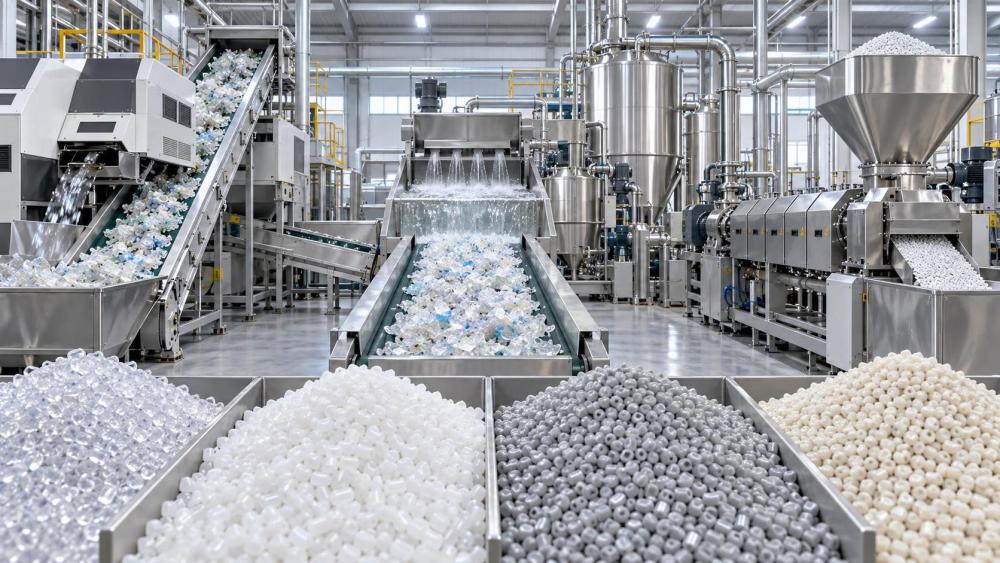
Washing is where many hidden downstream problems are either reduced or carried forward. Food residues, oils, detergents, labels, adhesives, soil, and fine particles can affect odor, discoloration, volatile emissions, filtration load, and thermal stability. A flake that appears visually clean may still contain residues that become noticeable only when the material is heated during extrusion or molding.
The required washing intensity depends on feedstock and end use. Rigid household packaging, for instance, may contain residues that are different from those found in agricultural films or commercial collection streams. Aggressive washing may improve cleanliness, but it also introduces its own process requirements: wastewater management, drying efficiency, flake handling, and control of residual moisture. Poor drying is especially relevant for moisture-sensitive polymers such as PET, PA, PC, and some engineering plastics. During melt processing, moisture can contribute to hydrolytic degradation, reducing molecular weight and changing rheological behavior.
Odor deserves separate attention because it is not always predicted by standard mechanical testing. Odor can originate from absorbed consumer-product residues, degradation products, inks, adhesives, washing chemistry, or mixed-polymer contamination. It may be irrelevant for some concealed industrial parts, yet unacceptable for consumer goods, interiors, appliances, or packaging-related applications. If odor is a critical requirement, it should be evaluated on molded or extruded test articles, not assumed from the appearance of pellets.
Every heat history changes the polymer
PCR material has already experienced at least one service life and usually another melt cycle during reprocessing. Heat, oxygen, shear, moisture, and residence time can alter polymer chains. Depending on the resin and processing conditions, this may appear as chain scission, branching, crosslinking, oxidation, gel formation, or a broader molecular-weight distribution. The result is not always a simple loss of performance. Sometimes a recycled polymer flows more easily because chain scission has lowered molecular weight; in other cases, branching or crosslinking can raise viscosity or create unstable flow behavior.
This is why melt flow rate or melt volume rate should be treated as a useful screening indicator, not a complete quality verdict. A single value can help assess processing consistency, but it does not reveal polymer identity, odor, residual contamination, molecular-weight distribution, color drift, or the presence of gels and non-melting particles. Technical evaluators should compare the test method, test condition, sampling plan, and lot-to-lot range rather than relying on a single nominal number from a datasheet.
In extrusion, degraded material may show up as pressure fluctuations, screen-pack loading, die lines, gels, or inconsistent gauge control. In injection molding, it can appear as short shots, excessive flash sensitivity, brittle gates, surface defects, or changing cycle behavior. These symptoms are not always caused by the pellet itself; machine setup, drying, masterbatch selection, and mold conditions also matter. But a stable process cannot fully compensate for unstable incoming resin.
Filtration and compounding can upgrade a stream, but they cannot erase its history
Melt filtration is one of the most important control points in PCR pellet production. Screen changers, continuous filtration systems, and suitable screen configurations can remove solid contaminants before pelletizing. Their effectiveness depends on contamination type, melt viscosity, filtration area, pressure capability, and how consistently the upstream process operates. Fine filtration can improve visual quality and reduce downstream defects, but it also increases pressure demand and may be difficult to sustain with heavily contaminated feedstock.
Compounding provides another opportunity to improve usability. Stabilizers, compatibilizers, chain extenders, odor-control additives, impact modifiers, fillers, and color concentrates may help tailor recycled resin for a targeted application. Yet formulation should not be confused with recovery quality. Additives can address specific weaknesses, but they cannot reliably turn an unknown mixed stream into a predictable engineering polymer. If contamination is fundamental, the more realistic path may be to select a less demanding application, blend with virgin resin, or redesign the compound around a wider processing window.
Equipment choices affect this outcome. Twin-screw extrusion can support mixing, devolatilization, additive incorporation, and dispersion, while vacuum degassing can help reduce certain volatiles. Screw design, feeding accuracy, melt temperature, residence time, and cooling conditions all influence the final pellet. In practical terms, two suppliers may start with similar recovered flakes and still produce materially different PCR pellets because their compounding and process-control discipline differ.
What should be checked during PCR pellet qualification?
The right test plan should follow the application rather than a generic recycled-material checklist. A processor making thick-walled black components may prioritize contamination, flow consistency, impact performance, and repeatability. A sheet producer may focus on gels, color, odor, moisture, and surface quality. Film converters will often be more sensitive to contamination, die deposits, gauge variation, and sealing behavior. Electrical, automotive, medical, food-contact, or flame-retardant applications may introduce additional regulatory, traceability, or performance requirements that need separate confirmation.
One common mistake is qualifying PCR from a small laboratory sample and then assuming the same behavior at production scale. A trial should include more than a few molded plaques. It should assess drying, feeding, melt pressure, screen changes, scrap generation, color adjustment, cycle stability, and the behavior of regrind if the process uses it. For extrusion applications, a meaningful assessment usually includes enough run time to reveal die build-up or filtration-related variation.
Traceability is a process-control tool, not just a sustainability claim
PCR specifications are stronger when they describe feedstock boundaries and control methods, not only recycled-content percentages. Technical teams should ask whether the material is based on bottles, rigid mixed packaging, films, household waste, commercial waste, or a broader mixed-plastic stream. They should also clarify whether the grade is a single-polymer recyclate, a deliberately compounded blend, or a blend containing virgin resin.
Batch traceability, retained samples, change-notification procedures, and lot-specific test documentation are especially useful where process windows are narrow. These controls do not guarantee perfect uniformity, but they make deviations easier to investigate. When a line begins to show haze, odor, pressure instability, or unexpected mechanical failures, the ability to trace material back to a feedstock class and processing batch can save considerable time.
This is the practical perspective behind APIM’s coverage of recycled polymers, compounding systems, extrusion technology, specialty films, and industrial material applications: material performance is tied to the full conversion chain. A PCR pellet cannot be evaluated only as a commodity resin. Its recovery pathway, formulation, processing history, and intended end use must be considered together.
The most useful decision is usually application-specific
High-quality post consumer plastic recovery does not mean eliminating every variable; it means identifying the variables that matter and controlling them to an agreed level. Some applications can absorb wider variation through wall thickness, dark colors, robust geometry, or blending strategies. Others cannot. Clear films, light-colored surfaces, tight-tolerance parts, high-voltage electrical components, and long-life load-bearing products require a more cautious qualification path.
Before approving a PCR grade, evaluate the feedstock origin, sorting route, wash quality, drying practice, melt filtration, compounding approach, test-method consistency, and production-scale behavior. If a supplier cannot provide clarity on these points, the issue is not necessarily that the material is unusable. It simply means the technical risk has not yet been defined well enough to place that pellet into a demanding process or product.
Have questions about this sector analysis, or seeking best practices specific to your niche? Drop us a line below and let the senior consultants at APIM assist you.
We respect your privacy. Your information is strictly confidential.
Related News
- 00
0000-00
Do polyolefin hot melt adhesives bond well to polyethylene? - 00
0000-00
Korean Study Finds PLA Barely Degrades in Landfill After 320 Days - 00
0000-00
How to assess batch consistency from a thermal potting compounds supplier - 00
0000-00
How much weight can carbon fiber reinforced plastics save in cars? - 00
0000-00
Switching from PS to ABS Sheet Extrusion: Equipment Checks