




How High Throughput Plastic Pelletizing Technology Cuts Regrind Variability
Why regrind consistency changes from one line to another
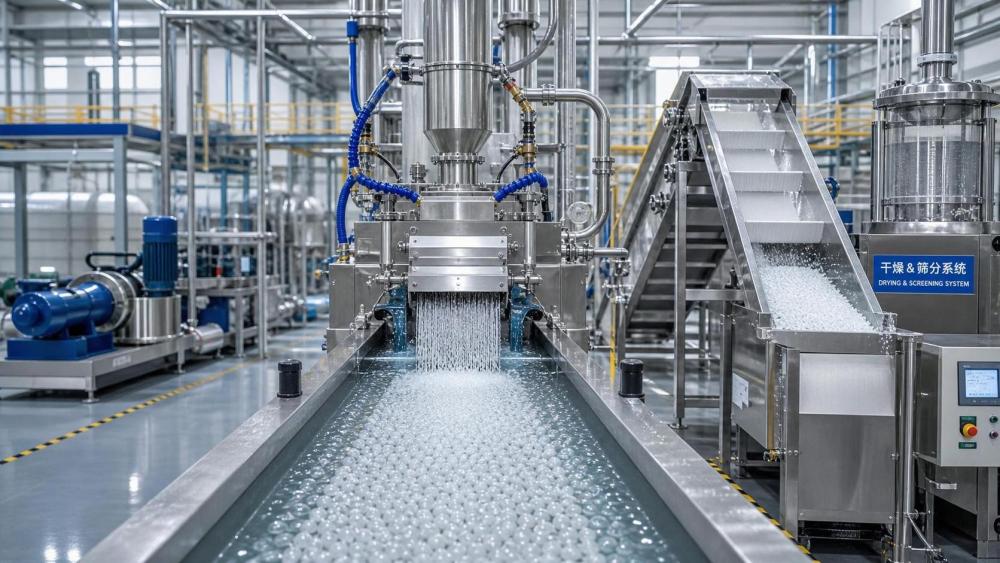
High throughput plastic pelletizing technology matters when recycled or compounded material must behave like a controlled industrial input, not a fluctuating byproduct.
In practice, regrind variability rarely comes from one factor alone. Pellet size spread, cooling instability, fines generation, moisture pickup, and melt pressure swings often interact.
That is why the same pelletizing line can perform well for one polymer family and still create avoidable variation in another.
APIM often frames this issue through process logic. Material performance depends on formulation, extrusion stability, filtration, degassing, and the way pellets are formed and cooled.
When throughput rises, weak process windows become easier to see. Small deviations in die pressure or cutter speed start showing up downstream as feeding inconsistency, visual defects, or property drift.
High throughput plastic pelletizing technology cuts regrind variability because it keeps pellet geometry, residence time, and thermal history closer to target, even under demanding output rates.
Actual operating conditions usually decide the best pelletizing approach
Different production environments ask different things from high throughput plastic pelletizing technology. A recycling line handling washed post-consumer flakes behaves very differently from a filled engineering compound line.
More brittle materials may create fines during conveying. Hygroscopic polymers may react badly to uneven cooling and later moisture exposure. Filled systems may challenge die wear and cutting stability.
The practical question is not simply whether output is high. The better question is how stable the pellet remains after cutting, cooling, drying, storage, and refeeding.
That broader view matters in automotive compounds, electronics housings, packaging films, and industrial molded parts, where pellet inconsistency quickly becomes a process control issue.
When recycled polyolefins are the main stream
For recycled PE and PP, the main concern is often flow uniformity rather than premium appearance. Even so, pellet shape still affects feeder behavior and blend accuracy.
In these lines, high throughput plastic pelletizing technology usually helps most when contamination levels and melt viscosity vary from batch to batch.
Underwater systems can improve cooling consistency and reduce strand break risks. Strand pelletizing may remain suitable where material is cleaner and line flexibility matters more.
When engineering compounds need tighter downstream control
Glass-filled PA, flame-retardant PC, conductive compounds, and mineral-filled blends usually need narrower pellet variation because dosing errors can influence molding stability and final part performance.
Here, high throughput plastic pelletizing technology is less about maximum tonnage alone. It is about preserving formulation consistency while avoiding excessive shear, dust, and thermal degradation.
A line that looks productive on output data can still create costly variation if pellet bulk density changes too much across shifts.
Where high throughput plastic pelletizing technology has the biggest effect
The influence of high throughput plastic pelletizing technology becomes clearer when typical use cases are compared side by side.
This comparison shows why high throughput plastic pelletizing technology should be selected around process behavior, not just nameplate capacity.
In recycling lines, stable pellets reduce hidden process noise
Mechanical recycling often looks straightforward until downstream inconsistency starts appearing as feeder surging, screen loading, or unstable extrusion pressure.
A more uniform pellet can reduce those problems because conveying becomes smoother and blending behavior becomes easier to predict.
This is especially relevant for recycled PET, recycled PP, and recycled PE streams entering sheet, film, or injection molding operations.
In actual use, high throughput plastic pelletizing technology supports circular material goals only when throughput gains do not come at the cost of unstable pellet morphology.
APIM’s broader materials view is useful here. Recycled content targets matter, but processing stability determines whether those targets remain commercially workable across repeated production cycles.
In compounding lines, the real test comes after pellet formation
Compounded materials carry more formulation complexity. Additives, fibers, flame retardants, impact modifiers, and conductive fillers all react differently during pelletizing.
That means high throughput plastic pelletizing technology must protect more than throughput. It must protect dispersion quality and avoid extra variation during the last step of melt processing.
For example, a conductive compound may suffer if fines alter carbon distribution in the regrind blend. A glass-filled resin may show feeding shifts if pellet length becomes inconsistent.
In these cases, a good evaluation looks beyond pellet appearance. It checks feeder response, molding pressure consistency, scrap rate, and part-to-part property spread.
- Measure pellet size distribution over time, not only at startup.
- Track fines after conveying and storage, not only at the cutter.
- Compare regrind behavior at different blend ratios.
- Review die wear and cutting blade intervals under full output.
Misjudgments that often weaken the result
One common mistake is treating similar polymer families as identical pelletizing cases. Recycled PP with variable contamination does not behave like a stable virgin PP compound.
Another is focusing on pellet size averages while ignoring distribution width. Downstream equipment reacts to spread, not just nominal dimensions.
A third issue is evaluating high throughput plastic pelletizing technology by initial output alone. Long shift performance, maintenance intervals, and moisture control usually tell the more useful story.
It is also easy to overlook line integration. Feeders, melt pumps, screen changers, degassing systems, and drying sections all influence the consistency finally seen in regrind.
What to confirm before choosing a system or upgrade path
A practical decision framework keeps high throughput plastic pelletizing technology aligned with the actual operating window.
- Define the polymer mix, filler content, and expected viscosity range.
- Check whether downstream molding, film, or extrusion steps are sensitive to fines or pellet length variation.
- Review water, cooling, drying, and contamination control as part of the pelletizing decision.
- Estimate wear part life under target throughput, not pilot conditions.
- Run trials that include regrind loops, storage time, and repeat feeding.
That approach fits the wider APIM perspective on materials and processing. Consistency is rarely created by one machine alone; it comes from how process steps hold together under real production pressure.
When regrind variability is the concern, the next move is to map the specific line condition, compare pellet behavior across operating states, and identify which stability gap is truly limiting output quality.
Have questions about this sector analysis, or seeking best practices specific to your niche? Drop us a line below and let the senior consultants at APIM assist you.
We respect your privacy. Your information is strictly confidential.
Related News
- 00
0000-00
How does washing affect contamination in post-consumer recycled PP resins? - 00
0000-00
How does feedstock affect depolymerization equipment selection? - 00
0000-00
US Sets 213.44% Preliminary Antidumping Deposit on Chinese PTMEG - 00
0000-00
When should epoxy be used as a thermal interface material for semiconductors? - 00
0000-00
US Midterm Results Unlikely to Quickly Shift Recycled Plastics Market or Legislation