




EU Sets PCR Plastic Residue Limit Under REACH
On August 3, 2026, the European Commission published amendment notice Ref: ECHA/2026/17, adding a new entry to REACH Annex XVII that sets a residue limit for washed and de-labeled post-consumer recycled (PCR) plastics used for food contact and for exports to the EU. The measure covers PET, PP, and PE, and puts immediate attention on recycling processors, pellet producers, exporters, buyers, and supply chain teams handling EU-facing business, because compliance is now tied not only to material type but also to washing performance and recognized validation status.
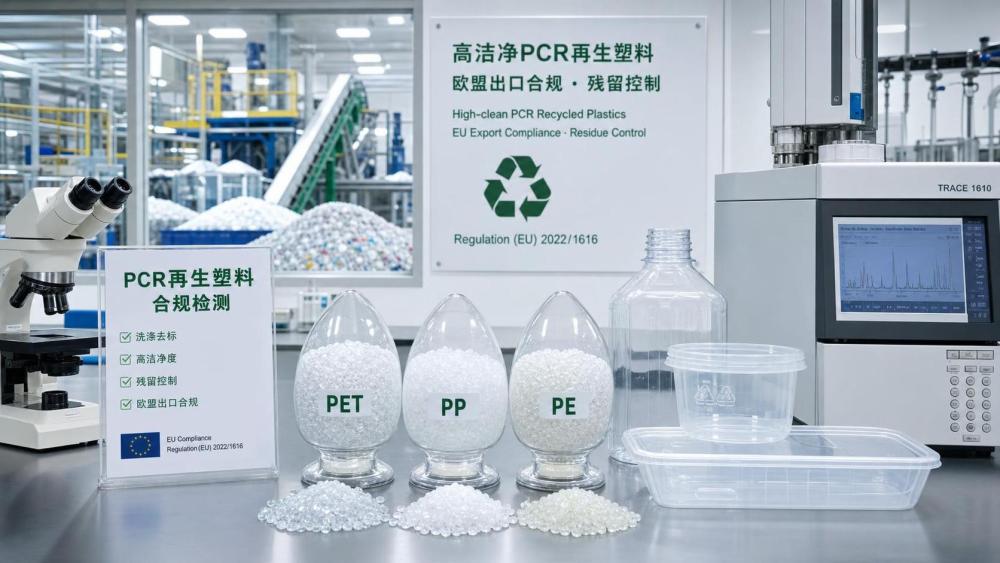
What the amendment formally adds
According to the information provided, the amendment introduces Entry 79 into REACH Annex XVII. It sets a strict limit on organic residues remaining after washing and label-removal processes in PCR plastics, including residues such as adhesives, inks, and surfactants.
The stated threshold is total organic carbon of no more than 5 ppm. The requirement applies to PCR plastics including PET, PP, and PE when they are intended for food-contact use and for export to the EU.
The same information also indicates that suppliers without an EU-recognized PCR washing validation report will not be able to enter the EU supply chain.
Where the pressure will be felt first
Export-oriented recyclers and pellet makers face a direct compliance gate
From an industry perspective, companies in PCR washing and pelletizing are likely to be the first to feel the impact because the new rule is tied to post-washing residue performance. The main effect is likely to appear in export qualification, customer approval, and shipment readiness for EU-bound business.
What deserves closer attention is that this is not only a product-specification issue. It also affects whether a supplier can remain commercially usable in an EU-facing supply chain if the required validation status is missing.
Buyers and procurement teams may need to tighten supplier screening
For raw material buyers, converters, and downstream purchasers sourcing PCR plastics for EU-related applications, the likely impact is in supplier onboarding, material approval, and documentation review. Analysis shows that procurement decisions may need to place greater weight on whether a supplier can present an EU-recognized PCR washing validation report, rather than relying only on general recycled-content claims.
This matters particularly where food-contact use or export exposure makes residue compliance a transactional requirement rather than a technical preference.
Trade and supply chain service functions may face documentation risk
Export service providers, compliance coordinators, and logistics-facing teams may also be affected because the rule changes the document set needed to support entry into the EU supply chain. Observably, the risk here is less about the existence of PCR material itself and more about whether proof of validated washing performance is available when orders are placed or delivered.
The practical pressure point is likely to be contract execution, customs-facing paperwork preparation, and customer communication on compliance status.
What companies should be checking now
Whether current PCR grades fall within the affected use scenario
Companies should first distinguish which PCR materials are intended for food-contact applications or for export to the EU. The confirmed information points specifically to those use cases, so businesses with mixed destination markets or mixed application portfolios need to identify where this amendment is commercially relevant.
Whether washing validation documents are already in place
Analysis shows that a central issue is not only residue control itself but whether the supplier holds an EU-recognized PCR washing validation report. Companies should therefore review whether existing suppliers can provide that documentation and whether internal qualification files are complete enough for customer review.
Whether sales commitments and delivery planning rely on unverified suppliers
What deserves closer attention is the gap between regulatory wording and day-to-day order execution. If supply plans for EU customers depend on suppliers that have not yet secured recognized validation, the business risk may appear in delayed approvals, interrupted supply continuity, or the need to switch sources during delivery planning.
Whether customer communication needs to be updated immediately
For sales, account management, and compliance teams, this amendment creates a near-term need to align messages to customers and partners. The key issue is to clarify what is already verified, what remains under review, and which product lines may require additional confirmation before shipment into EU-linked channels.
Why this reads as more than a narrow technical revision
Analysis shows that this development is more appropriately understood as both a short-term compliance change and a longer-term policy signal. In the short term, it introduces a clear threshold and a validation condition that can affect market access. In the longer term, it suggests that process quality in PCR preparation, especially washing and de-labeling, is becoming a more explicit part of market-entry expectations for EU-bound recycled plastics.
At the same time, it is still appropriate to keep watching how implementation is reflected in actual customer requirements, audit practices, and document review standards. The confirmed facts establish the rule and its immediate compliance consequence, but operational interpretation across transactions may still need close follow-up.
How the industry may need to frame this change
This update should be read less as a general statement about recycled plastics and more as a specific compliance filter for certain PCR materials and supply routes. Its significance lies in linking residue control after washing to commercial access into the EU supply chain.
From an editorial perspective, the most balanced reading is that this is already a concrete compliance development, while its broader commercial effects will depend on how quickly suppliers, buyers, and service teams align qualification documents and supply planning with the new requirement.
Basis of this article and what still needs verification
This article is based on the user-provided news title, event date, and event summary regarding the August 3, 2026 amendment notice Ref: ECHA/2026/17 and the addition of Entry 79 to REACH Annex XVII.
For this type of development, common source categories usually include official regulatory notices, company disclosures, industry association updates, authoritative media coverage, and standards-related documents. A specific official source link was not provided in the input, so the exact source text and any later implementing details still require ongoing verification.
Further monitoring should focus on any subsequent official wording, compliance guidance, or market-facing clarification related to scope, validation expectations, and transaction-level documentation requirements.
Have questions about this sector analysis, or seeking best practices specific to your niche? Drop us a line below and let the senior consultants at APIM assist you.
We respect your privacy. Your information is strictly confidential.
Related News
- 00
0000-00
Do polyolefin hot melt adhesives bond well to polyethylene? - 00
0000-00
Korean Study Finds PLA Barely Degrades in Landfill After 320 Days - 00
0000-00
How to assess batch consistency from a thermal potting compounds supplier - 00
0000-00
How much weight can carbon fiber reinforced plastics save in cars? - 00
0000-00
Switching from PS to ABS Sheet Extrusion: Equipment Checks
Tag