




ECHA REACH Draft Adds PFAS Tests for PCR Equipment
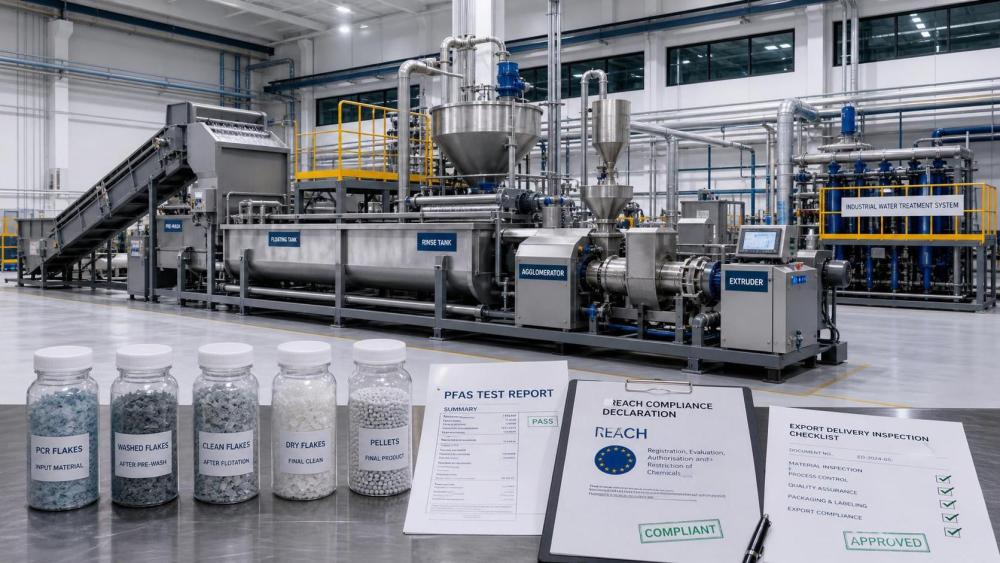
On July 26, 2026, the European Chemicals Agency released a draft REACH revision that brings PFAS residues associated with chemically recycled PCR plastics into a new compliance focus during washing, de-labeling, flotation, and pelleting. For manufacturers exporting PCR plastic washing lines, wet pelleting systems, and related water treatment modules to the EU, the change matters because it links market access and delivery qualification to third-party PFAS migration testing under EN 17582:2026 and a process cleanliness declaration from January 2027 onward.
What the Draft Revision Formally Introduces
According to the information provided, the draft revision was issued by ECHA on July 26, 2026 under reference REACH-2026-07-26-01. It is the first time that PFAS residues that may be introduced in the washing, de-labeling, flotation, and pelleting stages of chemically recycled PCR plastics have been brought within mandatory notification and compliance verification scope.
The same information states that from January 2027, manufacturers exporting PCR plastic cleaning lines, wet pelleting systems, and supporting water treatment modules to the EU must provide a third-party PFAS migration test report in line with EN 17582:2026, together with a process cleanliness declaration.
The direct business effect identified in the source material is on delivery qualification and end-customer access for Chinese suppliers of PCR washing and pelleting equipment serving the EU market.
Where the Commercial Impact Is Likely to Appear First
Equipment exporters facing a new documentation gate
From an industry perspective, exporters of PCR washing and pelleting equipment are the first group exposed to the rule change because the requirement is tied to exports to the EU. The practical pressure point is not only product shipment, but also whether technical files, test reports, and declarations can support customer qualification and cross-border delivery without delay.
Buyers and project procurement teams reassessing supplier access
Analysis shows that EU-facing buyers and procurement teams may need to treat PFAS migration testing and process cleanliness documentation as part of supplier screening. In practice, this can affect bid review, technical specification alignment, and final acceptance conditions for PCR plastic washing lines, wet pelleting systems, and related water treatment modules.
Testing and certification participants moving closer to the transaction
What deserves closer attention is the role of third-party testing and compliance support providers. Because the stated requirement includes a PFAS migration test report under EN 17582:2026, documentation readiness may become part of the transaction timeline rather than a later administrative formality.
After-sales and traceability functions entering the compliance chain
Observably, the introduction of a process cleanliness declaration can also affect post-delivery support and traceability. Where customers ask for consistency between exported equipment, process records, and compliance files, after-sales teams may need to respond to documentation-related questions rather than only equipment performance issues.
What Companies Should Track Before January 2027
Readiness of test reports and technical files
Analysis shows that manufacturers targeting the EU market should pay close attention to whether their technical documentation can support the required third-party PFAS migration testing report and process cleanliness declaration. The immediate issue is not broad regulatory theory, but whether export files and customer-facing compliance packages are complete enough for qualification review.
Changes in tender language and customer specifications
It is more appropriate to understand this as a signal that procurement documents and technical tenders may start reflecting the new PFAS-related compliance expectation. Companies involved in quoting, contract review, and project delivery should therefore watch for revised wording in customer specifications and bid documents.
Delivery planning and supplier qualification timing
Observably, the stated January 2027 requirement creates a timing issue for orders that span quotation, manufacturing, testing, and shipment. Companies may need to review whether current supplier qualification steps, document preparation cycles, and handover schedules are aligned with the new compliance threshold for EU-bound projects.
Follow-up wording from regulators and market participants
Because the provided information refers to a draft REACH revision, what deserves closer attention is how official wording, verification expectations, and market-side implementation language develop next. At this stage, companies should monitor subsequent expressions of the rule in compliance reviews, customer requests, and trade documentation rather than assume every execution detail is already fixed.
Why This Looks Like an Execution Signal, Not Just a Headline
Analysis shows that this development is significant less because it discusses PFAS in general and more because it connects a specific compliance requirement to identifiable equipment categories and export activity. The combination of mandatory notification and compliance verification, a named test standard, and a stated start date suggests that market participants should treat this as an operational compliance signal.
At the same time, it is more appropriate to understand the development as a rule change that is moving toward execution rather than as a fully settled enforcement outcome. The industry still needs to watch how certification practice, procurement language, and customer acceptance criteria reflect the draft in actual transactions.
How the Market May Need to Read This Stage
From an industry perspective, the immediate meaning of the draft is clear: EU-bound PCR washing and pelleting equipment may face an additional PFAS-related compliance layer tied to testing and process cleanliness documentation. The broader commercial consequence is that access to customers and delivery qualification may increasingly depend on document readiness as much as on equipment capability.
A balanced reading is that this is not merely background regulatory noise, but neither is it a basis for assuming all implementation details are already settled. Current attention should center on compliance preparation, bid and contract language, and the way downstream customers begin to apply the requirement in practice.
Basis of This Article and What Still Needs Verification
This article is based on the user-provided news title, event date, and event summary. For developments of this kind, commonly relevant source categories may include official regulatory announcements, releases from supervisory authorities, trade or customs authority information, industry association notices, standards organization documents, and reporting by established professional media.
No specific official source link was provided in the input, so the exact official link still needs to be verified on an ongoing basis. Observably, the points that merit continued tracking include later policy detail, certification and testing interpretation, changes in tender documents, market feedback, and how companies implement the requirement in actual export and delivery workflows.
Have questions about this sector analysis, or seeking best practices specific to your niche? Drop us a line below and let the senior consultants at APIM assist you.
We respect your privacy. Your information is strictly confidential.
Related News
- 00
0000-00
Do polyolefin hot melt adhesives bond well to polyethylene? - 00
0000-00
Korean Study Finds PLA Barely Degrades in Landfill After 320 Days - 00
0000-00
How to assess batch consistency from a thermal potting compounds supplier - 00
0000-00
How much weight can carbon fiber reinforced plastics save in cars? - 00
0000-00
Switching from PS to ABS Sheet Extrusion: Equipment Checks
Tag