




ECHA Brings Forward REACH Limits for PCR Plastic Residues
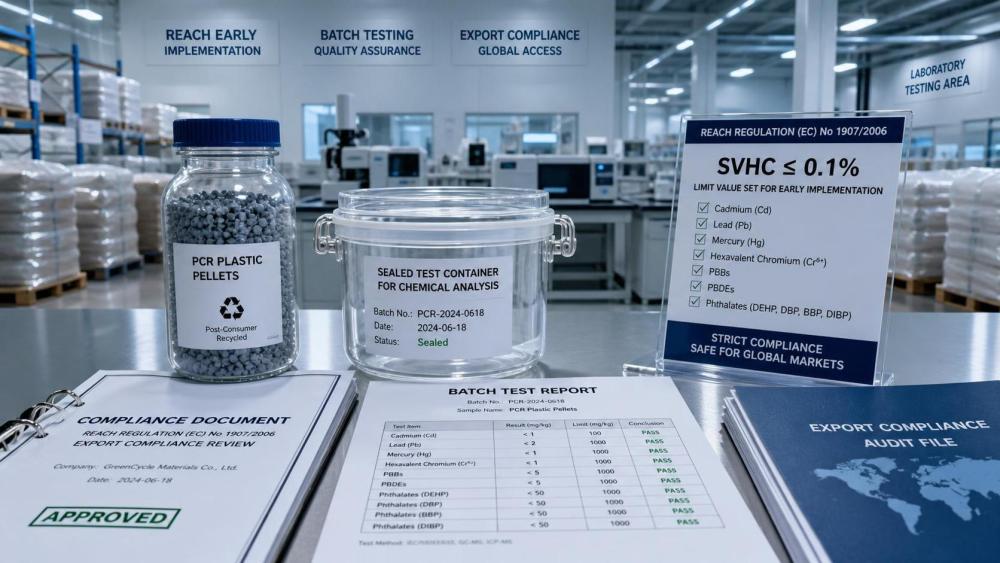
On August 15, 2026, an accelerated compliance change takes effect for recycled plastics entering the EU market. The trigger is an urgent notice issued by ECHA on August 5, moving forward the enforcement date for REACH Annex XVII limits on washing residues in PCR plastics, including substances such as benzene, chloroform, and NMP. For exporters, importers, testing providers, and supply chain operators handling recycled plastic products or composite materials containing PCR content, the issue is no longer only about future preparation but about immediate document validity, batch testing readiness, and customs-facing compliance continuity.
What Has Changed in the EU Compliance Timeline
According to the information provided, ECHA issued an urgent communication on August 5, 2026, stating that the limit requirements for PCR plastic washing residues under REACH Annex XVII will be enforced from August 15, 2026, rather than the previously scheduled date in October 2026.
The scope of the requirement covers all recycled plastic products and composite materials containing PCR content that are placed on the EU market.
The summary provided also makes clear that the change directly affects compliance certification, batch-level testing, and customs clearance procedures for Chinese exporters engaged in PCR plastic washing and pelletizing.
Importers are required to immediately verify the validity of supplier Declarations of Conformity (DoC) and third-party test reports.
Where the Pressure Appears First Across the Supply Chain
Export shipments may face a narrower compliance window
From an industry perspective, exporters of PCR plastic materials and related products are likely to feel the first operational impact because the rule change alters the effective compliance date with very limited lead time. The main pressure points are shipment readiness, document completeness, and whether batch-related testing materials remain usable for goods intended for the EU market.
What deserves closer attention is whether existing compliance files, especially DoC records and supporting test reports, are still aligned with the new enforcement timing for each shipment or lot.
EU import-side controls are likely to focus on document validity
Importers are explicitly identified in the provided summary as parties that need to immediately review supplier conformity documents and third-party test reports. This means the practical effect is not limited to product formulation or washing performance; it also extends to import-side review procedures and release documentation.
Observably, any mismatch between shipment timing, supplier declarations, and test evidence could become a commercial or clearance issue, even before broader market feedback becomes visible.
Testing and certification-related workflows may become more time-sensitive
For testing service providers and compliance support teams, the accelerated date means the timing of batch verification becomes more critical. The issue here is less about introducing a new category of obligation and more about compressing the time available to demonstrate conformity for products already moving through the trade pipeline.
Companies relying on external testing or certification support should therefore pay close attention to report validity, document issuance timing, and consistency between technical files and the goods actually being shipped.
What Companies Should Review Immediately
Check whether conformity documents still support current shipments
Analysis shows that the first practical step is a file review rather than a broad policy interpretation exercise. Businesses shipping recycled plastics or composite materials with PCR content into the EU should examine whether existing DoC documentation and third-party test reports remain valid for products scheduled for delivery, customs handling, or market placement after August 15, 2026.
Reconfirm batch testing arrangements and traceability records
Because the provided information directly references batch testing, companies should focus on whether current lot-level verification records are complete and internally consistent. This is particularly relevant where multiple production batches, reprocessed feedstock streams, or staggered delivery schedules are involved.
Review supplier qualification and procurement assumptions
For importers and procurement teams, the rule change may require an immediate check on supplier responsiveness and document reliability. It is more appropriate to understand this as a procurement and compliance coordination issue as much as a regulatory one, especially where purchase decisions were made on the assumption that the previous October timeline still applied.
Watch for changes in execution language and downstream commercial documents
The input does not provide detailed enforcement language beyond the urgent acceleration of the date. For that reason, companies should closely monitor how this change is reflected in practical documentation, including customer compliance requests, technical submissions, customs-facing materials, and any trade documents that depend on proof of conformity. This remains an area to watch rather than a confirmed outcome.
Why This Looks Like an Execution Signal, Not Just a Policy Update
Analysis shows that this development is better understood as an immediate execution signal rather than a distant regulatory milestone. The date shift from October to August compresses preparation time and pushes compliance review into active shipments and current supply commitments.
At the same time, observably, the information provided does not yet establish every downstream enforcement detail. That means the market should treat the change as already landed in principle, while continuing to watch how document review, testing expectations, and import-side scrutiny are applied in practice.
How the Market Should Read This Change Now
This update matters because it changes timing, and timing in compliance-driven trade often determines whether documentation, testing, and delivery plans remain workable. For companies involved in PCR plastic washing, pelletizing, export, importing, or compliance support, the immediate question is not only whether they understand the rule, but whether their current files and shipments still match the new enforcement date.
From an industry perspective, it is more appropriate to understand this news as a rule already moving into execution, combined with a need for continued observation of implementation detail. The impact should not be overstated, but neither should the operational urgency created by the earlier effective date.
Basis of This Article and What Still Needs Verification
This article is generated from the user-provided news title, event date, and event summary. The analysis is based on the stated ECHA urgent notice, the revised enforcement date, the identified product scope, and the noted effects on conformity certification, batch testing, customs clearance, and importer document checks.
For this type of development, relevant source categories typically include official regulatory notices, publications by supervisory authorities, customs or trade authority releases, industry association updates, standard-setting documents, and reporting by authoritative trade media. A specific official source link was not provided in the input, so continued verification is still necessary.
What still needs ongoing attention includes any later clarification of enforcement wording, certification practice, document review standards, procurement document changes, market feedback, and how companies actually implement the requirement in export and import operations.
Have questions about this sector analysis, or seeking best practices specific to your niche? Drop us a line below and let the senior consultants at APIM assist you.
We respect your privacy. Your information is strictly confidential.
Related News
- 00
0000-00
Do polyolefin hot melt adhesives bond well to polyethylene? - 00
0000-00
Korean Study Finds PLA Barely Degrades in Landfill After 320 Days - 00
0000-00
How to assess batch consistency from a thermal potting compounds supplier - 00
0000-00
How much weight can carbon fiber reinforced plastics save in cars? - 00
0000-00
Switching from PS to ABS Sheet Extrusion: Equipment Checks
Tag