




ECHA Adds PCR Washing Residue Limits to REACH
On August 15, 2026, a new compliance requirement tied to REACH will begin to apply to recycled plastics entering the EU. The update follows an official ECHA notice issued on August 4, 2026, and centers on residue limits for 12 organic substances in the washing stage of post-consumer recycled (PCR) plastics. For suppliers of PCR pellets, washed recycled feedstock, and composite materials containing PCR, the change matters because it connects market access to third-party test documentation and directly affects export compliance and downstream purchasing checks.
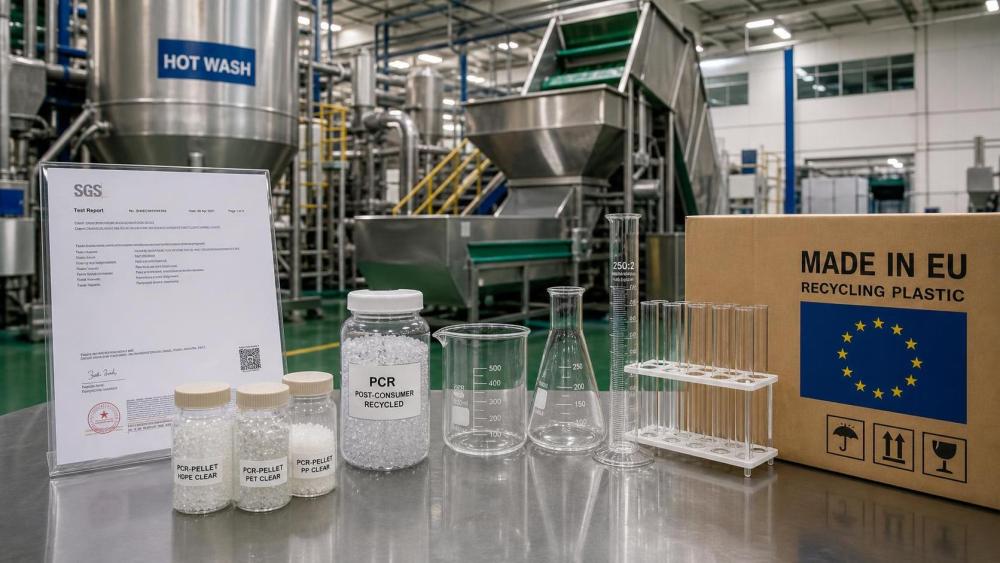
What the ECHA update formally changes
According to the provided event summary, ECHA officially updated REACH Annex XVII by incorporating limits for 12 organic residues, including benzene, toluene, and chloroform, into Entry 77 for the washing stage of recycled plastics. The official notice was issued on August 4, 2026.
The same summary states that all suppliers of PCR pellets, washed recycled materials, and composite materials containing PCR that are imported into the EU must provide third-party testing reports. The requirement becomes mandatory from August 15, 2026.
The confirmed scope of impact described in the input is the export compliance path for PCR Plastic Washing & Pelleting businesses and the purchasing verification process used by downstream customers.
Where the operational pressure is likely to appear first
Export-facing recycled material suppliers
From an industry perspective, suppliers shipping PCR pellets or washed recycled feedstock into the EU are likely to feel the change first because the rule is tied to import compliance. The practical pressure point is documentation readiness: shipments aimed at the EU market will now need third-party test reports that support conformity with the new residue limits. What deserves closer attention is whether existing export files, quality documents, and pre-shipment checks are already aligned with this requirement.
Processors and composite material producers
Businesses supplying composite materials that contain PCR may also face added review steps because the requirement is not limited to one material form. Analysis shows that the effect is likely to extend beyond washing operations themselves and into material conversion and product preparation, especially where PCR content must be demonstrated together with residue-related compliance evidence for EU-bound business.
Procurement and buyer verification teams
For downstream buyers, the update creates a more formal verification task in supplier onboarding and ongoing purchasing control. Observably, procurement teams may need to check not only material specifications and PCR content claims, but also whether a valid third-party report is available before order confirmation, delivery acceptance, or customer qualification. This matters for purchasing continuity because compliance review may move earlier in the transaction process.
Testing and compliance support functions
Testing service providers and internal compliance teams are also relevant participants because the rule explicitly refers to third-party reports. It is more appropriate to understand this as a signal that technical files, conformity evidence, and traceability records may receive closer scrutiny in business dealings linked to EU imports, even where the detailed execution approach is not fully described in the provided input.
What companies should examine now
Check whether current documents are sufficient for EU-bound shipments
Analysis shows that companies handling PCR exports should first review whether their current reporting package can support the new REACH-related requirement from the effective date. The key point is not to assume that routine internal quality records will automatically satisfy buyer or import-side expectations where the rule now specifically calls for third-party testing reports.
Review supplier qualification and purchasing clauses
For companies buying PCR materials or PCR-containing composites, what deserves closer attention is whether supplier qualification documents, purchase terms, and incoming material review procedures already request the necessary testing evidence. Where contracts or tender files do not yet reflect this change, there may be a gap between commercial ordering and compliance acceptance.
Watch for changes in technical files and delivery timing
Observably, one practical issue is the possibility that documentation review becomes part of delivery preparation rather than a post-shipment formality. Companies should therefore monitor whether testing reports, technical files, and supporting compliance documents need to be updated or submitted earlier in the sales and delivery cycle. The provided information does not define an execution timeline beyond the mandatory date, so this remains a point to monitor rather than a confirmed outcome.
Track how customers interpret the mandatory date
It is more appropriate to understand the August 15, 2026 deadline as an immediate compliance trigger rather than a broad policy discussion point. At the same time, the input does not provide detailed enforcement wording, customer-side acceptance criteria, or sector-specific exemptions. Companies should therefore keep watching how buyers, import-side reviewers, and related compliance functions translate the requirement into actual documentation checks.
How this should be read at the current stage
Analysis shows that this development is best read as a rule implementation signal rather than a tentative policy direction. The reason is that the input describes a formal Annex XVII update, identifies affected product categories, requires third-party testing reports, and gives a mandatory date. At the same time, observably, the market still needs to watch how the requirement is applied in transaction practice, procurement review, and document acceptance, because those execution details are not fully set out in the provided information.
Why the market is likely to keep watching this update
From an industry perspective, the main significance of this event is that compliance for PCR materials entering the EU is becoming more document-driven at the washing residue stage. The change should not be overstated beyond the provided facts, but it does indicate that exporters, processors, and buyers may need to align testing evidence more closely with trade and procurement workflows. It is more appropriate to understand this update as a confirmed compliance change with immediate operational relevance, while the detailed market response still requires observation.
Basis of this article and points that still need verification
This article is based on the user-provided news title, event date, and event summary. For developments of this kind, commonly relevant source types include official notices, regulator publications, trade or customs guidance, industry association updates, standards documents, and reporting by established industry media. A specific official source link was not provided in the input, so the original publication path still needs to be verified on an ongoing basis. What remains worth monitoring includes detailed implementation wording, certification and testing interpretation, changes in tender or purchasing documents, market feedback, and how companies execute the requirement in practice.
Have questions about this sector analysis, or seeking best practices specific to your niche? Drop us a line below and let the senior consultants at APIM assist you.
We respect your privacy. Your information is strictly confidential.
Related News
- 00
0000-00
How does washing affect contamination in post-consumer recycled PP resins? - 00
0000-00
How does feedstock affect depolymerization equipment selection? - 00
0000-00
US Sets 213.44% Preliminary Antidumping Deposit on Chinese PTMEG - 00
0000-00
When should epoxy be used as a thermal interface material for semiconductors? - 00
0000-00
US Midterm Results Unlikely to Quickly Shift Recycled Plastics Market or Legislation
Tag