




China's PCR Plastic Equipment Exports Rise 37% as Southeast Asia Leads
On June 30, 2026, the latest June export statistics cited from China customs data pointed to a sharp increase in outbound shipments of dedicated PCR plastic washing and pelleting equipment. The change is notable not only because export value rose strongly, but because the demand concentration in Southeast Asia appears closely tied to compliance pressure from new EU EPR requirements and the resulting acceleration of recycling capacity upgrades. For equipment exporters, overseas buyers, recyclers, and supply-chain service providers, this is less a routine trade fluctuation than a signal that procurement timing, technical configuration, and delivery planning are starting to move in response to regulatory execution.
What the June export data clearly shows
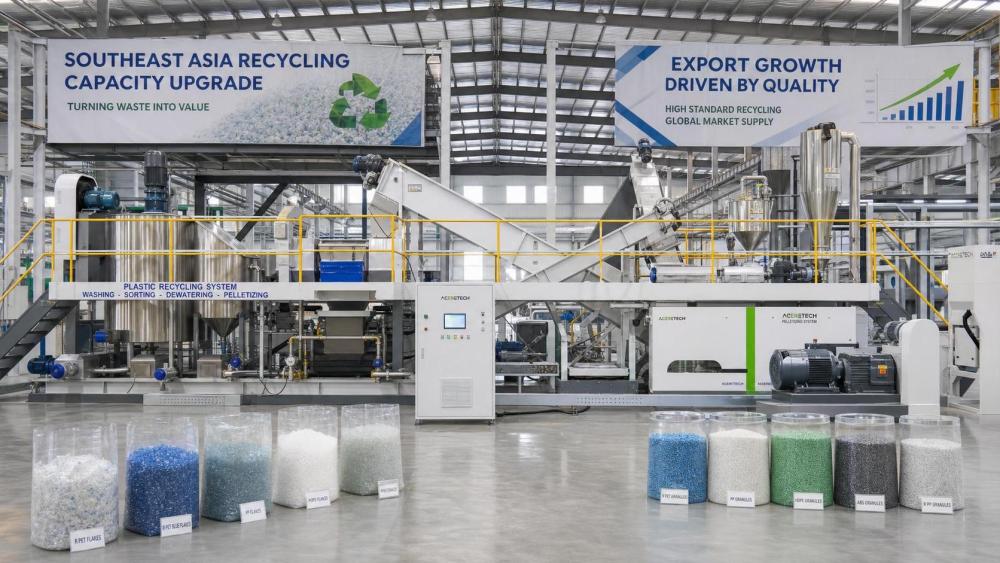
According to the latest export statistics referenced in the input for June 2026, monthly exports of dedicated PCR Plastic Washing & Pelleting equipment reached USD 128 million, up 37.2% year on year. Vietnam, Thailand, and Indonesia accounted for 54.6% of the total. The stated drivers were the expansion of local recycled plastics capacity in Southeast Asia and pressure linked to new EU EPR rules, which pushed local recycling plants to speed up adoption of integrated lines combining high-efficiency wet washing, intelligent sorting, and vacuum dewatering. Chinese equipment manufacturers have also seen delivery lead times extend to 18 to 22 weeks, with overseas buyers advised to secure Q4 production capacity in advance.
Where the regulatory signal is likely to be felt first
Export equipment suppliers facing tighter delivery coordination
From an industry perspective, Chinese exporters of PCR plastic washing and pelleting equipment may feel the impact first through order scheduling, contract timing, and technical bid alignment. Because the reported demand increase is associated with compliance-driven recycling capacity expansion, buyers are likely to place closer attention on whether equipment specifications match their downstream regulatory or customer requirements. What deserves closer attention is not only price and throughput, but also whether technical documents, configuration lists, and delivery commitments are consistent enough to support procurement decisions under tighter timelines.
Overseas recyclers and procurement teams under compliance-linked time pressure
For recycling plants and procurement teams in Southeast Asia, the reported shift suggests that equipment purchasing is becoming more closely connected to external compliance expectations rather than purely local capacity planning. Analysis shows that when demand is driven in part by EPR-related pressure, purchasing decisions may place more weight on integrated process capability, documentation completeness, and supplier delivery reliability. The practical impact is likely to appear in tender review, supplier qualification, and production-slot booking rather than in a simple increase in equipment inquiries.
Trade and supply-chain service providers watching document and execution risk
Freight coordinators, project delivery teams, and after-sales service providers may also face a more demanding execution environment. With lead times already extended to 18 to 22 weeks, any mismatch in order scope, technical attachments, or shipment readiness could have a wider effect on installation schedules and downstream project timing. Observably, businesses involved in export handling should pay closer attention to contract documents, shipment planning, and post-delivery coordination, because longer lead times tend to raise the cost of amendments and delivery slippage.
Operational points companies should track now
Review whether technical files match buyer compliance expectations
Analysis shows that the demand increase is linked to integrated lines featuring wet washing, intelligent sorting, and vacuum dewatering. That makes technical documentation more important in practical procurement. Exporters and buyers should pay attention to whether specifications, configuration descriptions, and supporting technical materials are complete and internally consistent, especially where procurement decisions may be tied to compliance-driven recycling upgrades.
Build procurement schedules around the reported 18 to 22 week lead time
The reported extension of manufacturer lead times changes the practical procurement window. For overseas buyers, this is a direct planning issue rather than a secondary market detail. It is more appropriate to treat the current lead-time range as a near-term execution constraint and to adjust Q4 capacity booking, approval flow, and supplier communication accordingly, while recognizing that the input does not provide further breakdown by model or supplier.
Monitor how rule-driven demand changes tender and supplier review
What deserves closer attention is whether procurement documents, tender language, or buyer qualification criteria begin to reflect stronger emphasis on integrated processing capability and delivery certainty. The input does not provide official implementation details or a formal procurement standard, so companies should not treat any single specification trend as universal. Still, it would be prudent to watch for changes in bid documents, technical annexes, and buyer review priorities.
Prepare for after-sales and traceability expectations to become more visible
Where equipment demand is linked to regulatory pressure on recycled materials processing, after-sales responsiveness and quality traceability may become more commercially relevant. This should be understood as an operational observation rather than a confirmed rule change. Companies involved in export sales and overseas delivery should therefore keep installation support records, equipment configuration records, and service communication well organized in case buyers place greater weight on operational accountability during project execution.
Why this looks more like an execution signal than a one-off trade spike
Observably, the June export surge is best read as a sign that rule-related pressure is beginning to shape real equipment purchasing behavior across parts of the recycling chain. The combination described in the input, expanding Southeast Asian recycled plastics capacity alongside new EU EPR pressure, suggests a closer link between downstream compliance expectations and upstream machinery orders. At the same time, Analysis shows that this should not yet be treated as a complete or uniform market shift. The available facts confirm stronger exports, concentrated demand in three Southeast Asian markets, and longer lead times, but they do not yet establish a final long-term pattern for all regions, all buyers, or all technical standards.
How the market may need to interpret this stage
The current development is more appropriately understood as an implemented market response to regulatory and compliance pressure rather than as a fully settled rule outcome. The facts point to concrete procurement movement and delivery pressure, while the broader implications still depend on how purchasing criteria, compliance expectations, and project execution develop in coming quarters. A measured reading is warranted: the signal is real, but the full operating impact across trade, certification practice, and equipment selection still requires continued observation.
Basis of this article and what still needs verification
This article is based on the user-provided news title, event date, and event summary. For events of this type, relevant source categories commonly include official notices, regulator releases, customs or trade authority information, industry association updates, standards organization documents, and reporting from authoritative media. No specific official source link was provided in the input, so the exact official link remains to be further verified. Continued monitoring is still needed on policy detail, certification and compliance interpretation, tender document changes, market feedback, and how companies are executing procurement and delivery in practice.
Have questions about this sector analysis, or seeking best practices specific to your niche? Drop us a line below and let the senior consultants at APIM assist you.
We respect your privacy. Your information is strictly confidential.
Related News
- 00
0000-00
How does washing affect contamination in post-consumer recycled PP resins? - 00
0000-00
How does feedstock affect depolymerization equipment selection? - 00
0000-00
US Sets 213.44% Preliminary Antidumping Deposit on Chinese PTMEG - 00
0000-00
When should epoxy be used as a thermal interface material for semiconductors? - 00
0000-00
US Midterm Results Unlikely to Quickly Shift Recycled Plastics Market or Legislation