




China Starts Pilot Traceability Checks for PCR Plastic Exports
On July 3, 2026, China’s General Administration of Customs announced a pilot traceability control program for exports of PCR plastic washing and pelleting in Guangdong, Zhejiang, and Jiangsu. The measure brings export compliance, recycled material sourcing, processing records, and customer-facing documentation into the same discussion, especially for companies handling recycled PET and PP pellets. For the industry, the key point is not only that a new control step is being introduced, but that traceability data is being tied more directly to export oversight in provinces that account for more than 60% of China’s PCR export capacity.
What the Pilot Covers From Mid-July
According to the announced information, the pilot was released on July 3, 2026 and the first phase will take effect on July 15, 2026. It applies in Guangdong, Zhejiang, and Jiangsu.
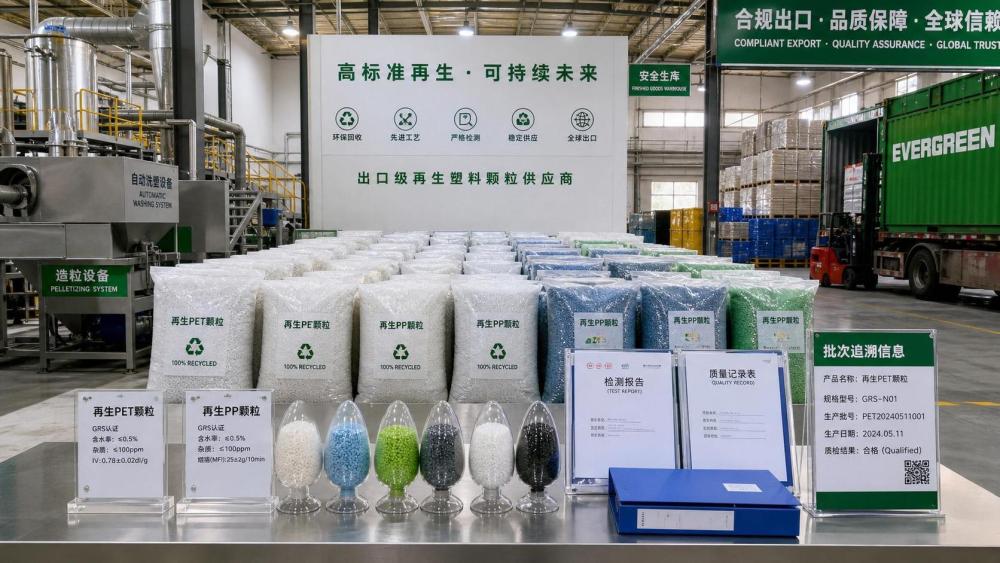
The pilot concerns export traceability supervision for PCR Plastic Washing & Pelleting. Companies are required to attach a unique electronic label to recycled PET and PP pellets. The stated purpose is to record and preserve on-chain data covering raw material origin, washing process information, heavy metal testing, and REACH compliance.
The first batch of the pilot is stated to cover more than 60% of China’s PCR export capacity.
Where Business Impact Is Most Likely to Appear
Exporters may face tighter documentation alignment
From an industry perspective, direct trading companies are likely to feel the change first because the pilot is linked to export traceability supervision. The likely impact is on shipment preparation, product identification, and consistency between goods, labels, and supporting records. What deserves closer attention is whether existing export documentation workflows can match the new electronic labeling and data record requirements without delaying delivery.
Recyclers and pellet producers may need stronger process records
Analysis shows that processors producing recycled PET and PP pellets may be affected at the operational level. The required data points include raw material source, washing process details, heavy metal testing, and REACH compliance, so the immediate pressure may fall on record integrity rather than only on output volume. Companies in washing and pelleting activities should pay attention to whether their current production records are complete enough to support traceability review.
Procurement and sourcing teams may need clearer supplier evidence
Observably, raw material procurement functions may also be affected because source information is explicitly part of the traceability chain. This does not automatically change sourcing strategy, but it does make supplier documentation and evidence quality more relevant to export-facing business. Buyers and sourcing managers should watch for requests related to origin records, batch linkage, and the continuity of supporting files across supply stages.
Supply chain service providers may be drawn into compliance coordination
Logistics, customs support, and other supply chain service providers may see a coordination role expand under this pilot. The likely effect is not that they become the regulated party in the same way as the exporter or processor, but that shipment readiness may increasingly depend on whether traceability materials are organized and available at the right time. What deserves closer attention is handoff quality between production, compliance, and export execution.
What Companies Should Watch Now
The gap between policy language and operational detail
Analysis shows that the announced framework is clear on the direction of control, but day-to-day implementation will depend on how companies translate electronic labels and on-chain record requirements into actual export procedures. Businesses should continue watching for any further official wording, clarifications, or procedural details linked to the pilot rollout from July 15.
Which products and shipments fall into immediate focus
The confirmed scope points to recycled PET and PP pellets under PCR plastic washing and pelleting exports. Companies handling these product flows should review which shipments, batches, and customers may fall into the pilot window first, especially where export timing overlaps with the start date.
Whether internal records can support external review
From a practical perspective, one of the main issues is whether existing files are usable for traceability verification rather than simply available in separate systems or paper archives. Businesses should examine the continuity of records across raw material intake, washing process documentation, test results, and compliance statements tied to REACH.
Customer communication and delivery planning
Observably, exporters may also need to prepare for customer questions about labeling, traceability, and compliance evidence. Even without assuming shipment disruption, it is reasonable to pay attention to lead-time planning, document readiness, and communication with overseas buyers where recycled content claims or compliance expectations are already sensitive.
Why This Looks More Like a Regulatory Signal Than a Final Outcome
It is more appropriate to understand this as an early but meaningful regulatory signal rather than a finished market result. The confirmed facts show that customs authorities are moving traceability for PCR export materials into a more structured pilot stage, with electronic identification and preserved data records at the center. That said, the broader commercial effect still depends on implementation practice, follow-up guidance, and how strictly the pilot changes transaction routines in real export operations.
From an industry perspective, the reason to keep watching is that the pilot starts in provinces covering a large share of export capacity. That makes this relevant beyond a narrow local test, even though it should not yet be read as a complete nationwide outcome.
How This News Is Best Understood at This Stage
At this stage, the announcement is best read as a targeted shift in export governance for PCR recycled plastics, especially for recycled PET and PP pellet flows tied to washing and pelleting. The immediate significance lies in stronger traceability expectations and the closer connection between production records and export supervision. The longer-term significance still requires observation, particularly around implementation detail, operational friction, and whether the pilot remains limited or becomes a broader reference point for future export control practice.
Basis of This Article and What Still Needs Verification
This article is based on the user-provided news title, event date, and event summary. It does not rely on any additional unverified data, company statements, market figures, or source links.
For this type of development, commonly relevant source categories would include official customs announcements, company disclosures, industry association updates, authoritative media reporting, and standard-related compliance documents. However, a specific official source link was not provided in the input, so the exact source document should still be continuously verified. Follow-up attention should remain on any additional official clarifications, implementation details after July 15, and whether the pilot scope changes over time.
Have questions about this sector analysis, or seeking best practices specific to your niche? Drop us a line below and let the senior consultants at APIM assist you.
We respect your privacy. Your information is strictly confidential.
Related News
- 00
0000-00
How does washing affect contamination in post-consumer recycled PP resins? - 00
0000-00
How does feedstock affect depolymerization equipment selection? - 00
0000-00
US Sets 213.44% Preliminary Antidumping Deposit on Chinese PTMEG - 00
0000-00
When should epoxy be used as a thermal interface material for semiconductors? - 00
0000-00
US Midterm Results Unlikely to Quickly Shift Recycled Plastics Market or Legislation