




China Starts PCR Plastic Export Carbon Label Pilot
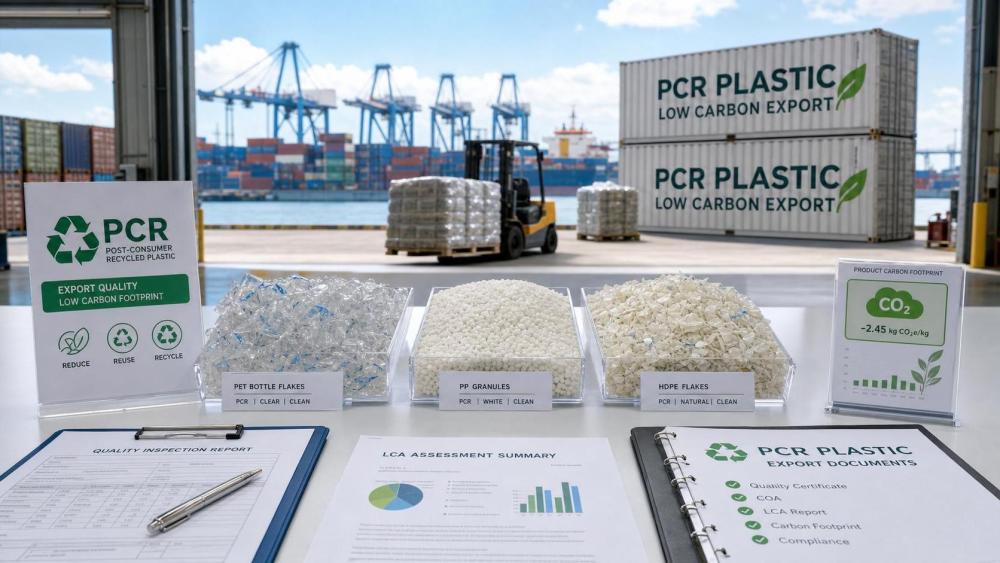
On June 29, 2026, China’s General Administration of Customs and the Ministry of Ecology and Environment launched a pilot carbon footprint labeling scheme for exported PCR plastic recyclate. The first covered products are PET bottle flake washing material, recycled PP granules made from woven bags, and granulated HDPE pipe scrap. For exporters, recyclers, testing providers, and overseas-facing supply chain teams, the development is worth close attention because it links export clearance with LCA documentation and places carbon data alongside product compliance in actual trade execution.
What the pilot includes at this stage
The pilot was jointly introduced by China’s General Administration of Customs and the Ministry of Ecology and Environment on June 29, 2026. According to the provided information, the scheme applies first to three PCR plastic recyclate categories: PET bottle flake washing material, recycled PP granules from woven bags, and granulated HDPE pipe scrap.
Another confirmed requirement is that export declarations must be submitted together with an LCA report issued by a CNAS-accredited laboratory, with the assessment based on ISO 14040/44. The pilot is scheduled to take effect from August 1, 2026, at the ports of Ningbo, Xiamen, and Shenzhen. The stated policy purpose is to prepare in advance for a possible extension of EU CBAM into the plastics recycling field.
Where the pressure points may appear in the value chain
Export-facing recyclers will likely feel the change first
From an industry perspective, companies exporting the three listed product types may be the first to face direct operational impact. The reason is straightforward: the pilot connects customs filing with carbon footprint documentation. In practice, the areas to watch are shipment readiness, documentation timing, and whether product batches can be matched clearly to the supporting LCA materials required for declaration.
Supply chain and trade execution teams may need tighter document coordination
For trading companies and supply chain service providers, the likely impact is less about production and more about process control. Analysis shows that customs preparation, laboratory coordination, and export document completeness may become more tightly linked under this pilot. What deserves closer attention is whether internal handoff between procurement, quality, compliance, and customs teams is aligned well enough to avoid delays near shipment windows.
Overseas buyers and procurement teams may treat carbon data as part of transaction review
For downstream buyers, especially those sourcing PCR materials for export-related business, the immediate issue is not necessarily a change in product specification but a change in transaction support requirements. Observably, once carbon footprint reporting becomes part of export clearance in pilot ports, procurement discussions may increasingly include questions around report availability, laboratory qualification, and timing of supporting documents.
What companies should monitor before August 1
Watch for any further official clarification
The pilot has defined the covered products, documentation basis, and implementation ports, but companies should still track whether there are follow-up clarifications on declaration procedures, document formats, or practical filing details. Analysis shows that policy headlines and operational rules are not always the same thing, and the gap between the two is often where execution risk appears.
Check whether product scope matches actual export business
Businesses handling PET, PP, or PE recycled materials should pay close attention to whether their shipped goods fall squarely within the first-batch categories described in the pilot. The practical issue is product classification and consistency between commercial descriptions, customs declarations, and the supporting LCA report. This matters most for companies with mixed recycled material portfolios or multiple processing routes.
Review laboratory arrangements and document lead times
Because the pilot requires an LCA report issued by a CNAS-accredited laboratory under ISO 14040/44, exporters should focus on whether existing service arrangements can support shipment schedules. What deserves closer attention is not only whether a report can be obtained, but whether the timing, accreditation status, and document completeness line up with export declaration needs.
Prepare customer and supplier communication in advance
For companies sitting between supply and overseas demand, communication may become a practical work item rather than a policy discussion. Analysis shows that suppliers may need to provide clearer process and material information, while customers may ask earlier about carbon-related export documentation. Preparing standard responses, document checklists, and delivery contingencies would be a reasonable operational step.
How this development is better understood right now
Observably, this is more than a routine labeling update, but it is not yet a final industry-wide endpoint either. It is more appropriate to understand this as an early policy signal with real operational consequences in a limited rollout. The signal is clear in one respect: carbon footprint documentation for recycled plastics is moving closer to the border clearance process, at least for selected export categories and ports.
At the same time, analysis shows that the current stage remains a pilot. That means the market still needs to watch how implementation works in practice, whether the covered scope changes, and how trade participants adapt their workflows. The significance today lies less in proven market outcomes and more in the direction of compliance expectations.
A near-term rule change with longer-term implications
At this stage, the pilot should be read as both a short-term compliance development for affected exporters and a longer-term policy signal for the recycled plastics trade. The immediate issue is procedural readiness for shipments through Ningbo, Xiamen, and Shenzhen from August 1, 2026. The broader takeaway is that carbon accounting is becoming harder to separate from export execution in parts of the PCR plastics business.
A neutral reading is therefore the most appropriate one: the policy has a defined and limited starting scope, but it merits continued attention because it may shape how documentation, customer requirements, and cross-border trade expectations evolve in this segment.
Basis of this article and what still needs verification
This article is based on the user-provided news title, event date, and event summary. The confirmed facts used here are limited to the stated launch date, pilot authorities, covered product categories, LCA report requirement, ISO 14040/44 basis, CNAS-accredited laboratory requirement, implementation date, pilot ports, and the stated reference to preparing for a possible EU CBAM extension into plastics recycling.
For this type of industry update, source categories commonly relevant to later verification include official government notices, customs announcements, ministry releases, industry association updates, authoritative media reports, and standard-related documents. A specific official source link was not provided in the input, so the exact underlying notice should continue to be verified. What still deserves follow-up attention is whether additional implementation guidance, document details, or scope adjustments are released after the pilot start date.
Have questions about this sector analysis, or seeking best practices specific to your niche? Drop us a line below and let the senior consultants at APIM assist you.
We respect your privacy. Your information is strictly confidential.
Related News
- 00
0000-00
Do polyolefin hot melt adhesives bond well to polyethylene? - 00
0000-00
Korean Study Finds PLA Barely Degrades in Landfill After 320 Days - 00
0000-00
How to assess batch consistency from a thermal potting compounds supplier - 00
0000-00
How much weight can carbon fiber reinforced plastics save in cars? - 00
0000-00
Switching from PS to ABS Sheet Extrusion: Equipment Checks
Tag