




China Opens Fast-Track Customs for PCR Plastic Exports
On July 10, 2026, China’s General Administration of Customs began a pilot green customs clearance channel for PCR plastic washed and pelletized materials that meet GB/T 39218-2020, covering Ningbo, Xiamen, and Shenzhen. The move matters not only to PET, PP, and PE PCR pelleting exporters, but also to traders, supply chain teams, and overseas buyers because it shortens export clearance time and raises the importance of documentation readiness through a required third-party PCR traceability certification report.
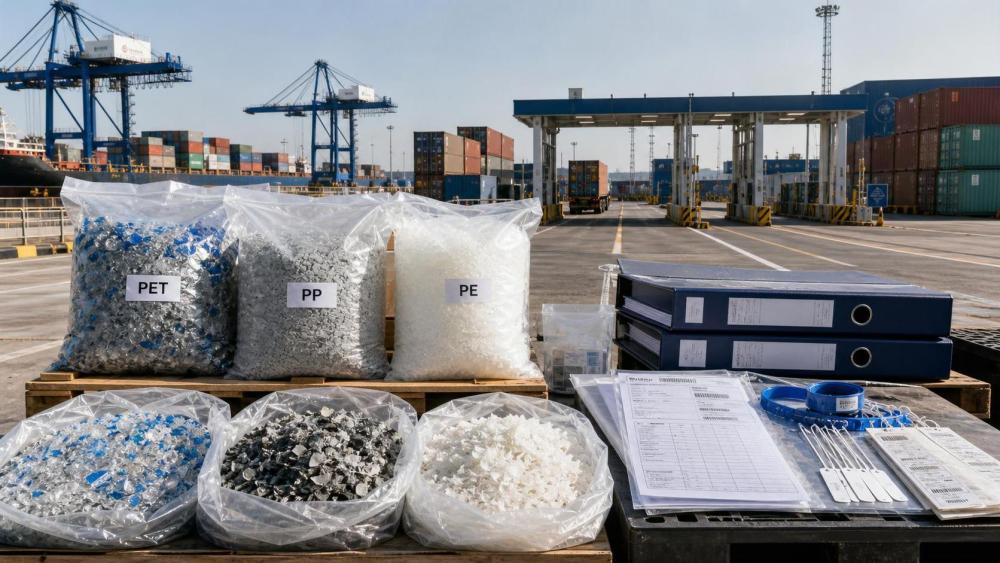
What the pilot mechanism includes
According to the provided information, the pilot started on July 10, 2026 in three locations: Ningbo, Xiamen, and Shenzhen. It applies to PCR plastic cleaning and pelletizing materials for export when they comply with GB/T 39218-2020.
The customs arrangement is described as a combination of immediate release upon declaration and priority inspection. Based on the provided summary, the average export cycle has been reduced to 2.3 days from the previous 5 to 7 days.
The measure also requires a third-party PCR traceability certification report to accompany the shipment. The stated scope covers exporters of PET, PP, and PE PCR pelleting materials.
Where the impact is likely to be felt first
Exporters handling PCR pellets
From an industry perspective, the most direct effect is on companies already exporting PET, PP, and PE PCR pellets. They are likely to feel the change in customs timing, shipment planning, and document preparation. What deserves closer attention is that faster clearance does not remove compliance requirements; it places more weight on whether product qualification and traceability files are complete at the time of filing.
Trading and order coordination teams
Analysis shows that trading companies and commercial teams may be affected through delivery commitments and customer communication. A shorter average export cycle can change how shipment windows are quoted, but only for cargo that falls within the stated pilot scope and carries the required certification materials. The operational focus is likely to shift toward matching order schedules with documentation readiness.
Logistics and customs service providers
Observably, customs brokers, freight coordinators, and related service providers may see the effect in declaration workflows and inspection planning. The pilot mechanism suggests that service quality may depend more heavily on accurate classification of eligible goods, complete filing packs, and coordination across the three pilot ports.
Overseas buyers and procurement functions
For buyers sourcing PCR materials, the development may matter most in delivery predictability and compliance discussion. Analysis shows that the new requirement for third-party PCR traceability certification could become part of routine buyer-seller communication, especially when customers need clearer evidence of recycled-content traceability alongside shipment timing.
What companies should pay attention to now
Check whether products clearly fall within the pilot scope
Companies should first focus on whether their exported materials are PCR plastic washed and pelletized products within the stated PET, PP, and PE categories, and whether they meet GB/T 39218-2020. The practical issue is eligibility, not just commercial intent to use the faster channel.
Prepare the traceability file before shipment filing
The required third-party PCR traceability certification report is not a minor attachment. From a practical standpoint, firms should pay attention to whether this document is available, complete, and aligned with shipment records before customs declaration begins.
Separate the policy signal from actual operating conditions
What deserves closer attention is the distinction between a pilot arrangement and a universal operating outcome. The provided information confirms a pilot in three cities and a reduced average export cycle, but companies still need to manage shipment-by-shipment execution based on port, cargo qualification, and documentation status.
Adjust customer communication on lead times carefully
Export teams and account managers may need to revisit how they describe delivery timing to overseas customers. Analysis shows that the shorter average cycle can support more precise communication, but it should be framed around eligible shipments and current pilot conditions rather than treated as a blanket lead-time reduction for all exports.
Why this looks like both an operational change and a policy signal
Observably, this development is more than a simple customs efficiency update because it combines two signals at once: faster handling for eligible PCR exports and a clearer documentation threshold through third-party traceability certification. That combination suggests a practical direction for the market, where facilitation and compliance are moving together rather than separately.
At the same time, it is more appropriate to understand this as a pilot-stage industry development rather than a completed market-wide shift. The information provided confirms the mechanism, the ports, the applicable product categories, and the average time change, but it does not by itself establish how broadly the approach may expand beyond the current trial arrangement.
How this update is best understood at this stage
On balance, this news is best read as a near-term operational change for qualified PCR pellet exporters and a longer-term signal that traceability-backed recycled material trade is receiving more structured customs treatment. The immediate relevance lies in export execution, document readiness, and customer delivery planning. The broader industry meaning is still developing and remains something to watch rather than a settled conclusion.
Basis of this article and what still needs verification
This article is based on the user-provided news title, event date, and event summary. For this type of development, commonly relevant source categories may include official customs notices, company announcements, industry association updates, authoritative media coverage, and standard-related documentation.
No specific official source link was provided in the input, so the exact official publication path still requires follow-up verification. Continued attention should be given to any later official wording, changes to implementation rules, expansion beyond the three pilot locations, and any further clarification on documentation requirements for eligible PCR exports.
Have questions about this sector analysis, or seeking best practices specific to your niche? Drop us a line below and let the senior consultants at APIM assist you.
We respect your privacy. Your information is strictly confidential.
Related News
- 00
0000-00
Do polyolefin hot melt adhesives bond well to polyethylene? - 00
0000-00
Korean Study Finds PLA Barely Degrades in Landfill After 320 Days - 00
0000-00
How to assess batch consistency from a thermal potting compounds supplier - 00
0000-00
How much weight can carbon fiber reinforced plastics save in cars? - 00
0000-00
Switching from PS to ABS Sheet Extrusion: Equipment Checks
Tag