




China Opens 72-Hour Fast Track for PCR Plastic Exports
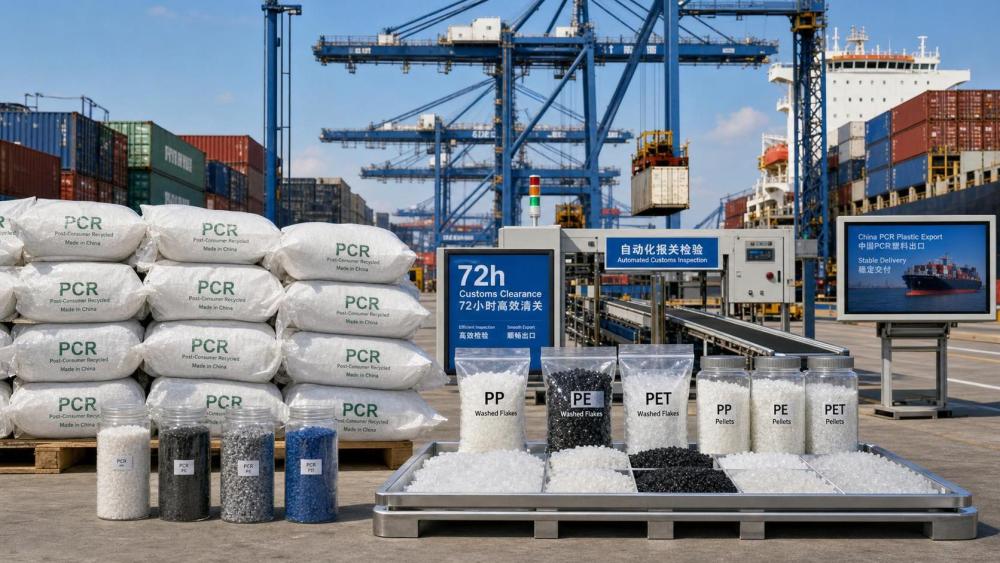
On June 28, 2026, China’s General Administration of Customs introduced a priority export inspection channel for GRS/ISCC-certified PCR plastic washed and pelletized materials covering PP, PE, and PET, while also applying intelligent review through the Single Window system. The reported result is a reduction in average customs clearance time from 5.2 days to within 72 hours. For exporters, overseas distributors, and buyers linked to Southeast Asia, the Middle East, and Latin America, this is worth close attention because it directly affects shipment timing, inventory turnover, and delivery certainty in cross-border recycled plastics trade.
What Has Been Confirmed So Far
According to the information provided, the measure took effect on June 28, 2026. It applies to PCR plastic washed and pelletized materials that are certified under GRS or ISCC, specifically including PP, PE, and PET.
The customs arrangement combines a priority inspection mechanism with intelligent document review under the Single Window system. Based on the provided summary, the average clearance period has been shortened from 5.2 days to within 72 hours.
The measure is described as covering more than 90% of PCR recycled material export orders destined for Southeast Asia, the Middle East, and Latin America. The stated business effect is improved inventory turnover and stronger delivery certainty for overseas distributors.
Where the Operational Impact May Appear First
Exporters handling qualified PCR materials
From an industry perspective, exporters are among the most directly affected parties because the policy is tied to certified PCR washed and pelletized materials. The immediate impact is likely to be felt in shipment planning, customs preparation, and customer delivery scheduling. What deserves closer attention is whether product scope, certification status, and filing documents are consistently aligned with the fast-track requirements in each transaction.
Overseas distributors managing replenishment cycles
Observably, distributors in the covered destination markets may see the clearest operational benefit in stock rotation and delivery predictability, because the measure is explicitly linked to shorter clearance times and improved order certainty. The relevant business link here is not only import arrival timing, but also how distributors reset reorder points, buffer inventory, and lead-time assumptions when working with China-origin PCR supply.
Procurement teams buying recycled resin for processing
For procurement functions at converters and manufacturers, the change may matter less as a policy headline and more as a lead-time variable. Analysis shows that shorter export clearance can affect purchase timing, supply scheduling, and internal production coordination. The main point to watch is whether the new customs efficiency translates into reliable repeat performance across normal order cycles rather than only initial implementation.
Supply chain service providers coordinating documents and bookings
Logistics coordinators, customs service providers, and trade operations teams may also be affected because the measure combines priority inspection with intelligent document review. In practice, their exposure is concentrated in document accuracy, sequence control, and the handoff between exporters and customs-facing systems. What deserves closer attention is whether faster review increases the value of cleaner data preparation and fewer document mismatches.
What Companies Should Watch in Practical Terms
Certification status is now closer to commercial execution
Because the fast-track mechanism applies to GRS/ISCC-certified PCR materials, companies should treat certification not only as a market access or customer requirement, but also as a factor that may influence export handling speed. The practical issue is whether product, certification, and shipping documentation remain fully consistent at the order level.
Lead-time promises should be updated carefully
Analysis shows that a shorter average clearance window can support better delivery commitments, but companies should avoid turning an average customs outcome into an unconditional sales promise. Sales, customer service, and logistics teams should align on how to communicate the new timing assumptions to buyers and distributors.
Market focus matters because coverage is concentrated
The provided information indicates that the measure covers more than 90% of export orders going to Southeast Asia, the Middle East, and Latin America. That makes destination-market exposure a practical point of attention. Companies with order books concentrated in those regions may review booking cadence, replenishment cycles, and customer communication first.
Policy signal and operational reality still need to be matched
Observably, the announcement provides a clear direction on customs efficiency, but actual business execution still depends on document readiness and shipment-specific handling. Firms should keep internal contingency planning in place while monitoring whether the shortened timeline is sustained consistently in routine export operations.
How This Development Should Be Read Right Now
Analysis shows that this is more than a narrow customs-processing update because it connects certification, export review, and delivery reliability in the PCR plastics trade. At the same time, it is more appropriate to understand this as an operational signal with immediate business relevance rather than as a complete reshaping of the recycled plastics market.
From an industry perspective, the strongest near-term meaning lies in execution quality: qualified materials moving faster through export procedures can improve planning confidence across the trade chain. Still, the longer-term significance depends on whether the shorter clearance pattern remains stable and whether market participants adapt their procurement and inventory decisions around it.
Why the Industry Will Keep Following This
This update is best understood as a concrete change in export handling for certified PCR plastic materials, with the most visible effect likely to appear in lead-time reliability and inventory movement for covered destination markets. It does not by itself confirm a broader market outcome, but it does provide a clearer operating signal for exporters, distributors, procurement teams, and supply chain coordinators.
At this stage, a neutral reading is more appropriate: the measure has immediate practical importance, and it may carry longer-term implications if the faster customs cycle proves durable in ongoing trade activity. That is why the industry is likely to watch both execution consistency and any further clarification of applicable procedures.
Basis of This Article and What Still Needs Verification
This article is based on the user-provided news title, event date, and event summary. The confirmed inputs include the June 28, 2026 implementation date, the priority inspection treatment for GRS/ISCC-certified PCR plastic washed and pelletized materials, the use of intelligent review under the Single Window system, the reduction in average clearance time from 5.2 days to within 72 hours, and the stated coverage of more than 90% of relevant export orders to Southeast Asia, the Middle East, and Latin America.
For this type of development, commonly relevant source categories may include official customs notices, company announcements, industry association updates, authoritative media reporting, and standards-related documentation. A specific official source link was not provided in the input, so continued verification remains necessary. What deserves closer attention is any later official clarification on scope, implementation details, or procedural adjustments affecting eligible materials and actual export execution.
Have questions about this sector analysis, or seeking best practices specific to your niche? Drop us a line below and let the senior consultants at APIM assist you.
We respect your privacy. Your information is strictly confidential.
Related News
- 00
0000-00
Do polyolefin hot melt adhesives bond well to polyethylene? - 00
0000-00
Korean Study Finds PLA Barely Degrades in Landfill After 320 Days - 00
0000-00
How to assess batch consistency from a thermal potting compounds supplier - 00
0000-00
How much weight can carbon fiber reinforced plastics save in cars? - 00
0000-00
Switching from PS to ABS Sheet Extrusion: Equipment Checks