




China Expands PCR Export Trace Codes Across Yangtze Delta
From July 8, 2026, China’s General Administration of Customs has moved PCR resin exports in key Yangtze River Delta ports into a stricter traceability framework. The change applies to PE, PP, and PET PCR pellets shipped under PCR Plastic Washing & Pelleting exports, and it matters most to exporters, recycling processors, compliance teams, logistics operators, and overseas buyers because it links customs clearance more directly to source documentation, testing records, and carbon-related data.
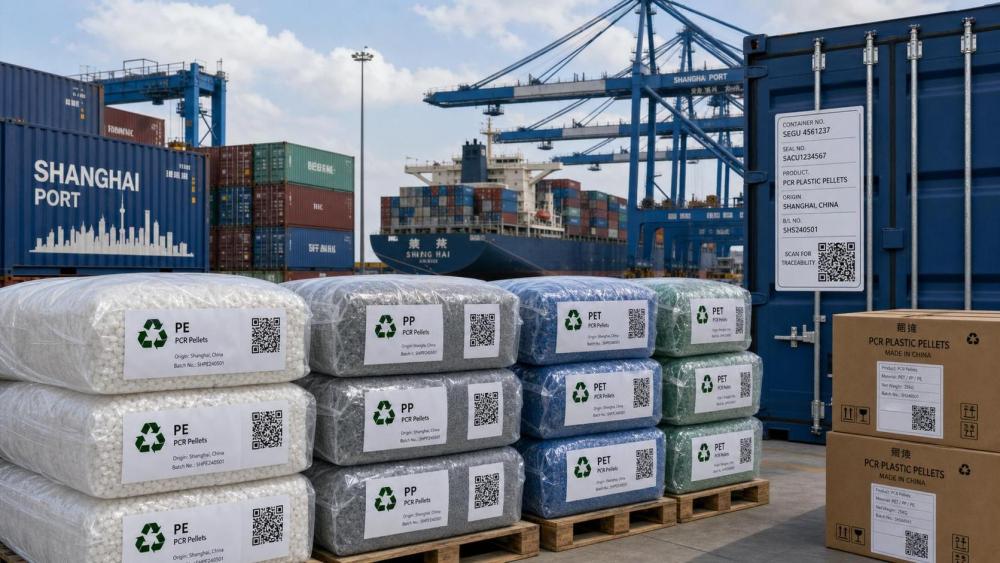
What the July 8 rollout now requires
According to the provided event information, mandatory trace code assignment began at 00:00 on July 8, 2026 at major Yangtze River Delta ports including Shanghai, Ningbo, and Taicang for PCR Plastic Washing & Pelleting export cargoes.
All exported PCR pellets covered by the measure must obtain a unique GS1-compatible QR code through the GreenChain Export Platform.
The required code information includes feedstock source, washing process details, heavy metal test reports, and carbon footprint data.
The scope described in the title covers all PE, PP, and PET PCR pellets within the rollout area. The provided summary also states that the measure is expected to improve traceability and ESG credibility for international buyers, while adding about 1.5 working days to pre-declaration preparation.
Where the pressure points appear in the supply chain
Exporters will feel the timing impact first
From an industry perspective, direct trading companies are likely to be affected most immediately at the shipment preparation stage. The reason is straightforward: export declarations can no longer rely only on conventional shipment readiness, and now depend on whether the required traceability data has been assembled and coded through the designated platform.
The practical impact is concentrated in document readiness, booking coordination, and delivery scheduling. What deserves closer attention is whether internal teams can absorb the reported 1.5-working-day lead time without disrupting vessel planning or customer delivery commitments.
Recyclers and pellet producers face tighter data alignment
For processors producing PE, PP, and PET PCR pellets, the likely impact sits upstream of customs filing. Feedstock origin records, washing process details, heavy metal testing, and carbon footprint information now become part of export readiness rather than background documentation.
Analysis shows that the main issue is not only whether these records exist, but whether they are complete, consistent, and usable in the format needed for trace code application. Any gap between plant records and export documents could slow shipment preparation.
Overseas buyers gain a clearer verification layer
For procurement teams and end users buying Chinese PCR materials, the change appears most relevant to supplier verification and ESG review. The provided information explicitly points to stronger traceability and credibility, which suggests that buyers may treat the QR-based data set as a more direct reference point in supplier evaluation.
Observably, this does not automatically change product demand by itself, but it may influence how buyers compare suppliers on documentation quality, reporting consistency, and readiness for traceability-based procurement discussions.
Logistics and supply chain service providers need earlier coordination
Supply chain service providers are likely to see the effect in booking windows, document cutoffs, and exception handling. Since the rule adds time before declaration, service providers may need earlier cargo confirmation and closer coordination with exporters to avoid last-minute filing risk.
What deserves closer attention is the handoff between cargo readiness and compliance readiness, because under this structure those two milestones may no longer happen at the same time.
What companies should watch in day-to-day execution
Whether internal records match filing requirements
Companies involved in PCR exports should closely review whether source, process, testing, and carbon-related records are already organized in a way that supports trace code application. The policy signal is clear, but actual shipment performance will depend on the quality and accessibility of supporting records.
How the extra lead time affects delivery commitments
The reported addition of about 1.5 working days before export declaration is a concrete operational issue. Firms should pay attention to how this affects customer promise dates, vessel cutoffs, and internal production-to-shipment sequencing, especially for regular export programs moving through Shanghai, Ningbo, and Taicang.
How to communicate the change to buyers and suppliers
Exporters and processors should also focus on communication discipline. Buyers may view the new trace code as a credibility tool, while suppliers and service partners may treat it as another compliance checkpoint. In practice, the difference between policy adoption and smooth execution often comes down to whether all parties understand what documents must be ready before shipment moves forward.
Whether follow-on rule language becomes more detailed
Analysis shows that companies should continue watching for more detailed official wording or procedural clarification around implementation. The current information establishes mandatory coding and core data fields, but day-to-day execution often depends on how requirements are interpreted in port operations and document workflows.
Why this looks like more than a short-term customs adjustment
Observably, this development is not just a paperwork change. It connects export clearance for PCR pellets with traceability, testing, and carbon-related disclosure in one process. That combination matters because it shifts compliance from a narrow customs function toward a broader proof-of-material-history requirement.
It is more appropriate to understand this as a structural signal rather than a one-off administrative inconvenience. At the same time, it should not yet be treated as a fully settled industry endpoint. The immediate rule is clear, but its longer-term market effect will depend on how consistently it is enforced, how buyers use the data, and whether similar requirements extend beyond the current rollout scope.
How the market may best interpret the July 8 move
The most balanced reading is that the July 8 rollout introduces a concrete compliance change with both operational cost and commercial signaling value. In the short term, the added pre-declaration time is the clearest business effect. In the longer view, the stronger message is that traceable PCR exports are being tied more closely to internationally legible data points such as GS1-compatible coding, test records, and carbon footprint information.
Current industry participants would be best served by treating this as an implemented near-term requirement and a longer-term indicator of stricter documentation expectations in recycled plastics trade, while continuing to monitor how the system works in actual port operations.
Basis of this article and points still requiring verification
This article is based on the user-provided news title, event date, and event summary. For this type of development, commonly relevant source categories may include official government notices, company announcements, industry association updates, authoritative media coverage, and standards-related documents.
A specific official source link was not provided in the input, so the exact underlying notice and subsequent implementation details still need ongoing verification. Areas worth monitoring include any further official clarification on operating procedures, any adjustment to documentation expectations, and any later expansion in practical enforcement scope.
Have questions about this sector analysis, or seeking best practices specific to your niche? Drop us a line below and let the senior consultants at APIM assist you.
We respect your privacy. Your information is strictly confidential.
Related News
- 00
0000-00
Do polyolefin hot melt adhesives bond well to polyethylene? - 00
0000-00
Korean Study Finds PLA Barely Degrades in Landfill After 320 Days - 00
0000-00
How to assess batch consistency from a thermal potting compounds supplier - 00
0000-00
How much weight can carbon fiber reinforced plastics save in cars? - 00
0000-00
Switching from PS to ABS Sheet Extrusion: Equipment Checks
Tag