




China Customs Starts PCR Plastic Export Traceability Pilot
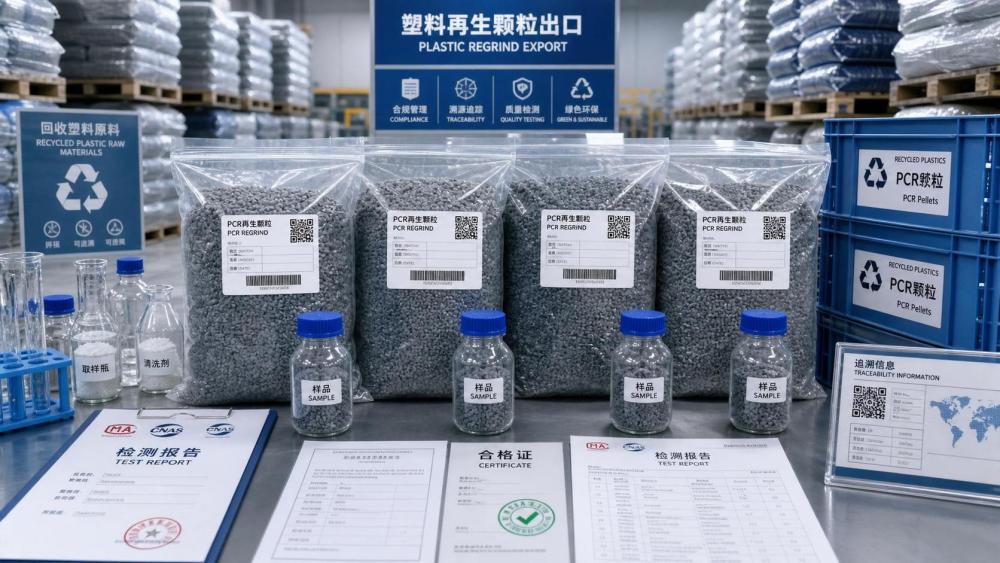
On July 4, 2026, China’s General Administration of Customs announced a pilot traceability program for exported PCR plastic washing and pelleting materials in Guangdong, Zhejiang, and Jiangsu. From July 15, exported PCR PET, PP, and PE washing-and-pelleting materials in the pilot scope must carry a unique GS1 electronic label linked to feedstock origin, washing process parameters, heavy metal test reports, and recycled content declarations. This is worth close attention from exporters, recyclers, procurement teams, compliance staff, and overseas-facing supply chain operators because it connects export filing, product documentation, and traceability expectations tied to REACH Annex XVII requirements for PAHs and phthalates in recycled plastics.
What the Pilot Requires
The announced pilot uses a “PCR Plastic Washing & Pelleting Export Traceability Management Platform” in three provinces: Guangdong, Zhejiang, and Jiangsu. According to the provided event summary, all exported PCR washing-and-pelleting materials covering PET, PP, and PE within the pilot must begin using a unique GS1 electronic label from July 15.
The label is required to connect four categories of information: raw material source, washing process parameters, heavy metal testing reports, and declarations of recycled content ratio. The first batch of the pilot covers companies accounting for more than 80% of exports to Europe, the United States, and Japan. The stated purpose is to respond to the traceability requirements under REACH Annex XVII related to limits on PAHs and phthalates in recycled plastics.
Where the Operational Pressure May Appear First
Export-facing recyclers and pellet producers
From an industry perspective, these companies are likely to feel the most immediate impact because the new requirement sits directly on exported PCR washing-and-pelleting output. The practical effect is not only the use of a GS1 electronic label, but also the need to connect that label with underlying process and compliance records. What deserves closer attention is whether internal production records, testing documents, and recycled content declarations can be matched consistently at shipment level.
Raw material sourcing and collection channels
Analysis shows that upstream sourcing may come under greater scrutiny because the label must link back to feedstock origin. For businesses supplying input materials into export-oriented PCR lines, the issue is less about headline policy language and more about whether source information can be documented in a form usable for export traceability. Any gap between procurement records and export documentation could become a practical bottleneck.
Trade and compliance teams handling Europe, the United States, and Japan
The first batch of the pilot is tied to companies representing a large share of exports to these markets, so commercial and compliance teams serving those destinations should pay close attention. The relevance here is that the pilot is framed around traceability expectations connected to REACH Annex XVII. For these teams, the likely impact falls on customer document requests, shipment readiness checks, and communication around product declarations.
Testing, documentation, and supply chain service functions
Observably, the requirement brings testing reports and process information closer to the customs-facing record set. Service providers and internal teams involved in documentation, labeling, and shipment preparation may need to watch for changes in timing, data completeness, and document consistency. The issue is not simply whether a report exists, but whether the required data points can be tied to the unique electronic label in a usable way.
What Companies Should Watch Now
Watch for any clarification around pilot scope and filing practice
Analysis shows that the announced framework sets out the platform, provinces, products, and data fields, but day-to-day execution often depends on how filing and record matching are applied in practice. Companies in the pilot areas should therefore follow any further official wording that clarifies submission steps, record retention expectations, or transaction-level handling.
Check whether product and customer portfolios fall inside the immediate pressure zone
What deserves closer attention is the overlap between product type, export destination, and operating location. Businesses exporting PCR PET, PP, or PE washing-and-pelleting materials from Guangdong, Zhejiang, or Jiangsu, especially into Europe, the United States, or Japan, should treat this as an immediate operational review point rather than a distant policy signal.
Match supplier records, process data, and testing documents before shipment deadlines
From an industry perspective, the challenge is likely to be record linkage rather than label issuance alone. Companies should focus on whether feedstock source information, washing process parameters, heavy metal test reports, and recycled content declarations are internally consistent and ready to be associated with a unique GS1 electronic label from the stated July 15 start date.
Prepare for more detailed customer communication
Observably, once traceability becomes more formalized at the export stage, customer-facing teams may receive more detailed questions on document availability and declaration basis. The practical point is to align sales, compliance, and supply chain communication so that responses on recycled content and supporting records remain consistent across quotation, order execution, and delivery stages.
Why This Looks More Like a Compliance Signal Than a Finished Outcome
Analysis shows that this development should not yet be read as a complete market-wide shift across all recycled plastics exports. It is more appropriate to understand it as a focused pilot with clear compliance direction: export traceability for PCR washing-and-pelleting materials is being tied more closely to identifiable records, especially where overseas regulatory expectations are relevant.
At the same time, the announcement carries a longer-term signal. Observably, the required linkage among origin data, process parameters, testing reports, and recycled content declarations points to a stricter documentation model for export-facing recycled plastics. That does not, by itself, confirm broader rollout details beyond the pilot, but it does indicate the kind of evidence structure companies may increasingly need to maintain.
How the Industry May Best Read This Stage
The immediate significance of this announcement lies in execution, not rhetoric. The pilot creates a near-term compliance task for affected exporters in three provinces and highlights that traceability expectations are moving closer to shipment-level documentation. It is more appropriate to understand this as a short-term operational change for companies within scope and a longer-term signal for the broader recycled plastics export chain, while further implementation details still need continued observation.
Basis of This Article
This article is based on the user-provided news title, event date, and event summary concerning the July 4, 2026 announcement by China’s General Administration of Customs on the pilot traceability platform for exported PCR plastic washing and pelleting materials.
For developments of this kind, relevant source types typically include official government announcements, company disclosures, industry association updates, authoritative media reporting, and standard-setting or regulatory documents. A specific official source link was not provided in the input, so the underlying text and any later implementation details should continue to be verified. Areas that still warrant follow-up include any further clarification on pilot execution, filing procedures, and subsequent scope changes.
Have questions about this sector analysis, or seeking best practices specific to your niche? Drop us a line below and let the senior consultants at APIM assist you.
We respect your privacy. Your information is strictly confidential.
Related News
- 00
0000-00
Do polyolefin hot melt adhesives bond well to polyethylene? - 00
0000-00
Korean Study Finds PLA Barely Degrades in Landfill After 320 Days - 00
0000-00
How to assess batch consistency from a thermal potting compounds supplier - 00
0000-00
How much weight can carbon fiber reinforced plastics save in cars? - 00
0000-00
Switching from PS to ABS Sheet Extrusion: Equipment Checks