




When is POM for gears a better choice than nylon?
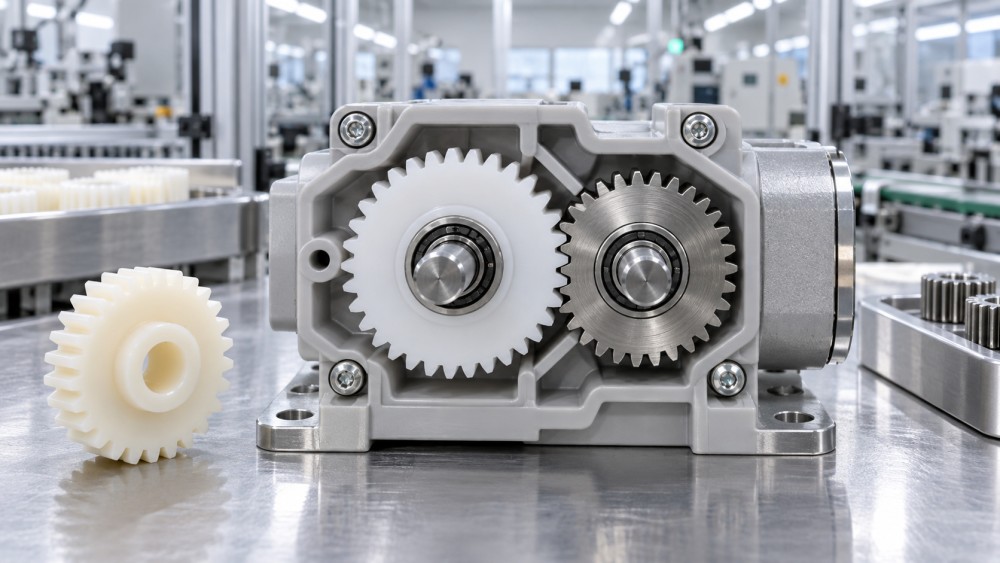
POM for gears is usually a better choice than nylon when the gear must hold its dimensions across changing humidity, run with low friction, and maintain predictable meshing accuracy over time. This often applies to small precision gears, enclosed mechanisms, office equipment, appliance drives, actuators, latches, pumps, and consumer-electronics assemblies where a small change in tooth geometry can create noise, backlash, or inconsistent motion.
Nylon remains a strong gear material and is often the better option for demanding impact loads or higher-temperature duty. The decision is therefore not “which resin is stronger?” It is whether the gear’s main risk is moisture-related dimensional change and frictional consistency, or whether it is shock loading, heat, and toughness under severe mechanical duty.
Choose POM when dimensional stability drives gear performance
The most practical reason to select POM, also called acetal, is its low moisture absorption compared with nylon. Nylon absorbs moisture from its environment, and that absorbed water changes the material’s dimensions and mechanical behavior. In a large, lightly loaded gear, this may be manageable. In a compact gear train with tight center distances, fine tooth profiles, or controlled backlash, it can become a functional issue.
A nylon gear that changes size after molding or during service may mesh differently from the condition used during initial testing. The effect can show up as increased running noise, altered contact patterns, more drag, or inconsistent torque. POM is less sensitive to ambient humidity, so its dimensions tend to remain more stable from dry indoor storage through normal operating conditions.
This is especially relevant when a gear must mate with another polymer gear, a metal pinion, or a precision molded housing. The gear material cannot be evaluated in isolation. Tooth geometry, shaft position, housing stiffness, and the expansion behavior of the mating components all affect whether the assembly continues to run correctly.
Low friction matters most in lightly lubricated or dry gear trains
POM has naturally favorable sliding behavior. For gears, that can reduce the tendency for sticking, uneven startup torque, and friction-generated noise, particularly where grease is limited or intentionally avoided. A low-friction polymer is not a substitute for sound gear design, but it can provide a more forgiving operating window in mechanisms that see repeated starts, reversals, or low-speed motion.
Common examples include small motor-driven actuators, dosing mechanisms, printer and scanner components, household appliances, access-control hardware, and compact transmission modules. These applications often value smooth movement and consistent force more than maximum load capacity.
The benefit is strongest when POM runs against a compatible mating surface and the tooth load stays within a reasonable range. A POM gear can still wear rapidly if contact stress is excessive, teeth are too thin, the shaft is misaligned, or abrasive contamination enters the housing. Low friction improves the material’s behavior; it does not eliminate the need to assess load distribution and gear geometry.
When nylon’s strength advantages do not decide the outcome
A frequent selection error is to compare only tensile or impact-strength data and conclude that nylon is automatically the safer gear material. Those properties matter, but gear failure is often driven by a combination of tooth bending, surface wear, heat buildup, creep, alignment, and environmental change. The resin with the highest headline strength is not necessarily the resin that maintains the best gear mesh in the finished mechanism.
For a low-load precision drive, POM’s consistent shape and smooth sliding behavior can produce a more reliable result than a stronger nylon grade whose moisture condition varies through manufacturing, storage, and use. This is not because POM is universally superior. It is because the performance limit in that application is precision and consistency rather than ultimate mechanical strength.
POM can also be useful when the molding process needs dependable part dimensions. Its relatively stable moisture behavior simplifies the relationship between molded dimensions, conditioning, inspection results, and assembly fit. Nylon gears may require closer control of resin drying, conditioning, and the timing of dimensional inspection. Those steps are manageable, but they must be planned rather than treated as secondary production details.
Conditions where nylon is still the more appropriate gear material
POM should not be selected solely because the gear is small or because the application requires low noise. Nylon can be the better material when gears experience substantial impact, intermittent overload, or conditions where toughness is more important than maintaining a very tight dimensional window. A properly selected nylon grade may also be more appropriate for higher-temperature environments where POM’s thermal margin becomes restrictive.
Consider nylon carefully when the gear is subject to abrupt torque reversals, repeated shock loading, high tooth-root stress, or elevated service temperature. Reinforced nylon compounds may further improve stiffness and strength, although reinforcement can change wear behavior, molding characteristics, and the effect on a mating gear. A glass-filled grade is not simply an upgraded version of an unfilled grade; it may require a different approach to tooth design, tooling, and tribological evaluation.
Chemical exposure also needs a separate review. POM has good resistance to many common fluids, but certain chemical environments can be unsuitable. Nylon has its own compatibility limits and can be affected by moisture and specific chemicals in different ways. The relevant question is not which polymer is “chemical resistant,” but whether the actual oils, cleaners, fuels, additives, or process residues in the assembly are compatible with the selected grade over the intended service conditions.
Evaluate the gear system, not only the resin datasheet
Before choosing between POM and nylon, define the conditions that determine gear behavior in the actual product. A useful review should cover:
- Load profile: steady torque, peak torque, shock events, reversals, and duty cycle.
- Speed and heat: rotational speed, frictional heating, ambient temperature, and ventilation around the gear train.
- Lubrication: dry running, grease type, lubricant retention, and the consequence of lubricant migration or loss.
- Precision requirements: allowed backlash, center-distance tolerance, tooth-profile accuracy, and torque consistency.
- Environment: humidity cycling, water contact, cleaning agents, oils, dust, and abrasive contaminants.
- Mating components: gear-pair material, metal shafts, housings, bearings, and the stiffness of the supporting structure.
- Manufacturing controls: resin drying, molding repeatability, post-molding handling, inspection timing, and batch consistency.
This review often reveals that the critical decision is not “POM versus nylon” in general. It may be unfilled POM versus a lubricated POM grade, unfilled nylon versus impact-modified nylon, or a different gear architecture that reduces contact stress enough to use the preferred material safely.
Do not assume a lubricant-filled grade is automatically better
Self-lubricating POM grades can be attractive for dry-running gears because they may improve friction and wear behavior. They are not an automatic upgrade. Additives can alter stiffness, toughness, shrinkage, surface finish, and dimensional control. In a high-precision gear, those tradeoffs may matter as much as the friction benefit.
The same caution applies to reinforced compounds. Higher stiffness can help maintain tooth form under load, but the filler may increase wear on the mating gear or make molded tooth surfaces less favorable for quiet operation. The material should be selected as a gear-pair system, with attention to both sides of the mesh and the expected lubrication regime.
A practical decision path
Start with the failure mode that is least acceptable. If the application cannot tolerate humidity-related changes in backlash, alignment, or torque, POM should be the leading candidate. If it cannot tolerate shock loads or prolonged high-temperature exposure, evaluate nylon first, including grades designed for the required thermal and mechanical conditions.
Next, review whether the gear will run dry or with limited lubrication. POM is often a strong candidate for smooth, low-friction motion under moderate loading. Then check the contact stress, tooth-root geometry, shaft support, and housing tolerances. A material decision cannot compensate for a gear train that concentrates load on too few teeth or operates with poor alignment.
Finally, evaluate molded parts in the condition that reflects their intended use. For POM, this means confirming dimensional repeatability, gear noise, starting torque, and wear in the assembled mechanism. For nylon, it also means considering the moisture condition that the gear will experience after production, during storage, and in service. Material selection should follow the behavior of the finished assembly, not only a comparison of catalog properties.
The decision in practical terms
Select POM when the gear is precision-sensitive, lightly to moderately loaded, expected to operate with low friction, and exposed to humidity variation that could disturb a tight gear mesh. It is particularly suitable when stable dimensions and repeatable motion are more valuable than maximum impact resistance.
Select nylon when the gear must absorb higher shock loads, withstand more demanding thermal conditions, or prioritize toughness over close dimensional control. In either case, the final choice should be tied to gear geometry, mating material, lubrication, and environmental exposure. For material teams comparing engineering polymers, APIM’s application-focused coverage is useful because it frames resin selection around processing, operating conditions, and part-level performance rather than a single property value.
Have questions about this sector analysis, or seeking best practices specific to your niche? Drop us a line below and let the senior consultants at APIM assist you.
We respect your privacy. Your information is strictly confidential.
Related News
- 00
0000-00
How does washing affect contamination in post-consumer recycled PP resins? - 00
0000-00
How does feedstock affect depolymerization equipment selection? - 00
0000-00
US Sets 213.44% Preliminary Antidumping Deposit on Chinese PTMEG - 00
0000-00
When should epoxy be used as a thermal interface material for semiconductors? - 00
0000-00
US Midterm Results Unlikely to Quickly Shift Recycled Plastics Market or Legislation