




What Drives Chemical Resistant Plastics Price in Industrial Applications
Why does chemical resistant plastics price vary so much in industrial projects?
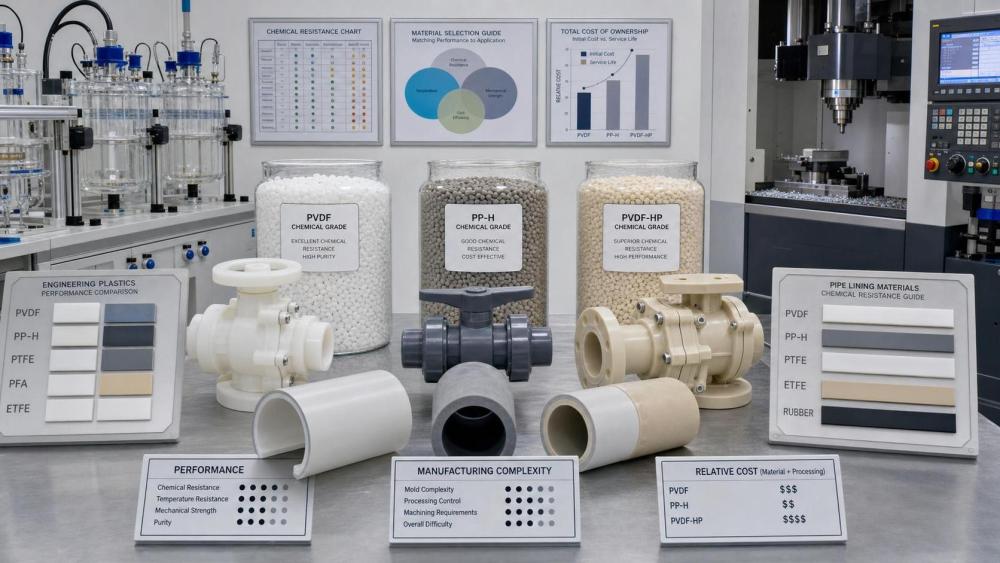
Understanding chemical resistant plastics price starts with a simple fact: not all chemical-resistant materials solve the same problem.
Some parts only face splash contact.
Others must survive continuous exposure, pressure, heat, and cleaning cycles for years.
That is why price differences can look extreme between standard engineering plastics, modified compounds, and high-performance resins.
In real sourcing work, the quoted resin cost is only one layer.
Chemical resistant plastics price is also shaped by formulation design, additive loading, compounding quality, conversion method, certification demands, and supply stability.
A molded valve component, an electronics housing, and a multilayer process liner may all require chemical resistance.
Even so, their cost logic can be very different.
This matters across automotive, electronics, packaging, industrial machinery, medical processing, and fluid handling.
Materials that replace metal, rubber, glass, or commodity plastics often reduce corrosion risk and weight.
But they can also raise material and processing costs if the specification is not tightly defined.
APIM often frames this issue through application logic rather than price alone.
That approach is useful because industrial value comes from fit, stability, and service life, not from a resin quote in isolation.
Which cost drivers usually have the biggest impact on chemical resistant plastics price?
The first driver is base polymer type.
PEEK, PPS, fluoropolymers, PVDF, and specialty nylons sit in very different price bands because of chemistry, production scale, and performance range.
The second driver is modification.
Glass fiber, mineral fillers, flame retardants, impact modifiers, conductive additives, and stabilizers can all change chemical resistant plastics price.
Sometimes they improve dimensional stability or mechanical strength.
Sometimes they also reduce resistance to a specific solvent, acid, or cleaning agent.
Processing complexity is another major factor.
A compound that needs strict drying, narrow melt temperatures, corrosion-resistant screws, or precise dispersion control will cost more to produce consistently.
This is especially relevant in twin-screw compounding, extrusion, sheet production, and precision injection molding.
Compliance adds another layer.
If the material must meet food contact, medical, electrical, low outgassing, or traceability standards, pricing usually rises.
The reason is not only testing cost.
Qualified raw materials, document control, and batch consistency also affect the final number.
Global supply conditions cannot be ignored either.
Feedstock volatility, plant maintenance, regional logistics, and inventory strategy can all move chemical resistant plastics price faster than expected.
A practical way to read the cost structure
This kind of comparison helps move the discussion away from unit price alone.
Is a higher chemical resistant plastics price always justified by better performance?
Not necessarily.
A higher chemical resistant plastics price often reflects broader resistance, higher heat tolerance, or more stable long-term behavior.
But that does not mean the most expensive resin is the right commercial choice.
In actual applications, the better question is whether the material matches the exact chemical environment.
For example, a part exposed to diluted cleaners at room temperature may not need a premium fluoropolymer.
A properly selected modified PP, PBT, PA, or PVDF grade may perform well enough.
On the other hand, aggressive solvents, hot acids, sterilization cycles, or mixed-media exposure can quickly eliminate lower-cost options.
More common mistakes happen when projects buy too much resistance or too little validation.
Over-specification raises material cost, tooling concerns, and lead time.
Under-specification creates cracking, swelling, discoloration, leakage, or early failure.
The best value usually sits between those two extremes.
APIM’s material coverage is useful here because it connects polymer behavior with processing and end-use conditions.
That broader view helps explain why similar-looking materials can produce very different lifecycle economics.
What should be compared before accepting a supplier quote?
A quote should be read as a technical offer, not only a commercial number.
Before comparing chemical resistant plastics price across suppliers, check what is actually included.
- Grade identity and whether the resin is virgin, modified, recycled-content, or blended.
- Chemical resistance data under relevant temperature, concentration, and exposure time.
- Mechanical properties after exposure, not only before exposure.
- Processing recommendations, including drying, melt range, and tooling sensitivity.
- Certification package, lot traceability, and change notification policy.
- Lead time, minimum order quantity, and backup manufacturing location.
That last point is often underestimated.
A lower price can lose its advantage if it depends on a narrow supply chain or long replenishment cycle.
For specialty compounds, consistency between batches matters as much as nominal specification.
This is especially true in electronics, precision parts, extrusion lines, and bonded assemblies using industrial adhesives.
Where APIM adds value is in helping compare these technical details in structured language.
That makes supplier discussions more precise and reduces the chance of approving a quote with hidden conversion or qualification costs.
Where do cost misunderstandings usually happen?
One common misunderstanding is to compare only price per kilogram.
In molded parts, actual economics may depend more on yield, cycle time, density, scrap rate, and service life.
Another issue appears when chemical exposure is described too broadly.
“Resistant to chemicals” is not enough for a sound decision.
The specific fluid, concentration, pressure, temperature, and cleaning schedule all matter.
There is also confusion between lab resistance data and field performance.
A resin may pass immersion testing but still fail under stress, vibration, UV exposure, or repeated thermal cycling.
Modified compounds create another trap.
Reinforcement can improve stiffness and creep resistance, yet it may change processing behavior or surface quality.
That means the cheapest acceptable resin on paper may become expensive during conversion.
A short decision checklist usually prevents these mistakes.
How can chemical resistant plastics price be evaluated more strategically?
A better evaluation starts with the exposure profile, not the material shortlist.
Define the media, time, temperature, pressure, stress level, part geometry, and approval requirements.
Then compare two or three realistic resin paths.
One can be a lower-cost engineering plastic.
Another can be a modified compound.
A third can be a high-performance fallback for harsher duty.
The comparison should include material cost, processing behavior, testing burden, lead time, and expected replacement interval.
That is where total value becomes clearer than headline chemical resistant plastics price.
In projects involving extrusion, films, molded components, or bonded assemblies, it also helps to review downstream effects.
Will the material need special screws, corrosion-resistant tooling, different drying equipment, or tighter inspection?
Those details often explain why quoted prices alone fail to predict real project cost.
A practical next step is to build a short comparison sheet around application conditions, qualification needs, and supply continuity.
Using structured technical references like APIM can make that review faster and more consistent.
The aim is not to find the lowest number.
It is to decide whether the selected material delivers the right resistance, process fit, and risk profile for the intended service life.
Have questions about this sector analysis, or seeking best practices specific to your niche? Drop us a line below and let the senior consultants at APIM assist you.
We respect your privacy. Your information is strictly confidential.
Related News
- 00
0000-00
Do polyolefin hot melt adhesives bond well to polyethylene? - 00
0000-00
Korean Study Finds PLA Barely Degrades in Landfill After 320 Days - 00
0000-00
How to assess batch consistency from a thermal potting compounds supplier - 00
0000-00
How much weight can carbon fiber reinforced plastics save in cars? - 00
0000-00
Switching from PS to ABS Sheet Extrusion: Equipment Checks