




Types of High Performance Polymers: Where PEEK, PPS, and PI Are Used
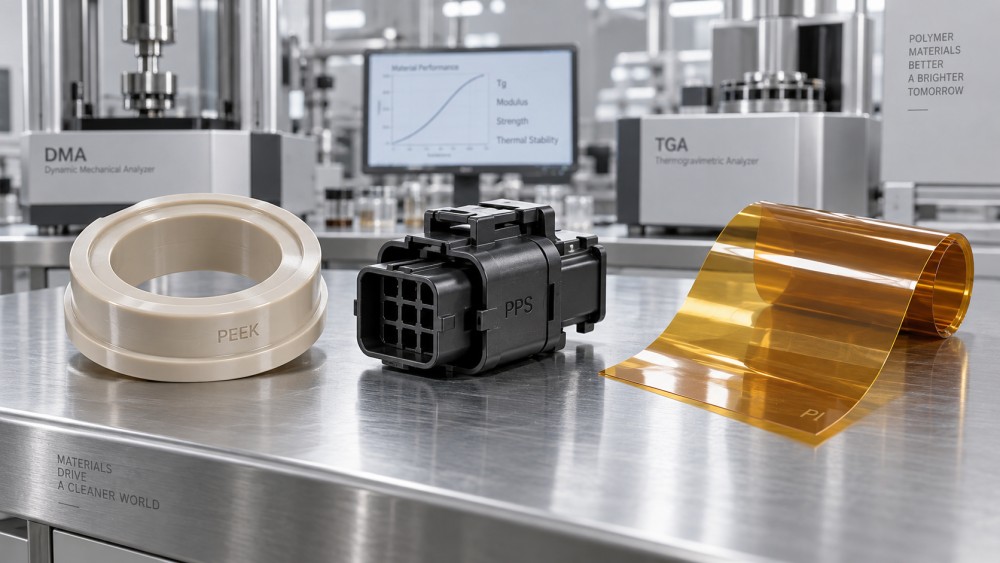
PEEK, PPS, and polyimide (PI) solve different kinds of demanding material problems. PEEK is used where mechanical loading, chemical exposure, and elevated temperature occur together. PPS is particularly useful for dimensionally stable, chemically resistant molded components, including electrical and automotive parts. PI stands out in high-temperature insulation films and specialized components where thermal stability and wear performance justify more complex processing.
The important distinction is not which polymer has the highest headline temperature rating. It is whether a specific grade can maintain the required strength, insulation, dimensions, or friction behavior throughout the intended operating cycle. A thin insulating film, a pump wear ring, and a reinforced electrical housing can all require a high-performance polymer without needing the same material.
What makes a polymer “high performance”?
High-performance polymers are generally distinguished from conventional engineering plastics by their ability to retain useful properties under more severe thermal, chemical, electrical, or mechanical conditions. The term is a practical industry category rather than a single standardized performance class.
Among the different types of high performance polymers, PEEK and PPS are semicrystalline thermoplastics: they contain both ordered crystalline regions and less ordered amorphous regions, and they can be melted for processing. Their crystallinity influences stiffness, chemical resistance, shrinkage, and dimensional stability. Cooling conditions therefore affect the finished component, not just production speed.
PI is a broader family. Many familiar polyimide films and high-temperature stock shapes do not melt-process like PEEK or PPS. Other polyimides are thermoplastic and use different manufacturing routes. Consequently, “PI” alone does not adequately describe either processing behavior or final performance.
These roles overlap, but the materials are not interchangeable. Reinforcement, additives, part geometry, and manufacturing method can change their relative suitability.
PEEK: where combined mechanical and environmental demands matter
PEEK is useful when a component must do more than survive heat. It combines mechanical strength, fatigue resistance, chemical resistance, and low moisture absorption, making it a candidate for parts that carry loads while operating in aggressive environments.
Pumps, valves, and rotating equipment
PEEK appears in wear rings, bearing cages, bushings, valve seats, and other precision components. These applications may combine fluid exposure, sliding contact, pressure, and temperature. Replacing metal with PEEK can reduce weight or avoid certain corrosion problems, but successful substitution depends on deformation and wear—not simply chemical resistance.
A valve seat, for example, must retain its sealing geometry under sustained pressure. A bushing must tolerate the combination of contact pressure and sliding speed without excessive frictional heating. Unfilled PEEK and bearing compounds containing carbon fiber, graphite, or other lubricating additives can behave very differently. The mating surface, lubrication, and abrasive contamination are also part of the material decision.
PEEK resists many industrial fluids, but it is not chemically universal. Strong acids and other aggressive media require specific compatibility checks at the actual concentration and temperature. Resistance established at room temperature cannot automatically be carried over to hot, pressurized service.
Aerospace and transport components
PEEK is used in selected brackets, clamps, cable-management parts, electrical components, and composite structures. Its attraction is the combination of low density relative to metals, useful elevated-temperature properties, and the ability to make complex shapes through thermoplastic processing.
Carbon-fiber reinforcement increases stiffness and can reduce thermal expansion in the fiber direction. It also introduces directional behavior: a molded component may shrink, expand, or carry loads differently along and across the dominant fiber orientation. This matters when a polymer part is attached to metal or when tight alignment must be maintained through temperature cycling.
Aircraft applications may also impose flammability, smoke, and other qualification requirements. A resin-family description does not establish that a particular compound, thickness, or finished assembly satisfies those requirements.
Selected medical applications
Medical-grade PEEK is used in selected implants, including spinal devices, as well as certain surgical instruments. Its radiolucency can support imaging, while its mechanical properties provide an alternative to metals in specific device designs.
Industrial PEEK is not interchangeable with implant-grade material. Biocompatibility, manufacturing controls, traceability, sterilization validation, and device-specific regulatory requirements determine suitability. Unmodified PEEK also does not inherently provide strong bone bonding; surface engineering and composite approaches address different biological requirements.
PEEK’s processing demands help explain its cost position. Its melting temperature is approximately 343°C, and melt processing requires temperatures above that point, together with suitable equipment and controlled mold conditions. Crystallinity affects final properties, so insufficient thermal control can undermine the performance expected from the resin.
PPS: where stable molded geometry and chemical resistance are central
PPS is widely used as a reinforced molding material. Glass-filled grades are especially relevant when a part needs rigidity, low moisture absorption, chemical resistance, and reproducible dimensions. Compared with PEEK, PPS frequently offers a lower-cost route to demanding molded components, although finished-part economics still depend on tooling, cycle time, and qualification.
Automotive fluid systems and electrical assemblies
PPS is used in selected pump housings, coolant-system components, valve parts, sensor housings, and electrical assemblies. In a fluid-handling component, the attraction is its resistance to many oils, fuels, and other industrial chemicals, combined with the stiffness achievable through reinforcement.
The specific fluid remains important. Coolant mixtures, additives, contaminants, and exposure temperature can affect durability differently. A compatibility statement for a base chemical does not fully describe a commercial fluid formulation or a component under stress.
For electrical parts, PPS offers low moisture absorption and useful dimensional stability. These properties help preserve connector geometry and insulating distances. However, dielectric performance, tracking resistance, and flame behavior depend on the grade and test conditions. Electrically conductive compounds cannot be treated as substitutes for insulating grades.
Precision parts exposed to assembly heat
PPS can be suitable for connectors, bobbins, and other components that encounter brief high-temperature manufacturing steps. Its melting temperature is approximately 280–290°C, but surviving an assembly process also depends on wall thickness, mechanical support, residual stress, and the duration of heating.
A short heat exposure and years of loaded operation are different requirements. PPS has a substantially lower glass-transition temperature than PEEK, typically around 85–90°C versus approximately 143°C for PEEK. Above the glass transition, the amorphous portion becomes more mobile. Crystalline regions and reinforcement still provide structure, but stiffness and creep behavior must be evaluated under the intended conditions.
This distinction prevents a common selection error: assuming that a high melting temperature guarantees high load-bearing capability at every temperature below it.
Where PPS needs caution
Rigidity does not equal toughness. PPS compounds can be sensitive to impact, sharp notches, and weak weld lines where separate melt fronts meet during molding. Glass reinforcement improves stiffness but can increase directional shrinkage and complicate the behavior of thin features.
A rigid housing may therefore perform well under steady pressure yet fail under an impact or assembly load concentrated at a screw boss. Gate placement, fiber orientation, wall transitions, and fastening design can be as important as the nominal resin properties.
PI: why films and specialized parts require separate consideration
Polyimide is best understood through its product form. A flexible PI film used for electrical insulation and a filled PI stock shape machined into a bearing component belong to the same broad family but solve different problems.
Flexible circuits and electrical insulation
PI films are used as substrates for flexible printed circuits and in selected wire, cable, motor, and transformer insulation systems. They combine thin-film flexibility with thermal stability and electrical insulation, supporting designs in which conventional films would lose useful properties during processing or service.
In a flexible circuit, the complete construction matters. Copper, adhesive layers, cover films, and interfaces must tolerate bending and thermal cycling together. The PI film may withstand a temperature that the adhesive or another layer cannot.
Moisture absorption also deserves attention. PI is not uniformly a low-moisture-uptake alternative to PEEK or PPS. Depending on the chemistry and application, absorbed moisture can affect dimensions, dielectric behavior, and processing. Drying and storage conditions may therefore be relevant even when the film itself has excellent heat resistance.
High-temperature wear and equipment components
Selected PI grades are used for bushings, thrust washers, sealing components, and parts in semiconductor-processing equipment. Their value lies in maintaining useful thermal and mechanical behavior where other polymers may soften or creep excessively.
Filled grades can improve wear or friction characteristics, but there is no universal “best PI bearing material.” Performance depends on temperature, pressure, sliding speed, atmosphere, lubrication, and the counterface. In controlled environments, contamination and outgassing requirements may be as important as wear life.
Some high-temperature PI products are made through powder-based forming and subsequent thermal treatment rather than conventional injection molding. Others are produced as films from precursor solutions. These routes affect achievable geometry, machining needs, production volume, and cost. A non-melting PI should not be described as a drop-in replacement for an injection-moldable thermoplastic.
High thermal stability does not imply universal chemical durability either. Certain PI chemistries can be vulnerable to hydrolysis or strong alkaline environments. Hot water, steam, and cleaning chemicals require grade-specific evaluation.
Reading performance claims without confusing different limits
Temperature figures are particularly easy to misinterpret. Melting temperature describes a physical transition in a semicrystalline thermoplastic. Glass-transition temperature describes increased mobility in its amorphous regions. Heat-deflection temperature measures deformation under specified test conditions. Long-term thermal ratings address property retention under defined aging conditions. None alone establishes a component’s safe operating temperature.
The same caution applies to mechanical data. Room-temperature tensile strength does not establish resistance to years of creep under load. A fiber-filled grade with high stiffness may have lower strain capability or different weld-line behavior than an unfilled grade. For films, thickness, tear resistance, bending fatigue, and laminate construction may matter more than bulk tensile properties.
Application comparisons become more useful when they start with the likely failure mode. A loaded pump component may be limited by creep or wear, favoring investigation of PEEK bearing grades. A chemically exposed molded housing may be governed by dimensional stability and weld-line strength, making reinforced PPS relevant. A thin electrical substrate exposed to manufacturing heat may point toward PI film, provided the entire laminate meets the requirement.
The practical distinction is therefore one of application architecture, not a simple performance ranking. PEEK often addresses combined loading and environmental exposure; PPS supports rigid, stable molded components; PI serves high-temperature films and specialized parts through a wider range of manufacturing routes. The final choice rests on the specific grade, product form, exposure conditions, and weakest point in the finished component.
Have questions about this sector analysis, or seeking best practices specific to your niche? Drop us a line below and let the senior consultants at APIM assist you.
We respect your privacy. Your information is strictly confidential.
Related News
- 00
0000-00
How does washing affect contamination in post-consumer recycled PP resins? - 00
0000-00
How does feedstock affect depolymerization equipment selection? - 00
0000-00
US Sets 213.44% Preliminary Antidumping Deposit on Chinese PTMEG - 00
0000-00
When should epoxy be used as a thermal interface material for semiconductors? - 00
0000-00
US Midterm Results Unlikely to Quickly Shift Recycled Plastics Market or Legislation