




How to verify Global Advanced Polymers supplier listings on APIM
A supplier listing is ready to support a sourcing decision when its company identity, product claims, and supply arrangements can be confirmed through independent records and current documents. To determine whether Global Advanced Polymers supplier listings on APIM are accurate, begin with the exact material grade and legal entity behind the offer. A detailed profile or downloadable certificate alone does not establish that the listed business can supply the specified material consistently.
Separate three questions: does the company exist, does the offered product match the application, and can the proposed shipment be traced to an accountable source? Each requires different evidence. A registered business can offer an unsuitable grade; a technically suitable material can arrive through an undocumented supply route. Keep these findings separate until they support the same proposed transaction.
Establish which business would actually supply the material
Record the listing address, contact details, product description, and review date before contacting the supplier. Preserve a copy of the relevant page so later changes can be compared with the original claim. Where a listing shows an update date, treat it as a starting point for questions about current availability, rather than evidence that every field was recently verified.
Match the legal company name against an official business registry where accessible. Compare the registration identifier, registered address, and business status with the quotation and proposed contract. An English trading name can differ legitimately from the registered name, but the relationship needs to be documented. Similar names, shared logos, and matching product photographs are weak identity evidence.
Distinguish the registered office, production facility, and dispatch warehouse. These locations do not have to be identical. Their functions do need to make sense: a trading office should not be accepted as evidence of an operating compounding plant. Ask whether the business manufactures the material, distributes an original producer’s grade, or sells a private-label formulation made elsewhere.
For a distributor, confirm the stated commercial relationship through the producer’s independently located contact channel when authorization matters. For a compounder, establish which facility makes the offered grade and which entity handles complaints. Outsourced production is not automatically disqualifying, but an unexplained production source weakens traceability and makes process-change control harder to assess.
Before payment, reconcile the contracting entity with the bank beneficiary. A different beneficiary requires a documented explanation and independent confirmation through a previously established contact. Treat a last-minute bank change as a separate verification event, even when earlier correspondence appeared consistent.
Turn the product description into an identifiable grade
“Glass-filled nylon,” “flame-retardant PC,” and “recycled PP” describe material categories, not complete purchasing specifications. Request the exact grade designation, producer or compounder, reinforcement or filler content, color code, and intended processing method. Identify whether the offer covers a standard grade, custom formulation, reprocessed material, or a proposed substitute.
A grade suffix can distinguish viscosity, stabilization, reinforcement, or color. Preserve the full designation across the quotation, technical data sheet, sample label, and order. If a seller proposes an “equivalent,” request a comparison against the properties that matter to the application. Membership in the same polymer family does not establish equivalent processing behavior or finished-part performance.
Clarify the material’s supply condition as well. Virgin resin, post-industrial regrind, recycled pellets, and compounded blends require different evidence. For recycled content claims, establish what the percentage describes, how it is calculated, and which records support it. A statement about recycled feedstock does not by itself establish the composition of every delivered batch.
For films and adhesives, the identifying details change. Film offers need thickness, construction, surface treatment, and roll specification. Adhesives need the formulation identifier, component arrangement, storage conditions, and shelf life. Generic descriptions leave too much room for an apparently similar product to perform differently during conversion or assembly.
Read technical documents for comparability and limits
Request a technical data sheet with a revision identifier or issue date and confirm its source. A document copied onto a seller’s letterhead needs an explanation of who owns the formulation and supports the stated values. Compare the sheet with the original producer’s published document where one is available. Resolve discrepancies before treating either version as authoritative.
Typical values and contractual acceptance limits serve different purposes. A technical data sheet often describes representative properties. A purchase specification defines what a shipment must satisfy. Ask which characteristics are controlled for batch release, what their limits are, and whether those results appear on a certificate of analysis. Do not assume every property on a technical sheet is measured for every lot.
Pay particular attention to claims expressed without measurement conditions. Heat resistance could refer to a short test under load or to longer-term operating behavior. Those claims answer different questions. Likewise, a favorable tensile value does not establish creep resistance, impact performance, or chemical compatibility in the finished component.
Use application conditions to decide which gaps matter. A reinforced compound intended for a loaded part needs evidence relevant to load duration, temperature, moisture exposure, and processing orientation. An adhesive used near heat needs bond-performance evidence after the relevant exposure, not just an initial room-temperature result. Request targeted clarification rather than collecting unrelated property tables.
Confirm what certificates actually cover
Classify each document before relying on it. A management-system certificate concerns the named organization and defined scope. A product classification or test report concerns specified material and test conditions. A certificate of analysis reports selected results for an identified batch. These documents cannot substitute for one another.
Read the holder name, facility address, scope, validity information, and grade references. Where the issuer offers a verification service or public directory, use it to confirm the record. Otherwise, seek confirmation through independently sourced issuer details. A clear scan and recognizable logo do not establish authenticity.
A genuine certificate still needs to apply to the offer. Certification for one production site does not establish coverage of another. A report for an unfilled natural grade does not automatically cover a reinforced, colored, or flame-retardant variant. If an application requires a particular approval, obtain evidence for the exact grade and applicable conditions before qualification proceeds.
Missing public records do not prove a document is false; some records are not publicly searchable. Keep the claim unresolved until the issuing organization or another appropriate source confirms it. Avoid converting “document received” into “claim verified” in the sourcing record.
Connect the sample to the proposed production supply
A passing sample has limited value if its origin cannot be connected to future shipments. Request a sample label identifying the grade and lot, together with the corresponding batch documentation. Establish whether it came from routine production, a development batch, or a specially prepared trial. Development material requires a separate explanation of how commercial production will reproduce its relevant characteristics.
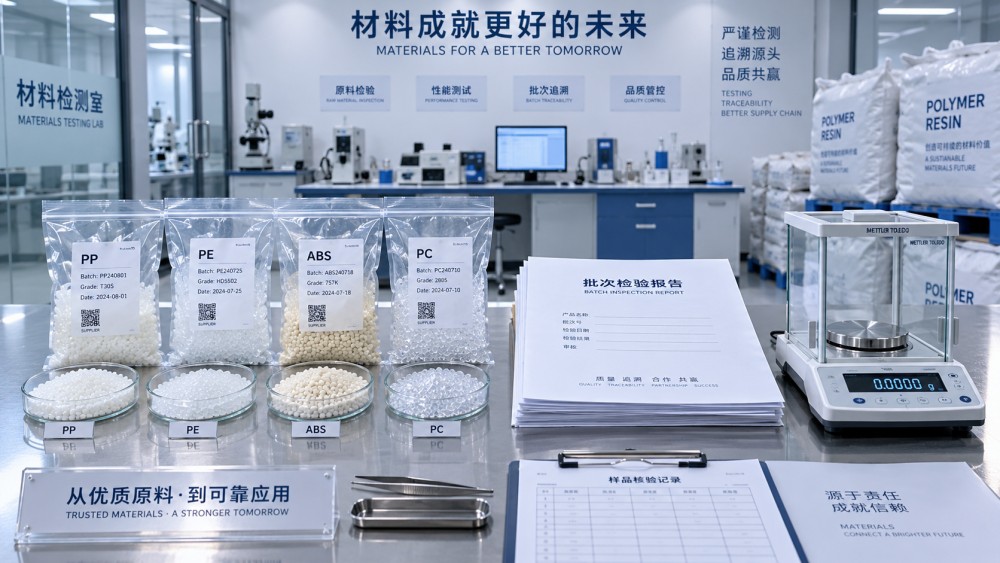
Trace the chain from producer and production lot through any repacking or distribution step to the delivered package. Ask how original lot identifiers are preserved when bags are split, relabeled, or combined into a shipment. If several production lots are included, their identities and supporting documents should remain distinguishable.
During trials, record drying conditions, processing temperatures, tooling or line settings, and observed defects. Polyamide moisture condition, for example, affects both processing and measured properties. An uncontrolled trial can wrongly attribute a processing problem to material quality, or conceal a material difference through compensating machine adjustments.
Match trial depth to the consequence of failure. A visual evaluation of sample pellets cannot qualify a compound for a demanding mechanical or electrical application. Relevant testing should address the properties that determine acceptance, with independent testing where supplier evidence leaves a material uncertainty. Preserve retained samples when later batch comparisons would be useful.
Verify availability separately from production capability
A catalog entry does not establish current stock. Ask whether the exact grade and color are available, reserved, scheduled for manufacture, or dependent on another source. Request the proposed dispatch location, packaging, minimum order quantity, and delivery basis in writing. For stocked goods, confirm the lot and quantity available; for made-to-order material, establish when production can be scheduled.
Production equipment photographs provide little evidence of grade-specific capacity. A twin-screw extrusion line does not establish competence with every polymer or additive package. For a custom compound, discuss experience with comparable processing temperatures, reinforcement handling, contamination control, and the relevant quality measurements. A facility visit or targeted audit is justified when these unresolved details could change qualification.
Storage history matters for dated or moisture-sensitive products. Confirm remaining shelf life for adhesives and the packaging condition of hygroscopic resins. Where storage excursions could affect performance, request the relevant history and disposition records. Old inventory and current production should not be treated as interchangeable without reviewing the material’s storage requirements.
Also agree how formulation, feedstock, site, and grade changes will be communicated. An undocumented substitution after sample approval can invalidate the original evaluation. The quotation and order should identify which changes require review before shipment.
Make the verification result usable in an order decision
Keep a compact evidence record linking each material claim to its source, date, and remaining gap. Use clear statuses such as confirmed, awaiting clarification, or contradicted. A polished listing with contradictory grade documents should remain on hold; a sparse listing supported by consistent identity records and traceable samples can justify further qualification.
Proceed to an order only when the evidence supports the exact transaction: the contracting entity is established, the grade and acceptance requirements are agreed, qualification results are applicable, and the shipment can be traced. An unexplained beneficiary, altered document, or refusal to identify the production source is grounds to pause until the discrepancy is resolved.
Put the verified details into the purchase specification, including the full grade designation, permitted color or formulation, agreed release limits, required batch documents, packaging, and substitution controls. This turns the verification work into terms that can be compared with the shipment received. Revisit the affected evidence whenever the source, grade, production site, or supply arrangement changes.
Have questions about this sector analysis, or seeking best practices specific to your niche? Drop us a line below and let the senior consultants at APIM assist you.
We respect your privacy. Your information is strictly confidential.
Related News
- 00
0000-00
Do polyolefin hot melt adhesives bond well to polyethylene? - 00
0000-00
Korean Study Finds PLA Barely Degrades in Landfill After 320 Days - 00
0000-00
How to assess batch consistency from a thermal potting compounds supplier - 00
0000-00
How much weight can carbon fiber reinforced plastics save in cars? - 00
0000-00
Switching from PS to ABS Sheet Extrusion: Equipment Checks