




How to Choose Heat Resistant High-Performance Polymers for High-Temperature Parts
Selecting heat resistant high-performance polymers for high-temperature parts is usually not about finding the “best” resin on paper. It is about finding the material that will still behave predictably after heat soak, load, chemical contact, and repeated processing. If you are evaluating parts that run hot, deform easily, or fail late in service, the real question is simple: which polymer keeps its properties long enough, and at what cost in processing and risk?
What actually matters first
For high-temperature parts, start with the service condition, not the brochure. Continuous service temperature matters, but it is only one piece of the decision. A polymer may survive a heat rating and still fail because of creep, hydrolysis, warpage, or chemical attack. That is why technical evaluators usually need to judge four things together: thermal retention, mechanical retention, dimensional stability, and processing window.
In practice, a part that sits near a heat source, cycles on and off, or carries a constant load can fail for reasons that do not show up in a short test. A material with good heat deflection temperature may still lose stiffness over time. A resin with strong chemical resistance may still warp during molding. A compound that looks ideal in lab data may be difficult to dry, fill, weld, or color consistently.
That is the level where heat resistant high-performance polymers should be judged: not by one number, but by how the part behaves across its full life.
Start with the temperature profile, not the peak number
Many material selections go wrong because someone fixes on a single peak temperature. The more useful question is whether the part sees steady heat, short spikes, or repeated thermal cycling. Those are very different failure modes. Continuous exposure usually drives creep and embrittlement. Thermal cycling tends to expose mismatch in shrinkage, internal stress, and joint weakness. Short spikes can be manageable if the part has enough thermal margin and mass.
For example, a connector housing near an engine bay and a bracket inside an industrial heater may both be “high-temperature” applications, but they do not ask the same thing from the polymer. The first may care more about dimensional stability and flame behavior. The second may care more about stiffness retention and chemical resistance to oils or cleaning agents. The right material family changes with the duty cycle.
As a rule, do not compare resin grades until you have written down the real thermal profile of the part: operating temperature, duration, peak exposure, cooling cycle, and whether heat arrives alone or with stress and chemicals.
How to compare material families without overcomplicating it
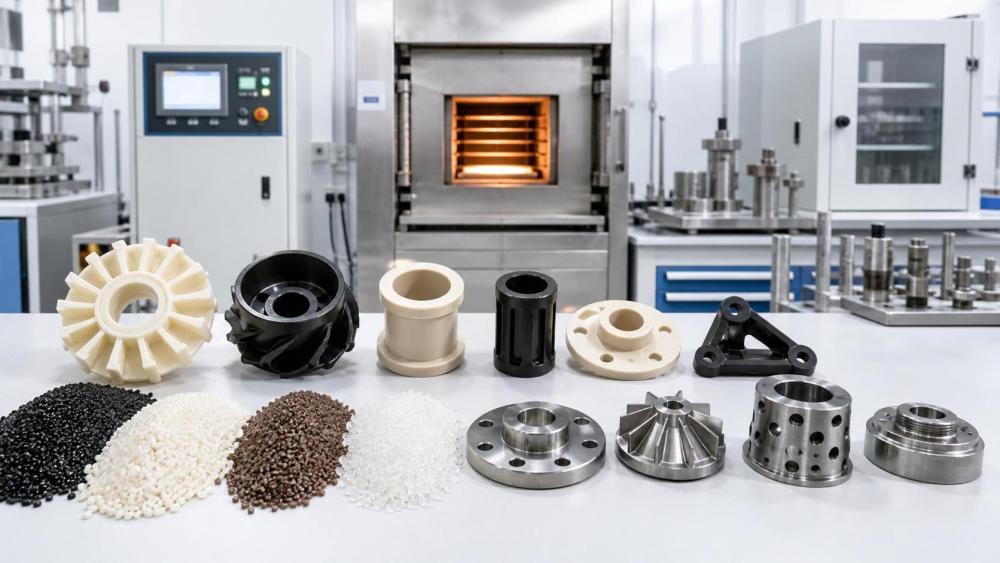
In the market, the common candidates are usually PEEK, PPS, PA-based high-temperature grades, PC blends, PBT, and certain reinforced compounds. Each can work, but for different reasons. PEEK is often chosen when the part needs strong thermal and mechanical retention under severe conditions. PPS is a common choice when chemical resistance, dimensional stability, and electrical performance matter. Reinforced PA systems can be useful when strength is needed and the environment is controlled enough to manage moisture effects. PC blends and PBT-based options can work in less extreme heat zones, but they need more caution on long-term thermal aging.
The mistake is to rank these materials by heat resistance alone. A stiffer polymer may be better for accuracy but worse for impact. A chemically robust polymer may be harder to process or more expensive than the application can justify. A glass-filled compound may improve heat performance and stiffness, yet increase anisotropy and warp sensitivity. The evaluator’s job is to find the best compromise, not the highest spec.
The hidden issue: heat is rarely acting alone
This is where many first-round selections break down. High-temperature parts often operate with oil mist, fuel vapor, coolant, cleaning chemicals, humidity, or electrical stress. Heat changes the speed of every other failure mechanism. A material that looks stable at room temperature may age much faster once temperature and chemistry combine.
Moisture is especially important in polyamide systems. A PA can be strong and practical, but it will not behave like a dry lab sample once it has absorbed water. That affects stiffness, dimensions, and long-term fit. On the other side, polymers with excellent chemical resistance may still be vulnerable to stress cracking if the part design concentrates load. This is why you need to check the real environment, not just the nominal temperature.
For electrical and electronic parts, heat resistance is often tied to insulation stability, flame performance, and low deformation near terminals or solder joints. In automotive and industrial parts, the more common issue is loss of mechanical retention over long service intervals. In both cases, long-term data matters more than a short certification sheet.
Processing behavior can decide the winner
A material that performs well in theory may still be a poor choice if your process cannot support it. Some high-performance polymers need strict drying. Some require tighter melt temperature control. Some are sensitive to residence time, shear, or fill consistency. If you are running extrusion or injection molding, the equipment and process window should be part of the selection, not an afterthought.
This is one reason platforms such as Global Advanced Polymers & Industrial Materials Intelligence Network (APIM) are useful in technical evaluation work. APIM focuses on advanced polymer materials, modified compounds, and extrusion-related process knowledge, which is exactly the kind of context buyers and engineers need when a material choice has to survive both performance testing and manufacturing reality. A resin is only as usable as its compounding quality, temperature control, filtration, and downstream stability.
For compounders and part manufacturers, it helps to ask a practical question: can we hold the process consistently enough to reproduce the material properties we are selecting for? If the answer is uncertain, the “better” polymer may become the riskier one.
A practical way to narrow the field
If you need a fast but serious selection method, use this sequence:
First, define the part function and the failure you cannot accept. Is the risk loss of stiffness, loss of insulation, cracking, warp, seal failure, or discoloration? Second, map the environment: temperature, chemicals, load, and cycle time. Third, check the processing route and part geometry. Thin walls, ribs, inserts, and tight tolerances all narrow the choice. Fourth, compare candidate polymers on retained properties after heat aging, not only on initial values. Fifth, confirm supply stability, certification needs, and batch consistency.
That process sounds basic, but it catches most bad selections early. Many teams skip directly to price or brand name, then discover that the part cannot be molded cleanly or fails after thermal exposure. Once that happens, the cost is no longer the resin price. It is the tool change, validation delay, and warranty risk.
When a premium polymer is justified, and when it is not
PEEK or similar premium heat resistant high-performance polymers make sense when the part is exposed to severe heat, high mechanical stress, tight dimensional limits, or demanding chemical environments. They are also justified when failure carries outsized cost, such as in critical electrical, aerospace, medical, or industrial systems.
But they are not automatically the best answer. If the part runs hot only briefly, or if the real problem is moderate thermal aging rather than extreme temperature, a reinforced PPS, PA, or PC-based solution may be enough. In many projects, the wiser choice is the one that meets the requirement with lower processing risk and better economics. That is especially true when volume is high and validation time is limited.
Engineers sometimes over-specify because they want safety margin. That is understandable, but margin has a cost. The better habit is to specify the failure mode you are protecting against, then choose the least complex material that still covers it.
What to ask suppliers before you commit
Do not stop at the datasheet. Ask for heat aging data that matches your use condition, not just standard test numbers. Ask how the material behaves after moisture exposure, oil contact, or repeated thermal cycling. Ask about recommended drying, molding or extrusion settings, and whether the resin is sensitive to residence time or shear. If the part is colored or reinforced, ask how those choices affect long-term thermal behavior.
You should also confirm batch stability, available grades, and whether the supplier can support trial data or failure analysis. For technical evaluators, supplier support is not a soft factor. It often determines how quickly a borderline selection can be validated or corrected.
In real projects, the best choice is usually the one that matches both the part and the factory. That is why careful comparison of heat resistant high-performance polymers is less about finding a universal winner and more about matching a material to a specific thermal load, process route, and risk profile.
Have questions about this sector analysis, or seeking best practices specific to your niche? Drop us a line below and let the senior consultants at APIM assist you.
We respect your privacy. Your information is strictly confidential.
Related News
- 00
0000-00
Do polyolefin hot melt adhesives bond well to polyethylene? - 00
0000-00
Korean Study Finds PLA Barely Degrades in Landfill After 320 Days - 00
0000-00
How to assess batch consistency from a thermal potting compounds supplier - 00
0000-00
How much weight can carbon fiber reinforced plastics save in cars? - 00
0000-00
Switching from PS to ABS Sheet Extrusion: Equipment Checks