




How to Choose Chemical Resistant Plastics for Pumps by Media and Temperature
How to Choose Chemical Resistant Plastics for Pumps by Media and Temperature
Choosing chemical resistant plastics for pumps requires more than checking a resin name.
Media composition, concentration, temperature, pressure, and service time all shape real performance.
A plastic that survives water service may fail quickly in hot acid, oxidizers, or solvent blends.
That is why chemical resistant plastics for pumps should be selected through operating conditions, not generic material reputation.
This guide explains how to compare plastics by media and temperature, reduce failure risk, and support better pump material decisions.
Start With the Fluid, Not the Polymer Name
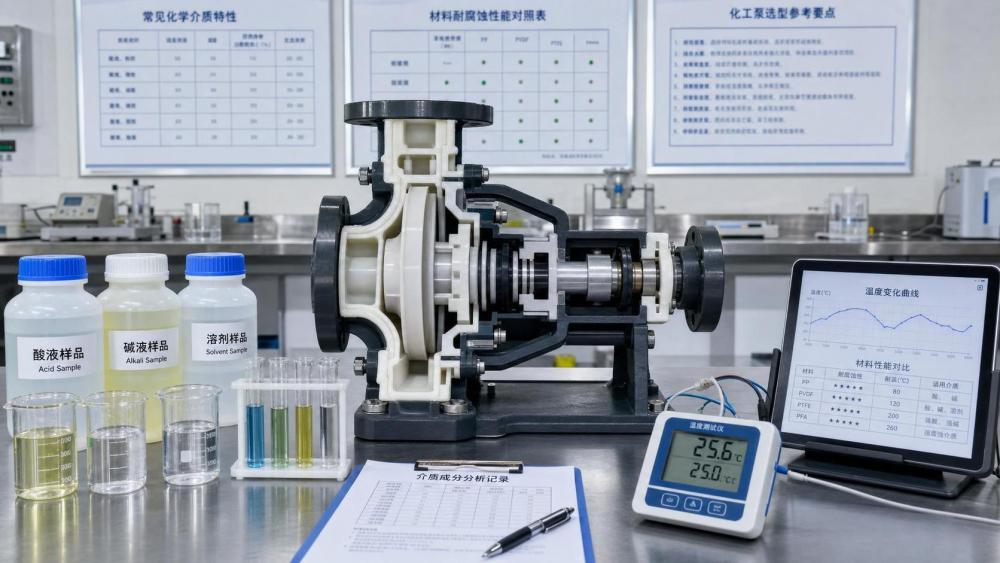
The first step in choosing chemical resistant plastics for pumps is defining the media in full detail.
Do not stop at labels like acid, alkali, or solvent.
A 10% sodium hydroxide solution behaves differently from a concentrated caustic stream at elevated temperature.
Mixed media also changes the picture.
For example, trace oxidizers, suspended solids, or cleaning additives can shift compatibility fast.
In practical assessment work, gather these inputs before comparing materials:
- Exact chemical name and concentration range
- Operating and upset temperature
- Pressure, flow rate, and possible cavitation
- Continuous or intermittent exposure time
- Cleaning cycle chemicals and flush conditions
- Presence of particles, abrasion, or UV exposure
This information creates a usable basis for selecting chemical resistant plastics for pumps with fewer blind spots.
How Temperature Changes Chemical Resistance
Temperature is often the real separator between a workable polymer and an early failure.
Many chemical resistant plastics for pumps look acceptable at room temperature.
At higher temperatures, diffusion speeds up, mechanical strength drops, and chemical attack becomes more aggressive.
This is especially important with hot alkalis, chlorinated chemicals, and organic solvents.
A common mistake is using compatibility charts without checking the test temperature.
Another mistake is focusing only on short-term immersion data.
Pump components experience stress, pressure cycling, and long service intervals.
That means the right choice should handle both chemistry and thermal aging.
As a rule, when temperature rises, narrow your shortlist and ask for application-specific data, not broad catalog claims.
Common Plastic Options for Pump Chemical Exposure
Several polymers appear frequently in pump housings, impellers, liners, wear parts, and wet-end components.
Each has a different balance of chemical resistance, temperature capability, stiffness, and cost.
PP and PE
Polypropylene and polyethylene are widely used chemical resistant plastics for pumps handling many acids and alkalis.
They offer good corrosion resistance and favorable cost.
Their limits usually appear with higher temperatures, stronger oxidizers, and dimensional demands.
PVDF
PVDF is a strong candidate for aggressive chemicals and higher temperature service.
It is often chosen when users need broader chemical compatibility than PP can offer.
It also performs well in many ultrapure and semiconductor-related systems.
PTFE and Modified Fluoropolymers
PTFE is known for very broad chemical resistance.
For pump applications, it is often used in liners, seals, and specialty components rather than fully structural parts.
The reason is simple.
Its mechanical behavior under load and creep must be evaluated carefully.
PPS, PEEK, and Other Engineering Plastics
Higher-end engineering plastics may fit demanding chemical and thermal conditions.
Still, chemical resistant plastics for pumps in this category should never be approved by temperature rating alone.
Some solvents, acids, or steam exposure can create issues despite strong mechanical properties.
Match the Material to the Media Family
A practical selection process works better when chemicals are grouped by behavior.
This does not replace testing, but it improves early screening.
This kind of table helps narrow chemical resistant plastics for pumps quickly, especially during early technical comparison.
Look Beyond Compatibility Charts
Compatibility charts are useful, but they are only a starting point.
In real pump service, failure rarely comes from chemistry alone.
Stress concentration, bolt load, vibration, and thermal cycling often expose weak choices.
That is why chemical resistant plastics for pumps should be checked against these risks:
- Swelling that changes tolerances or impeller clearance
- Creep under continuous mechanical load
- Permeation that affects safety or emissions
- Stress cracking from combined chemical and structural load
- Abrasion from slurry or suspended particles
- Loss of impact strength at service temperature
From a decision standpoint, a slightly more expensive polymer may cut maintenance, downtime, and replacement frequency significantly.
Build a Shortlist With a Practical Evaluation Method
A structured method keeps material selection grounded and easier to defend internally.
- Define the exact media, concentration, and operating temperature window.
- Screen chemical resistant plastics for pumps using trusted compatibility data.
- Remove options with weak thermal margin or known stress cracking risk.
- Check mechanical needs such as stiffness, wear, and dimensional stability.
- Review fabrication route, weldability, machining limits, and lead time.
- Request supplier data for long-term exposure, not only short lab tests.
- Validate critical choices through field history or targeted testing.
This approach works well when comparing PP, PVDF, PTFE, and engineered compounds for the same pump duty.
Typical Selection Mistakes to Avoid
Some material failures are predictable because the same mistakes repeat across projects.
- Approving a resin grade based only on generic chemical resistance tables
- Ignoring startup, cleaning, or upset temperature spikes
- Using room-temperature data for hot chemical service
- Missing the effect of mixed media or low-level contaminants
- Treating seals, liners, housings, and impellers as one material problem
- Optimizing only for purchase cost instead of service life
In many cases, the best chemical resistant plastics for pumps differ by component, even within the same unit.
Final Decision Criteria for Reliable Pump Service
The strongest material decision balances chemical resistance, temperature margin, mechanics, and lifecycle cost.
No single polymer is best for every chemical system.
That is the core reason chemical resistant plastics for pumps should be evaluated by media family, real concentration, and actual operating temperature.
For routine corrosive service, PP or PE may be enough.
For hotter or more aggressive media, PVDF or fluoropolymer-based solutions often make more sense.
For specialized duties, advanced engineering plastics may deserve a closer look, but only with application data behind them.
A practical next step is to build a short comparison sheet for each pump component, then verify the top candidate with supplier evidence and service-specific testing.
That process leads to more reliable pump operation, fewer surprises in the field, and better long-term value from chemical resistant plastics for pumps.
Have questions about this sector analysis, or seeking best practices specific to your niche? Drop us a line below and let the senior consultants at APIM assist you.
We respect your privacy. Your information is strictly confidential.
Related News
- 00
0000-00
NAPCOR Report: US PET Bottle Recycling Rate Fell to 29% in 2025 - 00
0000-00
How does washing affect contamination in post-consumer recycled PP resins? - 00
0000-00
How does feedstock affect depolymerization equipment selection? - 00
0000-00
US Sets 213.44% Preliminary Antidumping Deposit on Chinese PTMEG - 00
0000-00
When should epoxy be used as a thermal interface material for semiconductors?