




How does thickness affect UL 94 ratings for EMI shielding plastics?
An EMI shielding plastic does not carry the same UL 94 classification at every wall thickness. A grade reported as V-0 at a specified thickness may achieve a different result when tested thinner, and its shielding performance may also change. For evaluators comparing electromagnetic shielding plastics UL94 information, the decision starts with matching the documented test thickness and material configuration to the thinnest relevant section of the proposed part.
There is no universal minimum thickness that guarantees a V-0 rating for conductive plastics. The result depends on the exact compound, including its polymer, conductive fillers and flame-retardant system, as well as the conditions of the applicable test. A published classification is a useful material-screening tool, but it is not, by itself, approval of a finished enclosure.
What a thickness-specific UL 94 rating tells you
UL 94 is a set of flammability tests used to classify how plastic specimens behave when exposed to a small flame under specified laboratory conditions. For rigid materials used in electronic housings, the vertical burning classifications V-0, V-1 and V-2 are commonly encountered. These classifications consider behavior such as afterflame time and whether flaming particles ignite an indicator beneath the specimen.
V-0 generally represents more restrictive vertical burning performance than V-1 or V-2 under the relevant test criteria. It does not mean that the material is noncombustible, will never drip, or will extinguish under every fire condition. Nor does it establish how much electromagnetic interference the material can block.
When a material document states, for example, “V-0 at 1.5 mm,” the thickness is part of the reported result. It should not be read simply as “V-0 plastic.” A design with a thinner wall needs supporting classification data at an appropriate thickness; the result at 1.5 mm alone does not establish the result at 1.0 mm.
The reverse also requires care. A result at a thinner test thickness can be useful when evaluating a thicker section, but acceptance should follow the applicable material recognition and end-product requirements. Do not assume that a single data-sheet entry covers every thicker geometry, color or material variant.
Why reducing thickness can change the burning result
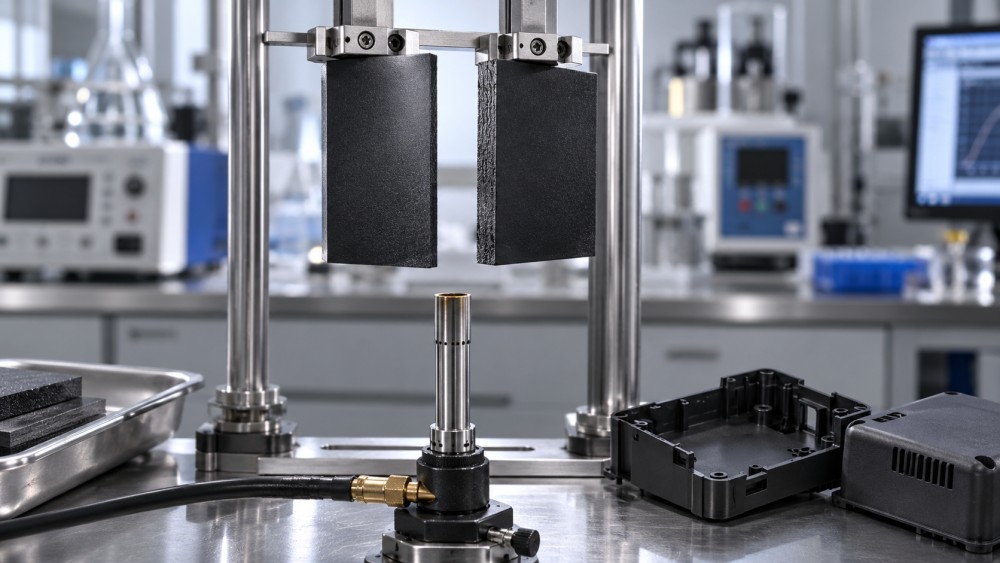
Thickness changes how a specimen heats, melts and burns. A thinner section has less material through its thickness and can heat through more quickly under a flame. It may also soften, shrink, deform or separate differently from a thicker specimen. Those changes affect whether combustion continues after the flame is removed and whether molten material falls from the specimen.
A thicker section is not automatically better in every respect. It can contain more combustible material and may sustain different melting or dripping behavior. The direction and size of the effect depend on the formulation and the test. For this reason, engineers should use the reported classification at the relevant thickness rather than extrapolate from a general rule about thin or thick walls.
Flame-retardant systems add another layer of complexity. Depending on the chemistry, they can act in the condensed material, in the gas phase, or through a combination of mechanisms. Changing thickness can alter how heat is absorbed, how a protective layer forms and how material moves during burning. A formulation optimized for one wall range may not retain the same classification when the wall is reduced.
Conductive fillers affect both shielding and flammability
EMI shielding compounds are formulated to interact with electromagnetic fields, often by creating an electrically conductive network within the polymer. Conductive carbon, carbon fibers, metal-based fillers and other additives can influence that network. Their type, loading, dispersion and orientation can also affect melt flow, mechanical properties and flame behavior.
There is no reliable shortcut from filler type to UL 94 classification. A conductive filler may change how heat moves through a specimen, alter melt strength or interact with the flame-retardant package. It can also change dripping behavior. A compounder may need to balance these effects against processing requirements and the shielding target.
Two compounds based on the same polymer family should therefore be treated as separate materials. A flame-retardant PC grade and a conductive, flame-retardant PC compound may share a resin family but have different UL 94 results. Adding a conductive masterbatch or another additive at the molding machine can likewise create a formulation that is not covered by the original grade’s documented classification.
Shielding effectiveness is a separate measurement. It depends on frequency, test method and specimen or enclosure configuration, among other factors. A material can have a favorable flame classification and inadequate shielding for the intended application, or provide useful shielding without meeting the required flame classification at the target thickness.
Translate the molded part into a defensible thickness requirement
Start with the drawing and identify the minimum relevant wall thickness, including tolerance. A nominal wall is not necessarily the thinnest section produced in the tool. Local thinning around bosses, transitions, gates or cosmetic features may matter, depending on the part’s function and the end-product evaluation.
For example, consider an electronic enclosure specified with a nominal wall of 1.5 mm and a locally thinner feature. A material rated V-0 at 1.5 mm supports screening at that stated thickness; it does not establish V-0 performance for the thinner feature. The engineering team needs to determine which sections are relevant under the applicable product requirements and compare those sections with the material’s documented classifications.
Design changes made to improve assembly can also alter the assessment. Adding ribs, varying wall thickness or relocating a gate can change flow and fiber orientation. This may affect shielding consistency and part quality even when the resin grade remains unchanged. A material test specimen and a molded enclosure do not necessarily have the same shape, orientation or local structure.
Where the design is close to a classification limit, a practical approach is to compare a slightly thicker wall, a different compound and an alternative shielding architecture before freezing the tool. Each option has trade-offs: more wall thickness may affect weight and cooling time, while a different compound may change stiffness, impact behavior, cost or supply availability.
What to request from a supplier
A technical data sheet is a starting point, not the complete qualification package. Ask for documentation that connects the exact material being purchased to the flame classification needed for the design. The following details are particularly useful:
- Exact grade and formulation: Confirm the commercial grade, conductive filler system and whether the supplied material is a ready-to-mold compound or requires additions during processing.
- Classification and test thickness: Obtain the UL 94 classification at the relevant thickness, including the test orientation or classification family. HB and V classifications are not interchangeable descriptions of the same test.
- Color and other recognized variations: Check that the proposed color and any material variations fall within the scope of the documented recognition or test report. Do not assume that a natural or black grade covers every color.
- Document type and scope: Distinguish a supplier data sheet or laboratory report from a UL material recognition record. Ask for the applicable file or record identifying the grade and covered conditions when formal recognition is required.
- Shielding test information: Request the frequency range, test method, specimen thickness and sample configuration behind any shielding claim. A single shielding value without those conditions is difficult to compare.
- Processing conditions: Obtain recommended drying and molding guidance, and discuss how regrind, additives or changes in processing may affect the qualified material and finished part.
Regrind deserves particular attention because a published classification for a material does not automatically establish coverage for any proportion of reused material. Confirm what the relevant recognition and product evaluation permit, and control the actual production practice accordingly. The same applies to color concentrates, processing aids and recycled content added after the compound has been qualified.
Material classification is not finished-product compliance
UL 94 results are obtained from standardized specimens under controlled conditions. An enclosure in service may experience different ignition sources, heat exposure, airflow and mechanical constraints. Seams, fasteners, labels, coatings and nearby components can also affect the completed product, even though they are not represented by a bare material specimen.
Product standards may specify acceptable material classifications, minimum thicknesses or alternative component and end-product tests. The applicable requirements depend on the product and its intended market. A V-0 material selection can support the evaluation, but it does not replace the tests or construction review required for the finished equipment.
Coated plastics illustrate the distinction. A metal-coated enclosure can provide shielding through its coating rather than through a conductive bulk compound. The substrate’s UL 94 rating is still relevant to material selection, but it does not automatically describe the fire behavior or compliance of the coated assembly. Coating continuity, adhesion, seams and grounding also need to be evaluated for shielding performance.
A practical decision sequence
Set the required flame classification and identify the relevant minimum wall thickness before comparing grades. Then shortlist exact compounds with documentation covering those conditions, and compare shielding data using comparable frequencies and test configurations. Review mechanical properties, molding behavior and availability alongside those two requirements; none can be assumed from the polymer family alone.
Before production release, align the material record, drawing, processing plan and product-level evaluation. If the wall thickness, color, additive package or supplier changes, revisit the evidence for the specific change. That discipline prevents a common qualification gap: a part that resembles the approved design but no longer matches the material or thickness on which the original decision was based.
Have questions about this sector analysis, or seeking best practices specific to your niche? Drop us a line below and let the senior consultants at APIM assist you.
We respect your privacy. Your information is strictly confidential.
Related News
- 00
0000-00
Do polyolefin hot melt adhesives bond well to polyethylene? - 00
0000-00
Korean Study Finds PLA Barely Degrades in Landfill After 320 Days - 00
0000-00
How to assess batch consistency from a thermal potting compounds supplier - 00
0000-00
How much weight can carbon fiber reinforced plastics save in cars? - 00
0000-00
Switching from PS to ABS Sheet Extrusion: Equipment Checks