




Depolymerization Chemical Recycling: Cost Drivers, Yield Risks, and Scale-Up Reality
Depolymerization Chemical Recycling: Cost Drivers, Yield Risks, and Scale-Up Reality
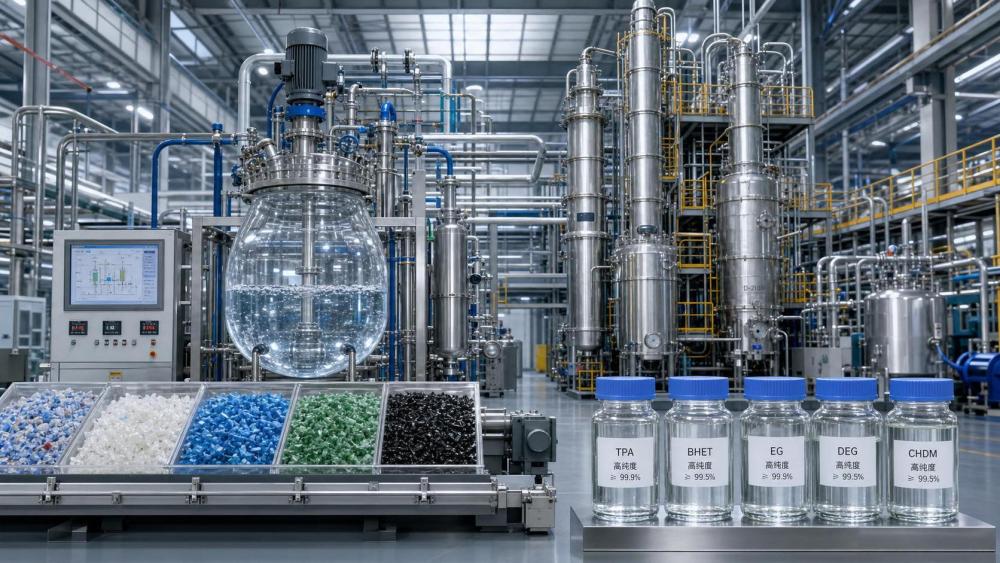
Depolymerization chemical recycling gets attention because it promises to recover monomers from plastic waste.
That sounds simple on paper. In practice, the economics are shaped by feedstock quality, purification load, energy demand, and plant utilization.
For procurement and investment decisions, chemistry is only one part of the story.
The harder question is whether depolymerization chemical recycling can produce stable output, at predictable cost, from inconsistent waste streams.
That is where many projects move from pilot optimism to commercial friction.
Why depolymerization chemical recycling looks attractive
Unlike mechanical recycling, depolymerization chemical recycling aims to break polymers back into monomers or intermediate building blocks.
This creates a route for materials that lose value in conventional reprocessing.
PET, polyamides, polyurethane systems, and some specialty polymers are frequent targets.
The business appeal is clear.
- Recovered monomers may support near-virgin material quality.
- Brand owners may count recycled content in regulated applications.
- Difficult waste streams may gain a higher-value outlet.
- Supply chains may reduce exposure to virgin resin volatility.
Still, depolymerization chemical recycling is not automatically a premium business.
Its value depends on whether recovered output can compete with virgin raw materials after collection, sorting, reaction, purification, and compliance costs.
The main cost drivers behind commercial performance
From a cost perspective, depolymerization chemical recycling is usually limited by five variables.
1. Feedstock preparation
Waste plastics rarely arrive clean, sorted, and compositionally stable.
Labels, pigments, multilayer structures, fillers, moisture, metals, and incompatible polymers all increase treatment cost.
In many projects, preprocessing is underestimated because it sits outside the reactor headline.
2. Reagent and catalyst consumption
Depolymerization chemical recycling often depends on solvents, glycols, alcohols, water systems, catalysts, or proprietary additives.
Losses in these inputs can quickly change unit economics.
Catalyst recovery efficiency matters more at scale than in pilot campaigns.
3. Energy and utility demand
Heating, pressure control, solvent recovery, distillation, drying, and wastewater treatment can dominate the operating profile.
This is especially true when the target product requires high purity.
4. Purification and quality assurance
The market does not buy chemistry claims. It buys specification compliance.
Recovered monomers must meet impurity, color, odor, and consistency thresholds.
Analytical testing, off-spec handling, and rework loops add real cost.
5. Plant uptime and throughput
A process can look profitable on a nameplate basis and fail on an annualized basis.
Feed interruptions, fouling, corrosion, cleaning cycles, and unstable reaction conditions reduce effective capacity.
That gap is one of the biggest reasons depolymerization chemical recycling economics disappoint.
Yield risks are usually larger than early models suggest
Yield is not just a chemistry number.
In depolymerization chemical recycling, commercial yield includes recoverable output, usable purity, solvent losses, side products, and off-spec volumes.
That broader definition changes the financial picture quickly.
Common yield risks include:
- Variable polymer composition within incoming bales.
- Additives that create unwanted reaction products.
- Colorants and fillers that burden separation steps.
- Moisture and contamination that reduce conversion efficiency.
- Thermal degradation during pretreatment or residence time excursions.
More importantly, low yield does not always show up as a dramatic failure.
It often appears as small losses across multiple steps.
Those losses compound through material balance, utility intensity, and purification cost.
Feedstock variability is the commercial bottleneck
This is the issue many executives underestimate at first.
Depolymerization chemical recycling can be technically sound and still struggle because the feedstock system is weak.
A stable reactor needs a stable input envelope.
That means sourcing strategy matters as much as process design.
In real procurement terms, the cheapest waste source is often not the lowest-cost feedstock.
Consistency usually beats spot-price bargains.
Scale-up reality: pilot data does not equal plant economics
Scale-up is where depolymerization chemical recycling faces its hardest commercial test.
Lab systems often use clean feed, careful supervision, and narrow operating windows.
Industrial plants deal with wider variability, longer runtimes, stricter maintenance schedules, and harsher impurity loads.
From recent market movement, the more telling signal is not pilot success.
It is whether a project can sustain output quality for months, not weeks.
Scale-up risk usually shows up in four areas:
- Heat and mass transfer behave differently at larger volumes.
- Impurity accumulation creates fouling and side reactions.
- Solvent recovery systems become more energy sensitive.
- Quality assurance protocols become tighter once customers qualify supply.
This also affects financing.
Lenders and strategic buyers usually want proof of stable throughput, not only theoretical output cost.
How to evaluate a depolymerization chemical recycling supplier or project
In actual business reviews, a few questions separate promising projects from expensive experiments.
- What exact feedstock specification is required, and how often does incoming material fall outside it?
- What is the commercial yield after purification, not just reactor conversion?
- How much output is sold into high-value applications versus downgraded channels?
- What are the solvent recovery rates, catalyst replacement cycles, and wastewater loads?
- How many continuous operating days has the system achieved at target quality?
- What customer approvals, regulatory documents, and traceability systems are already in place?
These questions matter because depolymerization chemical recycling is ultimately a manufacturing business.
It must be judged on repeatability, specification control, and delivered cost.
Where depolymerization chemical recycling makes the most sense
Not every plastic stream is a good fit.
The strongest cases usually share three traits.
- The waste stream is relatively concentrated and traceable.
- Recovered monomer value is materially higher than mechanical recycling output.
- End markets require performance or compliance that favors chemically recovered feedstock.
That is why depolymerization chemical recycling often looks more credible in selected polyester, polyamide, or industrial scrap loops.
It is usually less convincing when feedstock is highly mixed and output pricing is exposed to commodity resin pressure.
A practical decision framework
Depolymerization chemical recycling can be commercially relevant, but only under disciplined operating conditions.
The winning projects are rarely the ones with the most ambitious claims.
They are usually the ones with controlled feedstock, realistic yield accounting, strong purification design, and proven uptime.
For sourcing, partnerships, or capital decisions, the practical test is straightforward.
Can the depolymerization chemical recycling system deliver specification-grade output, at dependable cost, through normal operating variability?
If the answer is still based on pilot assumptions, the business case is not ready.
If the answer is supported by plant data, feedstock contracts, and quality records, the opportunity becomes much more real.
Have questions about this sector analysis, or seeking best practices specific to your niche? Drop us a line below and let the senior consultants at APIM assist you.
We respect your privacy. Your information is strictly confidential.
Related News
- 00
0000-00
How does washing affect contamination in post-consumer recycled PP resins? - 00
0000-00
How does feedstock affect depolymerization equipment selection? - 00
0000-00
US Sets 213.44% Preliminary Antidumping Deposit on Chinese PTMEG - 00
0000-00
When should epoxy be used as a thermal interface material for semiconductors? - 00
0000-00
US Midterm Results Unlikely to Quickly Shift Recycled Plastics Market or Legislation