




When is UV-curing adhesive bonding suitable for packaging films?
UV-curing adhesive bonding is suitable for packaging films when sufficient radiation reaches the adhesive, the formulation bonds reliably to the actual film surfaces, and the cured layer meets the package’s mechanical, chemical, and regulatory requirements. Its strongest application case is a film construction that permits controlled irradiation and benefits from rapid bond development without a drying oven or prolonged thermal exposure.
The critical qualification is that visible transparency does not establish UV-curing suitability. A clear film can absorb the wavelengths needed by the adhesive, while a well-cured adhesive can still adhere poorly to a treated polyolefin or crack during pouch flexing. Selection therefore depends on the complete film–adhesive–process combination, not on the adhesive’s cure speed alone.
The first decision is whether light can reach the entire bond line
For an adhesive cured after two films are brought together, at least one side of the construction must transmit enough radiation at the wavelengths that activate the formulation. The relevant optical property is spectral transmission through the actual incoming material, including coatings, printing, primers, and additives—not simply the nominal polymer type.
PET, PE, and PP films cannot be assigned a universal “UV-compatible” designation. Their transmission depends on grade, thickness, stabilizers, pigments, and surface layers. A supplier’s transmission curve is useful for screening, but the production construction should be checked at the intended curing wavelength.
Printing creates a particularly important distinction. An unprinted web may transmit adequately, while a dense white ink, dark graphic, or overlapping color blocks can shield parts of the adhesive. These areas can remain undercured even when adjacent transparent regions develop satisfactory strength. Qualification must cover the least-transmitting artwork, rather than a convenient clear test strip.
An opaque layer does not automatically rule out UV curing. A clear film bonded to an opaque film may still allow irradiation from the clear side, provided the light reaches the full adhesive thickness. A laminate with opaque layers on both sides, however, has no direct post-lamination irradiation path. That normally excludes conventional through-film UV curing unless a specifically validated alternative process is available.
Pre-irradiating an exposed adhesive before closing the laminate is a different process. It requires a formulation with a suitable open time, retained wetting ability, or controlled post-exposure reaction. An adhesive designed to cure immediately under light cannot simply be cured first and expected to bond afterward.
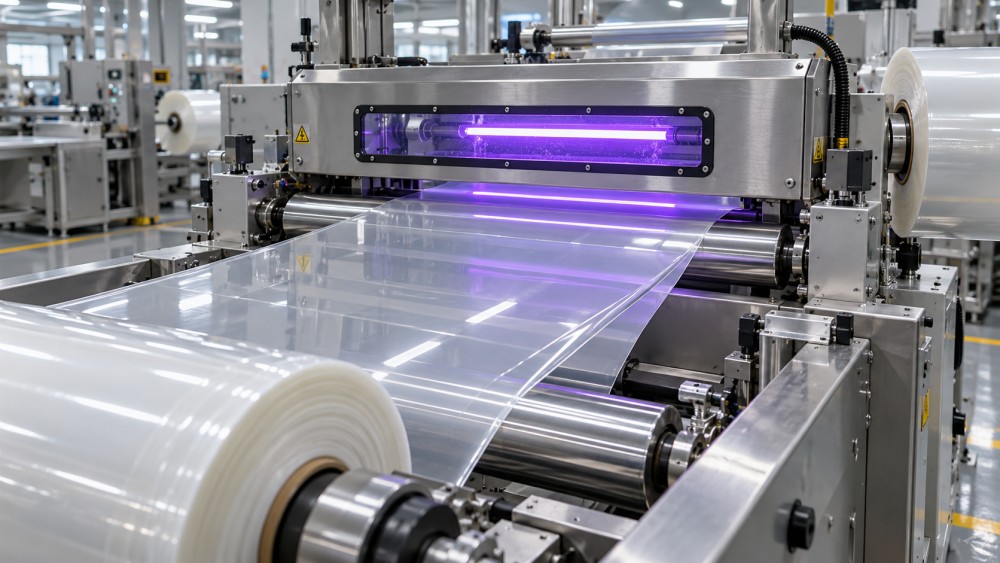
A transparent construction still needs a workable cure window
The adhesive’s absorption characteristics must match the lamp spectrum. A formulation qualified for a broad-spectrum mercury source is not automatically suitable for a narrow-band UV LED source. Substituting lamps without reformulating or requalifying the adhesive can change conversion, surface condition, and final bond performance.
Both irradiance and exposure time matter. Increasing web speed reduces residence time under the lamp, but increasing lamp output does not necessarily restore equivalent performance. Reaction kinetics, oxygen exposure, film absorption, and heat transfer can make two exposures with similar nominal energy produce different results.
The useful process specification is the curing condition achieved at the adhesive layer, not the lamp’s electrical rating. Lamp distance, optical cleanliness, source aging, web position, and transmission through the film all influence that condition. Radiometry should use equipment appropriate to the source spectrum and a defined measurement geometry.
Coating weight also changes the problem. A thicker adhesive layer can improve coverage on an uneven surface but increases the depth that must cure. A thinner layer may cure readily yet leave insufficient adhesive to accommodate surface texture or maintain bond continuity. Coat-weight limits should therefore be established together with optical and adhesion limits.
Two common chemistry families introduce different constraints:
- Free-radical acrylate systems can cure rapidly, but oxygen inhibition can affect exposed adhesive surfaces. Enclosing the adhesive between films reduces atmospheric contact, although trapped oxygen and the timing of irradiation still matter. Polymerization shrinkage and network stiffness also require attention.
- Cationic systems, including certain epoxy-based formulations, are less sensitive to oxygen inhibition and can continue reacting after irradiation. Their cure can nevertheless be affected by moisture and basic contaminants. Continued reaction is not a substitute for initiating the adhesive sufficiently throughout the required area.
These distinctions matter when deciding where to place the lamp, how soon the web can be rewound, and whether immediate handling strength represents the final cured state.
Surface compatibility can reject a system that cures perfectly
PE and PP have low surface energy and commonly need treatment or a suitable primer for reliable bonding. Corona or plasma treatment can improve wetting, but treatment history alone does not establish adhesion. Treatment decay, storage conditions, handling contamination, and additive migration can change the surface presented to the adhesive.
Slip agents and other mobile components are relevant because their concentration at the surface can change after film manufacture. A bond made with freshly produced film may behave differently after the same film has been stored. Testing only freshly treated laboratory samples can therefore overstate the available production window.
Surface-energy measurements help identify wetting problems, but they do not replace bond testing. An adhesive may spread evenly and still have poor interfacial durability. Conversely, raising treatment intensity is not an unlimited remedy: excessive treatment can create a weak surface layer or damage a sensitive film.
For printed or coated films, the weakest interface may be inside the substrate construction rather than between adhesive and polymer. Peel failure can occur within an ink layer, at an ink–film interface, or through a functional coating. Failure analysis should identify where separation occurs before the adhesive formulation is blamed or changed.
The cured adhesive must behave like part of a flexible package
A high initial peel value does not establish suitability for a flexible package. The adhesive must tolerate bending, creasing, sealing operations, transport, and contact with the packaged product without losing the properties that matter to the construction.
A highly crosslinked adhesive may provide chemical resistance yet be too stiff for repeated flexing. A softer formulation may accommodate movement but creep under sustained stress or lose strength at elevated temperature. The correct balance depends on film stiffness, adhesive thickness, pouch geometry, and service temperature.
Cure shrinkage can contribute to curl, residual stress, or appearance defects, especially with thin films and mechanically unbalanced laminates. Web tension and winding conditions can add stress before the adhesive reaches its final properties. A laboratory bond that remains flat as a small coupon may behave differently across a full-width roll.
Heat-sealing resistance needs separate evaluation. Although UV curing can reduce thermal exposure during bonding, the finished laminate may later pass through hot sealing jaws. Local heating and pressure can cause adhesive softening, delamination, distortion, or changes in seal behavior.
Retort, hot-fill, freezing, and exposure to oils, alcohols, acids, or fragrances impose additional demands. UV cure speed provides no evidence of resistance to these conditions. Suitability must be demonstrated with the intended contents or justified simulants, relevant conditioning, and testing after exposure—not only immediately after lamination.
Food-contact feasibility is a formulation-and-package question
For food packaging, “UV cured” is neither an approval category nor proof that reactive substances have been eliminated. Residual monomers, photoinitiators, reaction products, and other constituents may require assessment according to their identity, exposure potential, and applicable market requirements.
A non-food-contact adhesive layer does not remove the need for evaluation. Substances can migrate through some films, and transfer can also occur through set-off during winding or stacking. A transparent layer that transmits curing light is not necessarily an effective migration barrier.
Supplier documentation should identify the intended food-packaging applications, restrictions, recommended curing conditions, and supporting compliance information. A general statement that an adhesive is suitable for packaging does not establish suitability for every food type, storage period, temperature, or layer construction.
Migration testing should represent the finished package and its intended use. A laminate can pass a mechanical test while containing unacceptable residual substances; satisfactory chemical conversion alone also does not establish regulatory compliance. These are related but separate acceptance decisions.
Odor and taint deserve independent attention. A structurally sound bond can still be unsuitable for a sensitive packaged product if residual substances alter its sensory characteristics. Likewise, a low-odor adhesive should not be treated as evidence of low migration.
When UV curing offers an advantage—and when another route is stronger
UV curing becomes attractive when rapid bond development removes a genuine process constraint: for example, when a construction can proceed to a subsequent operation sooner, or when heat-sensitive films cannot tolerate the thermal load of another bonding route. The benefit depends on achieving usable laminate properties, not merely a dry or tack-free adhesive.
Solventless polyurethane lamination is worth comparing where opaque layers prevent irradiation and the production schedule can accommodate bond development. Water-based or solvent-based systems remain options where drying capacity and substrate compatibility support them. Extrusion lamination or thermal bonding may be more appropriate when the material construction and heat tolerance favor those routes.
The comparison should include the whole converting process. UV equipment introduces radiation shielding, source monitoring, maintenance, and possible cooling requirements; mercury-based systems may also require ozone extraction depending on lamp design. Eliminating a drying oven does not make the process free of thermal or operational constraints.
Qualification should demonstrate a production window, not one successful sample
A useful trial uses the intended film grades, representative stored material, actual printing, production coating weights, and realistic web speeds. Testing should deliberately include the least favorable credible combinations: lowest UV transmission, highest qualified adhesive thickness, reduced treatment level, and the lower end of allowable lamp output.
Acceptance should connect curing conditions to measurable package performance. Relevant evidence includes peel strength and failure mode, an analytical measure of cure appropriate to the formulation, resistance after conditioning, appearance, and any required migration or sensory results. A solvent-rub test or a single peel measurement is not sufficient proof of complete cure and end-use suitability.
The production specification should then define controllable limits for incoming film, treatment condition, adhesive application, radiation exposure, and line speed. If artwork changes or a film supplier modifies an additive package, optical transmission and adhesion may need reassessment even when the nominal film type remains unchanged.
UV-curing adhesive bonding technology for packaging is a sound choice when optical access, surface adhesion, cure reliability, and end-use performance overlap within a manageable operating window. If that overlap exists only at unusually slow speed, with freshly treated film, or in unprinted test areas, the construction has not yet demonstrated a robust basis for production.
Have questions about this sector analysis, or seeking best practices specific to your niche? Drop us a line below and let the senior consultants at APIM assist you.
We respect your privacy. Your information is strictly confidential.
Related News
- 00
0000-00
Do polyolefin hot melt adhesives bond well to polyethylene? - 00
0000-00
Korean Study Finds PLA Barely Degrades in Landfill After 320 Days - 00
0000-00
How to assess batch consistency from a thermal potting compounds supplier - 00
0000-00
How much weight can carbon fiber reinforced plastics save in cars? - 00
0000-00
Switching from PS to ABS Sheet Extrusion: Equipment Checks