




When UV curing structural adhesives suit high-speed assembly lines
UV curing structural adhesives are a strong fit for high-speed assembly only when the joint can be exposed to sufficient light, the required bond performance is compatible with the adhesive’s cured network, and the production cell can control the variables that determine dose. Their value is not simply that they cure in seconds. The more important advantage is that cure can be initiated at a defined point in the cycle, allowing parts to be located, bonded, inspected, and released with less waiting time than many moisture-, heat-, or two-component systems.
That advantage disappears when “fast cure” is treated as a substitute for bond design. A UV adhesive that reaches handling strength quickly may still be unsuitable for a joint exposed to sustained peel loading, thermal cycling, humidity, chemicals, impact, or hidden shadow areas. For a structural application, the technical decision should begin with the load path and curing geometry, not the lamp specification or the advertised cure speed.
The best fit is a controlled, light-accessible joint
High-speed assembly lines benefit most when UV curing structural adhesives are used in repeatable joints with reliable optical access. Typical examples include clear or translucent components, small precision assemblies, housings with a light-transmitting window, glass-to-metal bonds, transparent plastics, optical modules, sensor assemblies, medical-device components, and electronics subassemblies where one bonding surface permits UV or visible-light transmission.
In these applications, light curing can shorten the period during which a part must remain in a fixture. This does not necessarily mean that every part can immediately undergo full-service loading. It means the bond can often reach a defined handling condition quickly enough for automated transfer, downstream assembly, or controlled testing. That distinction matters when designing a line: handling strength, final cure, and validated service performance are different release criteria.
A favourable application generally has several characteristics:
- The adhesive is exposed to the required wavelength through at least one substrate or an open bond edge.
- Bond-line thickness is controlled and remains within the adhesive supplier’s recommended curing range.
- The joint is designed primarily for shear or compression rather than sustained peel or cleavage loading.
- The surfaces can be cleaned and presented consistently to the dispensing and curing stations.
- The assembly takt time can accommodate adhesive dispense, part mating, light exposure, inspection, and any required post-cure.
- The environmental and mechanical duty cycle has been evaluated using the final materials, geometry, and curing process.
Where these conditions are present, UV curing can simplify material handling. One-part adhesives avoid mix-ratio drift and pot-life management associated with two-component systems. Cure is delayed until irradiation, which can give automation equipment a workable assembly window without requiring a prolonged clamp time. For compact components produced in high volumes, those process characteristics can be more valuable than the nominal cure time itself.
“Structural” needs to be defined by the actual load case
The term structural is often used too broadly. An adhesive may produce high lap-shear values in a laboratory test while performing poorly in a joint dominated by peel, edge impact, differential thermal expansion, or cyclic flexing. High-speed lines should not qualify UV curing structural adhesives based on a single strength figure.
Joint geometry is central. Adhesives generally perform more predictably when the load is distributed across the bonded area. A well-designed overlap joint, sleeve joint, or supported flange can make effective use of the adhesive’s shear strength. A thin, unsupported edge bonded to a rigid substrate may create peel stress concentrated at the bond boundary, even if the bonded area appears adequate. In such cases, the adhesive may need a tougher formulation, a more flexible network, mechanical support, or a redesigned load path.
Substrate stiffness also changes the decision. Bonding glass, aluminium, stainless steel, polycarbonate, and fibre-reinforced polymers introduces different thermal expansion behaviour. A rigid UV-cured network can be appropriate for dimensionally stable precision parts, but it can accumulate stress when joined materials expand and contract at different rates. A bond that passes an initial strength test may fail after thermal cycling if the formulation lacks sufficient toughness or strain tolerance.
For this reason, the right question is not whether an adhesive is labelled structural. It is whether its cure chemistry, modulus, elongation, adhesion profile, and environmental durability fit the final joint. Acrylic-based light-curing systems often offer rapid cure and broad bonding utility. Cationic systems can provide useful properties in certain applications and may continue curing after exposure, but their process and substrate sensitivities differ. Hybrid or dual-cure chemistries can address inaccessible areas, though they add qualification variables that must be understood rather than assumed.
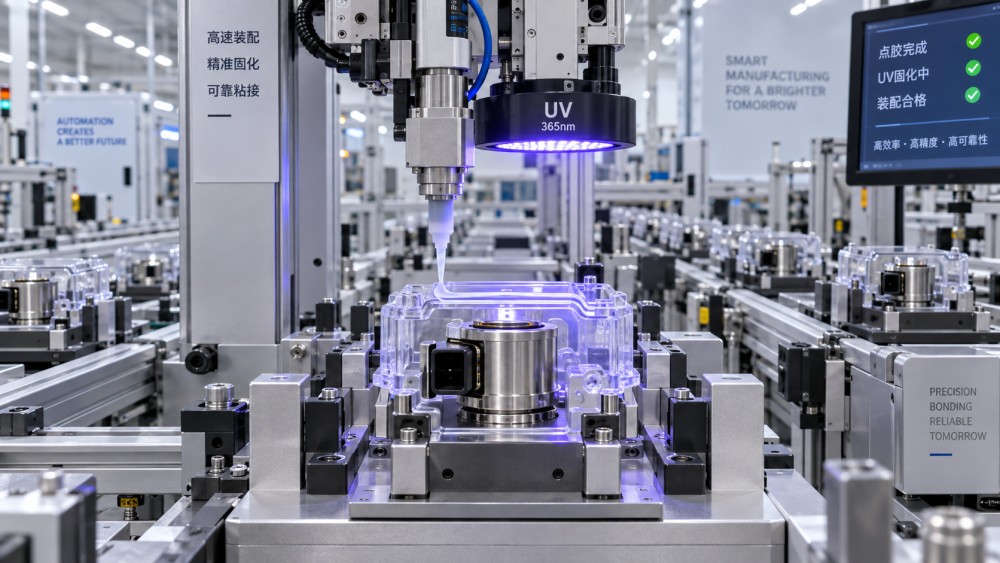
Light access is a process requirement, not a minor design detail
The most common limitation of UV curing is not adhesive strength; it is incomplete energy delivery. UV light does not reliably cure through opaque metals, heavily filled polymers, pigmented plastics, coated surfaces, or deep enclosed geometries. Even nominally transparent materials can attenuate relevant wavelengths because of thickness, additives, surface coatings, colourants, UV absorbers, or optical haze.
A transparent polycarbonate cover, for example, may transmit visible light effectively while blocking much of the UV spectrum needed by a particular adhesive. Glass type matters as well. Some glass compositions and coatings alter transmission at shorter wavelengths. The curing system must therefore be evaluated as a combination of lamp emission spectrum, adhesive photoinitiator response, substrate transmission, distance from the source, exposure angle, and bond-line geometry.
Quoted lamp power is not enough for process qualification. Irradiance at the adhesive interface and total delivered energy are the relevant measurements. Irradiance affects how quickly the reaction begins and develops; energy dose reflects irradiance over exposure time. Both can vary across the conveyor width, around complex parts, and over the service life of the light source. A process that cures reliably at the centre of a fixture can leave marginal zones near edges, corners, or recessed features.
High-speed lines should establish a measurement method using radiometry appropriate to the curing source and wavelength range. The objective is not merely to confirm that a lamp is operating, but to verify that the minimum dose reaches the critical bond region under normal production conditions. Lamp ageing, contamination on protective windows, reflector degradation, conveyor speed changes, distance variation, and part misalignment can all change dose without an obvious visual warning.
Where light reaches only the perimeter of the joint, cure may begin at the exposed edge while the centre remains under-cured. This can create a misleading early result: the assembly feels fixed, but the internal bond has not developed the intended properties. Cross-sectional examination, hardness mapping where relevant, controlled destructive testing, and ageing studies are more informative than a simple handling check.
Shadowed areas change the adhesive choice
Many assemblies are only partly accessible to light. A metal insert inside a plastic housing, a threaded feature, an overlapping flange, or a connector body can create regions that a lamp cannot reach. In these cases, a pure light-cure adhesive may not be appropriate unless the uncured material is intentionally excluded from the shadowed zone.
Dual-cure products are often considered when a visible perimeter needs immediate fixing while concealed areas require a secondary cure mechanism. Depending on the formulation, the secondary mechanism may be moisture cure, thermal cure, anaerobic cure, or another chemical route. This can be useful, but it does not remove the need for validation. The secondary cure may require time, temperature, humidity, metal ions, or a limited gap condition. Its final properties may differ between illuminated and shadowed regions.
The line design must also reflect the secondary cure. If downstream operations subject the joint to load before the shadowed portion has developed sufficient strength, the apparent cycle-time benefit may be overstated. A part can leave the UV station quickly while still requiring controlled storage, thermal treatment, or delayed functional testing. The correct production metric is therefore not lamp exposure time alone, but the earliest point at which the assembly can safely enter its next operation.
Surface condition often determines repeatability more than adhesive grade
UV curing structural adhesives can bond well to glass, metals, ceramics, and many engineered plastics, but nominal substrate identity does not guarantee consistent adhesion. Mould-release residues, machining oils, fingerprints, oxide layers, dust, silicone contamination, and low-surface-energy coatings can cause local bond failure even when the adhesive itself is correctly selected.
Plastics require particular care. Polycarbonate, PMMA, ABS, and some polyamides may be bondable with suitable formulations, but stress cracking, environmental stress cracking, and interaction with residual moulding stress must be considered. Polyolefins, fluoropolymers, and certain heavily treated or coated surfaces may require plasma, corona, flame treatment, primers, or a different bonding strategy. Surface treatment can improve initial adhesion while creating another control point: treatment effectiveness can decay with storage time, contamination, or inconsistent equipment settings.
Fast assembly exposes these weaknesses because there is little time for operators or automated systems to compensate. Dispense volume, bead placement, part seating force, open time before mating, and gap control all need to remain stable. A small variation in bond-line thickness may change light penetration, cure depth, stress distribution, or adhesive squeeze-out. For precision assemblies, the adhesive should be treated as a functional process material rather than as a simple consumable.
Automation gains depend on integrating dispense, fixturing, and cure
UV curing is especially useful when it removes a bottleneck created by long fixture residence times. Yet a high-output line can lose that benefit if the curing station becomes the new constraint. The entire cell must be balanced: dispense speed, viscosity stability, part placement accuracy, exposure time, fixture indexing, heat management, and inspection all influence effective throughput.
Adhesive rheology matters here. A low-viscosity material can wet close-fitting surfaces and fill fine features, but it may migrate into unwanted areas or create inconsistent bond thickness. A thixotropic grade can hold a bead on vertical or irregular surfaces, but may require more careful dispensing control. Capillary action can be advantageous for some glass or optical assemblies, while unacceptable in parts containing sensitive electronics or cosmetic surfaces.
Fixturing should hold the joint in its intended position without blocking the critical curing path. Reflective tooling may change exposure patterns. Transparent fixtures can transmit light but may yellow, scratch, or accumulate residue over time. Metal fixtures can act as heat sinks, affecting reaction conditions in temperature-sensitive assemblies. These effects are often modest in development trials and more significant during extended production.
Inspection should focus on conditions that correlate with bond integrity rather than appearance alone. Automated vision can confirm bead location, component position, overflow, and visible cure-zone coverage. It cannot by itself prove full internal cure or long-term adhesion. Process controls may include dispense mass or volume verification, lamp-dose monitoring, fixture-position confirmation, lot traceability, and periodic destructive tests using representative coupons or production parts.
Heat, ageing, and chemical exposure may outweigh cure speed
A UV-cured adhesive can be entirely suitable for a fast line and still be the wrong choice for the product’s operating environment. Service conditions should be reviewed before line investment is finalised. Relevant exposures can include elevated temperature, thermal cycling, humidity, immersion, cleaning agents, fuel or oil contact, salt environments, vibration, repeated shock, UV exposure after assembly, and electrical requirements.
Some cured systems become more brittle after heat ageing. Others can absorb moisture and lose stiffness or adhesion. In electronics, low ionic contamination, outgassing behaviour, dielectric properties, and compatibility with conformal coatings or potting compounds may matter as much as mechanical strength. In optical products, yellowing, refractive-index effects, haze, or fluorescence can disqualify an otherwise strong adhesive. In medical or food-contact applications, material suitability must be assessed against the applicable product and regulatory requirements rather than inferred from general adhesive performance.
Validation should reproduce the actual construction: production substrates, realistic surface preparation, minimum and maximum bond gaps, intended lamp configuration, and the relevant environmental exposure. Testing cured adhesive plaques is useful for material screening, but it cannot replace testing the bonded assembly. The failure mode is as important as the load value. Cohesive failure in the adhesive, substrate failure, interfacial failure, and mixed failure each indicate different limits in the material-joint-process system.
A practical qualification sequence
The most efficient route is to reduce uncertainty in the order that it affects feasibility. Confirm optical access before extensive mechanical testing. Verify that the intended substrates and surface states can be bonded without unacceptable cosmetic, chemical, or stress-cracking effects. Then establish a preliminary cure window using the actual light source and representative joint geometry.
Once a workable window is identified, evaluate strength and failure mode across realistic manufacturing tolerances: lower and upper adhesive volume, bond-line variation, lamp-dose variation, part-position variation, and the longest expected interval between dispensing and irradiation. Environmental testing should follow on joints produced at both nominal and deliberately marginal process settings. A robust process is one that retains acceptable performance across defined control limits, not one that works only at the centre of a laboratory setting.
UV curing structural adhesives suit high-speed assembly lines when rapid, controlled exposure aligns with the physical reality of the joint. They are most compelling where light can reach the adhesive predictably, fixturing delay is a genuine production constraint, and the required structural durability has been demonstrated in the final assembly. Where shadowed geometry, severe environmental loading, unstable surfaces, or peel-dominated joints control the outcome, a dual-cure system, another structural adhesive chemistry, or a revised joint design may provide a more reliable answer than speed alone.
Have questions about this sector analysis, or seeking best practices specific to your niche? Drop us a line below and let the senior consultants at APIM assist you.
We respect your privacy. Your information is strictly confidential.
Related News
- 00
0000-00
Do polyolefin hot melt adhesives bond well to polyethylene? - 00
0000-00
Korean Study Finds PLA Barely Degrades in Landfill After 320 Days - 00
0000-00
How to assess batch consistency from a thermal potting compounds supplier - 00
0000-00
How much weight can carbon fiber reinforced plastics save in cars? - 00
0000-00
Switching from PS to ABS Sheet Extrusion: Equipment Checks