




How to Test Whether a Hot-Melt Adhesive Bonds to a New Substrate
A hot-melt adhesive can appear to bond well during a quick hand test and still fail later when the part is flexed, exposed to heat, or handled in production. This often happens when a manufacturer introduces a new film, coated sheet, molded polymer, metal finish, textile, foam, or recycled-content substrate into an existing assembly process. The adhesive may wet the surface at application, but the interface may not develop enough durable attachment for the actual service environment.
The practical answer to how to test if a hot melt adhesive will bond to a new substrate type is to use a staged evaluation: first confirm that the adhesive can wet and anchor to the surface, then test bonded specimens under controlled conditions, and finally expose those specimens to the mechanical, thermal, chemical, and aging conditions the finished product will face. A single peel test is useful, but it is not enough unless it represents the real substrate condition and expected use.
Start by defining what “bonded” needs to mean
Before selecting a test method, define the failure that would matter in the finished part. A carton-sealing adhesive may only need to hold during transport. A hot-melt bond in an automotive trim assembly may need to remain intact through temperature cycling and vibration. An adhesive used to laminate a protective film may need clean peel behavior without residue, while a bond in an insulation panel may need high resistance to creep under sustained load.
This distinction changes the test setup. Asking whether an adhesive “sticks” is too broad. A more useful question is whether the bond remains acceptable at the required load, temperature range, dwell time, and exposure conditions.
- Is the bond structural, semi-structural, temporary, or only positional?
- Will the bonded area experience peel, shear, tensile force, compression, vibration, or repeated flexing?
- What is the lowest and highest service temperature?
- Could the assembly contact oils, plasticizers, cleaners, moisture, dust, or UV exposure?
- Does the product need to survive storage, transport, processing, or long-term field use?
- Is appearance important, such as clarity, edge lift, staining, read-through, or adhesive squeeze-out?
A bond that passes at room temperature can become weak near the adhesive’s softening range. Conversely, a bond that looks poor immediately after application may improve after the adhesive fully cools and crystallizes. Define pass and fail criteria before testing so the team does not make decisions from visual impressions alone.
Inspect the new substrate before blaming the adhesive
New substrate types frequently bring surface variables that are not obvious from the material name. Two grades of polypropylene, PET, polyamide, coated paper, aluminum, or thermoplastic elastomer can behave very differently in bonding because of additives, surface treatment, pigment packages, recycled content, mold-release residues, or manufacturing variation.
Begin with a practical material review. Ask the substrate supplier whether the surface contains slip agents, silicone, waxes, fluorinated treatments, antistatic additives, plasticizers, mold releases, lubricants, or protective coatings. These substances can migrate to the surface and reduce adhesion. A freshly produced sample may bond differently from one that has been stored for weeks, exposed to humidity, or handled with gloves containing oils.
Surface energy is also central. Hot-melt adhesives need sufficient wetting to flow across the surface and establish intimate contact before they cool. Low-energy materials such as polyethylene, polypropylene, some thermoplastic olefins, and fluoropolymer-based surfaces can be difficult to bond without treatment or a specifically designed adhesive. By contrast, high-energy surfaces such as clean metals, glass, untreated paper, and many polar polymers may wet more readily, although contamination can still cause failure.
A simple dyne test can provide an initial indication of whether the surface is receptive to wetting, especially for films and sheets. It should not be treated as a complete adhesion test. Dyne results reveal surface behavior at the time of measurement, but they do not show chemical compatibility, cohesive strength, aging resistance, or the effect of process heat.
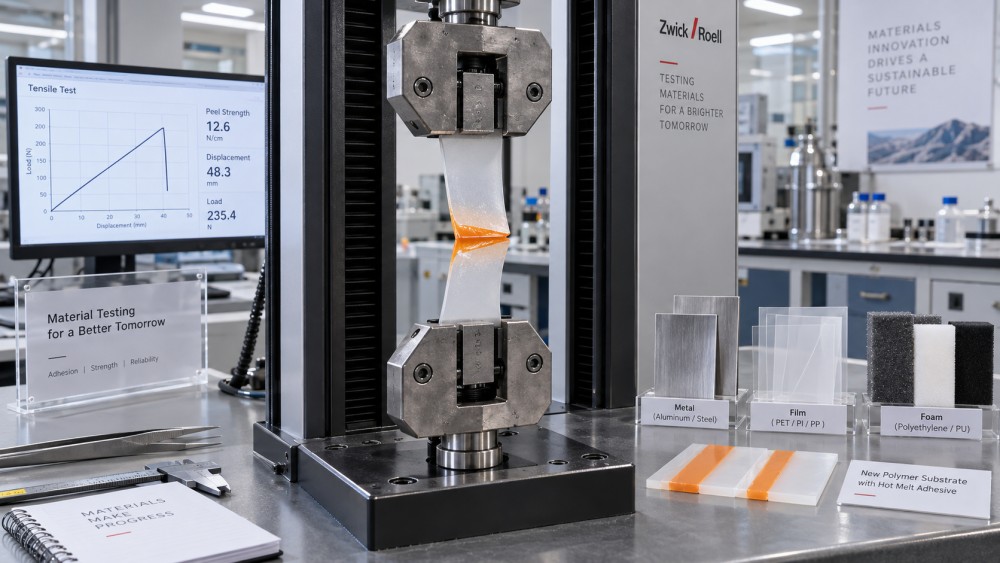
Build representative test coupons
The quality of the test specimen determines the value of the result. A laboratory coupon made with a smooth, cleaned surface and generous adhesive coverage can hide problems that will occur on a textured production part, at a narrow bond line, or after normal handling. Use actual production-intent substrate samples whenever possible, including the same surface finish, thickness, color, coating, and supplier source intended for use.
Make coupons that represent the real bond geometry. For flexible laminates, use strips suitable for peel testing. For rigid overlap joints, use lap-shear specimens. For assemblies where the adhesive is applied as dots, beads, slots, or spirals, recreate that pattern rather than coating the entire surface. Bond-line thickness matters as well: too little adhesive can leave dry areas, while too much may create a soft joint that creeps under load.
Record the application conditions for every sample. At minimum, document:
- substrate identification, lot information, and storage condition;
- surface preparation, if any;
- adhesive grade and lot;
- application temperature and open time;
- adhesive pattern, coating weight, or bead size;
- assembly pressure and dwell time;
- time allowed for cooling before testing;
- test temperature and loading method.
Hot-melt adhesives set rapidly, so open time deserves close attention. The adhesive must remain fluid enough to wet the new substrate before the parts are brought together. A delayed assembly may produce a bond that looks continuous but has weak interfacial contact. Pressure should be sufficient to bring the surfaces together, but excessive pressure can squeeze adhesive away from the intended area or distort soft substrates.
Use more than one screening test
Early screening does not need to be complex, but it should separate weak interfaces from promising combinations. A useful first sequence combines visual inspection, hand peel, controlled peel or shear testing, and failure-mode evaluation.
Visual and handling inspection
After the bond has fully cooled, inspect for skips, voids, poor edge coverage, adhesive stringing, bubbles, surface distortion, and areas where the adhesive appears to sit on top of the substrate rather than flow into its texture. Then flex, twist, or pull the coupon in a way that reflects its intended use. This is not a substitute for measured testing, but it quickly reveals gross process issues.
Peel testing for flexible materials
Peel testing is often appropriate for films, foils, labels, coated textiles, paper laminates, and flexible polymer sheets. Pull the bonded layers apart at a controlled angle and rate, using a method appropriate to the specimen geometry. The measured force matters, but the failure pattern is equally important. A bond that separates cleanly from the new substrate indicates adhesive failure at the interface. Adhesive remaining on both surfaces, tearing of the substrate, or cohesive splitting within the adhesive may suggest better interfacial adhesion, though each outcome must still be judged against product requirements.
Lap-shear testing for rigid overlaps
For rigid plastics, metal tabs, or flat overlapping components, a lap-shear configuration can show how the joint resists force parallel to the bond line. This is useful where the finished part will mainly carry shear load. However, lap-shear results should not be used to predict peel resistance, because peel concentrates stress at the bond edge and is often more demanding.
Static-load and creep observation
Some hot melts hold strongly during a short pull test but slowly deform under a sustained load. Hang a controlled weight, apply a fixed load, or maintain a loaded fixture at relevant temperatures. Observe whether the joint shifts, stretches, opens at the edge, or fails after time. This test is especially valuable for panels, foam assemblies, packaging closures, and bonds exposed to warmth.
Read the failure mode, not only the force value
A test number without a failure description can lead to the wrong corrective action. Examine both mating surfaces after each failure and note where separation occurred. The main patterns are usually easy to distinguish.
Mixed failure is common. One area may show cohesive failure while another releases cleanly. That inconsistency may point to uneven surface treatment, variable pressure, incomplete adhesive coverage, or changing substrate contamination rather than a simple adhesive mismatch.
Challenge the bond under real service conditions
Room-temperature tests are only the starting point. Select environmental exposures based on the product’s expected use. Heat exposure is particularly important because hot-melt adhesives can lose stiffness as temperature rises. Test at both the anticipated upper service temperature and after thermal aging. Cold exposure can matter as well, since some adhesive-substrate combinations become brittle and fail under impact or flexing at low temperature.
Humidity, water contact, oils, cleaning agents, and plasticizer migration should be considered when relevant. A hot melt may bond well to a plasticized vinyl surface at first, then weaken as mobile ingredients affect the adhesive interface. Similarly, a coated metal may pass dry testing but fail after moisture reaches an unsealed bond edge.
Temperature cycling can reveal differences in thermal expansion between the adhesive and substrate. Rigid plastics, metals, foams, and multilayer constructions move at different rates as temperature changes. Repeated expansion and contraction can initiate edge lifting even where a one-time heat test shows acceptable strength.
Run the same mechanical test before and after exposure, then compare the failure mode. A modest strength change may be acceptable in some applications; a shift from cohesive failure to clean adhesive release is a stronger warning that the interface is not durable.
When the first trial fails, change one variable at a time
It is tempting to raise application temperature, add more adhesive, increase pressure, and clean the surface all at once. That may create a passing sample, but it does not identify the actual cause. A controlled adjustment sequence is more useful.
- Confirm that the substrate sample is clean, properly identified, and representative.
- Check whether application temperature is within the adhesive supplier’s recommended processing window.
- Reduce the time between adhesive application and part assembly if the open time may be too short.
- Adjust pressure and bond-line thickness to improve contact without starving the joint.
- Compare untreated material with a cleaned or surface-treated version.
- Evaluate a hot-melt grade designed for the substrate family or service temperature.
- Retest the revised combination under the same aging and loading conditions.
Surface treatment may be appropriate for difficult materials, but it must be process-stable. Corona, plasma, flame treatment, primers, and mechanical abrasion can improve bonding on some substrates. Their effect may decline with storage, contamination, or treatment inconsistency, so testing should include the interval between treatment and adhesive application expected in production.
Questions that often come up during qualification
Can a hand pull test prove that the adhesive is suitable?
No. It can identify obvious non-bonding, but it cannot reliably demonstrate repeatability, heat resistance, creep resistance, or long-term durability. Use it as an initial screen before controlled coupon testing.
Should the adhesive be tested immediately after cooling?
Test after the adhesive has reached a stable condition, then repeat after any relevant aging exposure. Immediate testing can be useful for process feedback, but it may not reflect the bond after full set or storage.
Does a higher application temperature always improve bonding?
No. Higher temperature can improve wetting up to a point, but excessive heat may damage heat-sensitive substrates, alter coatings, increase odor or discoloration, and shorten practical open time. Stay within the adhesive’s specified processing range.
When is supplier-level technical review needed?
Further review is justified when the substrate includes an unknown coating or additive package, when the assembly has demanding heat or chemical exposure, or when inconsistent failure remains after basic process controls are verified. Providing failed and retained coupons, application records, and failure-mode observations will make that review more productive.
Have questions about this sector analysis, or seeking best practices specific to your niche? Drop us a line below and let the senior consultants at APIM assist you.
We respect your privacy. Your information is strictly confidential.
Related News
- 00
0000-00
Do polyolefin hot melt adhesives bond well to polyethylene? - 00
0000-00
Korean Study Finds PLA Barely Degrades in Landfill After 320 Days - 00
0000-00
How to assess batch consistency from a thermal potting compounds supplier - 00
0000-00
How much weight can carbon fiber reinforced plastics save in cars? - 00
0000-00
Switching from PS to ABS Sheet Extrusion: Equipment Checks