




How low-shrinkage UV-curing materials reduce bond-line distortion
Low shrinkage UV-curing materials can reduce bond-line distortion by limiting the contraction that develops as a liquid adhesive forms a polymer network. In a constrained joint, that contraction can pull bonded surfaces out of position, bend a thin substrate, or leave residual stress that becomes visible after the assembly leaves its fixture. Reducing shrinkage lowers one source of these problems, especially where small movements affect optical alignment, flatness, or component spacing.
The improvement depends on when contraction occurs and how the joint carries the resulting load. A material with low total shrinkage can still distort an assembly if it becomes stiff early, cures unevenly, or transfers stress into a flexible substrate. Technical evaluation therefore needs to connect formulation data with cure behavior and measured movement in the intended joint geometry.
How curing contraction becomes assembly distortion
During polymerization, reactive molecules become connected within a network, changing their packing and reducing the material’s volume. Before gelation, the adhesive can accommodate much of this contraction through flow, provided the joint allows movement and material redistribution. As the network develops, its ability to flow decreases. Further contraction increasingly generates stress wherever adhesion and the surrounding structure restrain it.
This distinction explains why total volumetric shrinkage does not directly predict final alignment. Two formulations may reach similar volume changes but develop different stresses because their gel points, stiffness development, and capacity for relaxation differ. Contraction after the material has become mechanically load-bearing is particularly relevant, although the response also depends on how quickly the adhesive and substrates can deform.
In a stiff, symmetric assembly, the result may be substantial residual stress with little visible movement. In an assembly containing a thin film, small lens, flexible circuit, or slender housing, the same cure-induced loading may produce bending or tilt. Strong adhesion transfers that loading into the substrates; weaker interfaces may relieve it through local separation, sacrificing bond integrity.
Joint geometry determines how these forces act. A bond offset from a component’s neutral plane can create a bending moment. Unequal adhesive deposits can pull a component asymmetrically. A continuous bond around a perimeter constrains movement differently from several discrete attachment points. Reducing material shrinkage helps each case, but cannot compensate fully for an arrangement that magnifies small contractions into significant displacement.
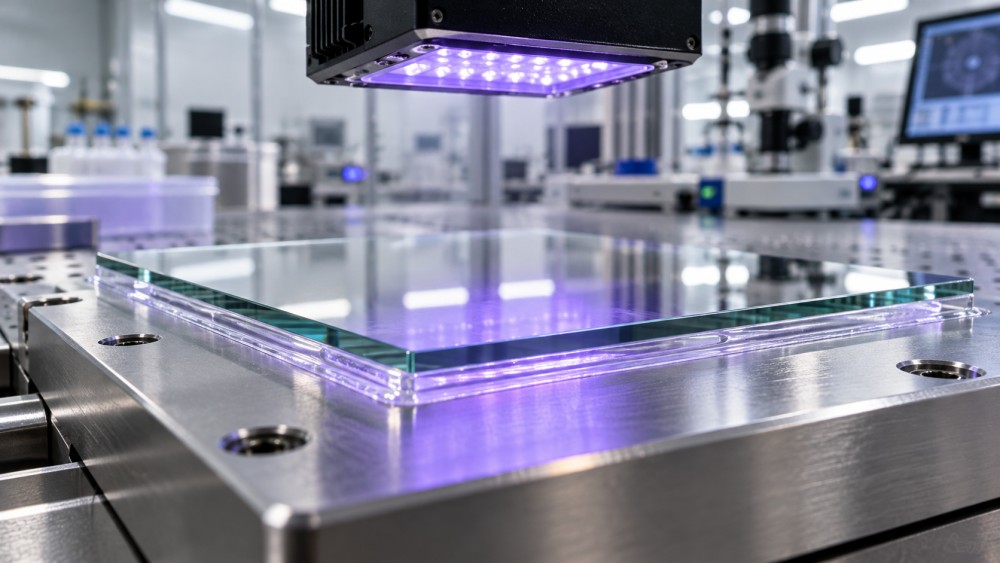
A useful illustration is a thin optical substrate bonded to a rigid carrier. As the adhesive contracts, the carrier limits movement at one surface while the thinner substrate bends more readily. Lower shrinkage reduces the imposed contraction. A more compliant cured adhesive may further reduce transferred stress, while uneven exposure or an asymmetric bond pattern can still create local curvature.
What formulation changes can achieve—and what they can trade away
Low shrinkage UV-curing materials use different formulation approaches, so the label alone provides little basis for comparison. Some reduce the concentration of reactive groups per unit volume by using larger reactive molecules. Others incorporate fillers or use chemistries whose polymerization produces less contraction. Each approach changes more than shrinkage and needs to be assessed against the application’s optical, mechanical, and processing requirements.
Reactive structure and network development
Within a related formulation family, larger oligomeric components can reduce reactive-group concentration and help limit contraction. However, viscosity may increase, affecting dispensing, wetting, bubble release, and the ability to form a uniform thin bond. Changes in functionality also affect network formation, cured stiffness, and resistance to creep. A formulation that reduces movement during cure may still allow unacceptable movement under sustained service loads.
Ring-opening chemistries, including some cationically cured epoxy systems, can offer lower polymerization shrinkage than some acrylate systems. This is a chemistry-dependent comparison, not a guarantee across product categories. Cationic systems can also continue reacting after illumination ends, and their cure behavior can be sensitive to moisture or basic contaminants. Dimensional measurements taken immediately after exposure may therefore miss later changes.
Some thiol-ene formulations provide another route to controlling shrinkage stress through their network development and delayed gelation. Their suitability still depends on adhesion, stiffness, environmental stability, and processing behavior. Selecting by chemistry name is less reliable than comparing measured performance under equivalent cure and conditioning conditions.
Fillers, compliance, and optical requirements
Nonreactive fillers reduce the fraction of the formulation that undergoes polymerization contraction. They can also alter thermal expansion and stiffness, both of which affect dimensional stability. The net result is not automatically lower stress: a filled adhesive may contract less while becoming stiff enough to transfer more of the remaining contraction into the bonded parts.
Fillers also influence light propagation. Depending on particle size, loading, and refractive-index relationships, they may scatter or attenuate curing light and affect optical clarity. A formulation that performs well in an exposed test specimen may cure differently beneath a coated window or through a narrow, partially shadowed bond line.
Lower modulus can reduce stress transfer, but compliance introduces its own limits. Precision assemblies may need sufficient stiffness to resist handling loads, vibration, or long-term creep. Evaluators should therefore compare shrinkage alongside modulus at relevant temperatures, glass-transition behavior, adhesion, and dimensional retention under load. The best candidate combines acceptable cure-induced movement with adequate restraint during service.
Why the bond line and exposure schedule can dominate the result
A lower-shrinkage formulation provides the greatest benefit when the dispensing and curing process is consistent. Variations in adhesive thickness, light delivery, temperature, or fixture release can otherwise obscure the material improvement or create a different distortion mechanism.
Bond-line thickness affects both contraction and constraint. For the same free shrinkage strain, a thicker adhesive layer has a larger potential change in thickness. In a bonded joint, however, stress and component movement also depend on layer compliance, lateral dimensions, and substrate stiffness. Making the layer thinner is not a universal solution: an excessively thin joint may have poor gap coverage, local starvation, or insufficient tolerance for surface variation.
Thickness uniformity can be as important as nominal thickness. A wedge-shaped layer can develop unequal movement across the joint, producing tilt. Controlled dispensing, suitable spacers, and consistent assembly pressure help establish a reproducible geometry. These controls also make comparisons between candidate materials more meaningful.
Cure uniformity determines where stress develops. A joint may receive different irradiance at its center, edges, and shadowed regions. Substrates, coatings, adhesive absorption, and fillers all influence the light reaching the reactive material. If one region becomes stiff while another remains mobile, subsequent contraction can create uneven stress and movement.
Nominal lamp power or exposure time is insufficient to describe this process. Evaluation should account for the source spectrum, irradiance at the assembly, exposure duration, transmission through the actual substrate, and the working distance and orientation. Equal radiant exposure delivered at different intensities does not necessarily produce equivalent conversion, temperature, or stress development.
A staged exposure may help some formulations by allowing redistribution or relaxation before the network becomes highly constrained. Its effectiveness must be demonstrated. A gentle initial exposure that leaves part of the joint inadequately cured can simply postpone movement until a later exposure or service condition.
Temperature can disguise the source of displacement. Polymerization generates heat, and the light source may add further heating. Components can expand during exposure and contract during cooling. Differences in thermal expansion between the adhesive and substrates introduce another contribution to residual stress. Comparing measurements at different temperatures can therefore misidentify thermal movement as polymerization shrinkage—or conceal it.
Fixturing changes what the evaluator sees. A rigid fixture may hold alignment throughout irradiation while stress accumulates inside the joint. Movement then appears on release. Excessive clamping can also deflect the parts before cure, leaving an assembly that moves when the imposed load is removed. Position should be checked during exposure, after thermal equilibration, and after fixture release.
How to verify that lower shrinkage improves the actual joint
A supplier’s shrinkage value is useful for screening when its measurement basis is clear. Ask whether the reported value is volumetric or linear, how it was measured, and what exposure and conditioning were used. Linear and volumetric values are not interchangeable. Converting between them assumes a deformation pattern that may not describe a constrained adhesive joint.
Density-based measurements can characterize volume change, while displacement-based methods can track contraction under a defined arrangement. Stress measurements answer a related but different question: how much force develops under the test system’s restraint. Results depend on specimen geometry and apparatus stiffness, so values from different methods should not be ranked as though they were directly equivalent.
The most useful evidence combines material characterization with a representative assembly test. The latter should preserve the features that govern distortion: substrate material and thickness, surface preparation, bond footprint, adhesive gap, light path, and fixture conditions. A convenient glass coupon may be inadequate when the production joint uses a flexible polymer film or a substrate that filters the curing wavelengths.
A focused validation sequence can establish whether the material solves the dimensional problem:
- Define the functional error. Specify whether acceptance depends on tilt, lateral shift, surface curvature, gap change, or another measurable displacement. Average bond strength cannot establish alignment performance.
- Establish a controlled comparison. Hold joint geometry and preparation constant, then use a documented cure schedule suitable for each formulation. Record any process differences needed to achieve adequate cure.
- Measure movement over time. Capture the initial position, movement during exposure where practical, the position after cooling and fixture release, and any subsequent drift.
- Confirm cure and bond integrity. Check that improved dimensional results are accompanied by adequate conversion, adhesion, and mechanical performance.
- Challenge the operating limits. Repeat the comparison across relevant gap tolerances, exposure variation, and service conditioning, including temperature, humidity, or sustained load where applicable.
Conversion assessment may use spectroscopy or residual-reaction analysis, while mechanical testing establishes whether the joint carries its intended loads. A tack-free surface alone does not demonstrate adequate cure throughout the bond line. Equally, a high initial bond-strength result does not establish dimensional stability over time.
Acceptance limits should come from the assembly’s tolerance budget. For an optical component, angular movement may matter more than average thickness change. For a thin cover bonded around its edge, local curvature may determine performance. Measuring the quantity that controls function prevents a favorable shrinkage number from becoming a substitute for application evidence.
If a candidate reduces movement during exposure but the improvement disappears after fixture release, the joint may still retain substantial stress. If movement develops during subsequent heating, thermal mismatch, further cure, or stress relaxation may be involved. These observations direct the next adjustment toward formulation, exposure, geometry, or restraint rather than prompting another material substitution without a clear hypothesis.
A low-shrinkage material earns its place when it reduces the assembly’s relevant dimensional error while maintaining cure completeness, adhesion, and stability through the intended operating conditions. The decisive result is repeatable alignment or flatness across realistic production variation, measured after the assembly is free to respond to the stresses created during bonding.
Have questions about this sector analysis, or seeking best practices specific to your niche? Drop us a line below and let the senior consultants at APIM assist you.
We respect your privacy. Your information is strictly confidential.
Related News
- 00
0000-00
How does washing affect contamination in post-consumer recycled PP resins? - 00
0000-00
How does feedstock affect depolymerization equipment selection? - 00
0000-00
US Sets 213.44% Preliminary Antidumping Deposit on Chinese PTMEG - 00
0000-00
When should epoxy be used as a thermal interface material for semiconductors? - 00
0000-00
US Midterm Results Unlikely to Quickly Shift Recycled Plastics Market or Legislation