




How film converting for release liners prevents coating defects
Introduction: Film converting for release liners is a critical control point for preventing coating defects that compromise adhesion, release consistency, surface uniformity, and downstream productivity.
For technical evaluators, the central question is not whether a liner can be coated successfully in one trial. It is whether the complete converting process can repeatedly deliver a stable coating surface.
Defects often originate before the coating head. Film gauge variation, contamination, poor winding, unstable tension, and inadequate surface treatment can create conditions that no coating formulation fully corrects.
A reliable evaluation therefore links substrate quality, web handling, coating chemistry, curing, inspection, and winding performance. This article explains the practical controls that reduce risk across release liner production.
Why Converting Quality Determines Coating Performance
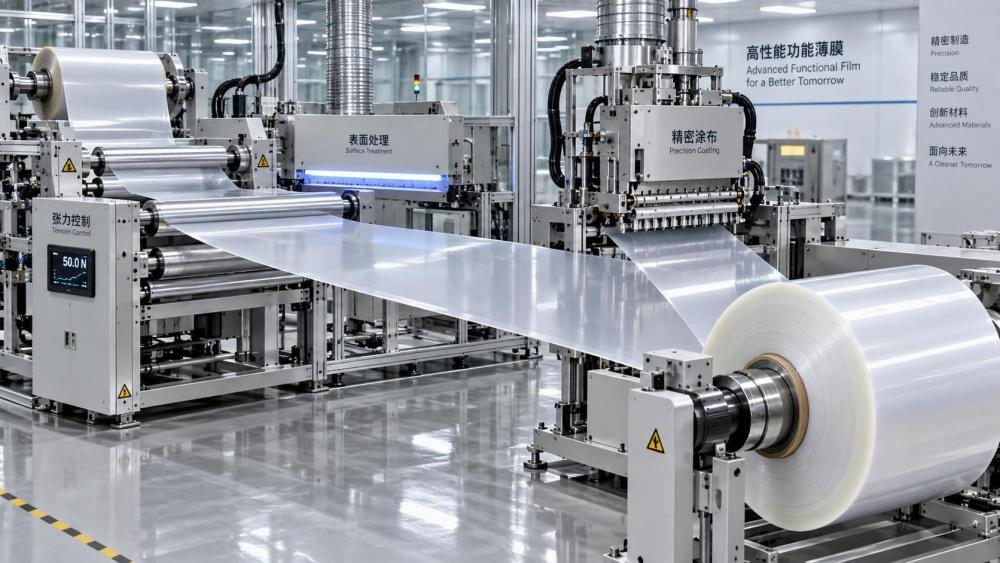
Release liners are functional substrates, not passive carrier films. Their surface condition directly affects silicone coating coverage, anchorage, release force, cure uniformity, and the appearance of the finished web.
When converting conditions are unstable, coating defects may appear as streaks, skips, craters, pinholes, fish eyes, wrinkles, edge build-up, or nonuniform release values across the roll.
Many of these problems are mistakenly assigned to the coating supplier. In practice, the root cause may be excessive tension variation, trapped air, poor slitting quality, or contamination transferred during handling.
Technical evaluators should examine the converting process as an integrated system. A film with acceptable laboratory properties can still perform poorly when its handling behavior changes at production speed.
The critical objective is to create a consistent coating window. This means the web enters the coater clean, flat, properly treated, dimensionally stable, and under controlled tension.
Film converting for release liners prevents coating defects by reducing uncontrolled variation before it reaches the coating station. This is more effective than attempting to compensate through higher coating weight.
Higher coat weight may temporarily hide minor surface issues, but it increases material consumption and can introduce cure, migration, or release-force variability. Process stability remains the better solution.
Start With the Film Substrate and Its Surface Condition
Substrate selection should begin with the release liner’s final application requirements. PET, BOPP, PE, paper laminates, and other film structures respond differently to tension, heat, treatment, and coating chemistry.
Film thickness consistency is particularly important. Gauge variation changes thermal behavior, web stiffness, nip pressure response, and coating-gap control, especially on wide webs and high-speed coating lines.
Surface defects can be microscopic but still commercially significant. Gels, scratches, additive bloom, dust, slip-agent migration, and handling marks may interrupt silicone coverage or reduce coat anchorage.
Technical teams should request film specifications that include thickness tolerance, surface energy targets, haze, coefficient of friction, winding quality, and acceptable contamination levels rather than relying on nominal thickness alone.
Surface energy must be appropriate for the coating system. If the film surface is too low in energy, the coating may dewet, form craters, or show poor adhesion after curing.
However, very high initial dyne values do not automatically guarantee long-term performance. Corona treatment can decay during storage, and surface chemistry may change through migration or environmental exposure.
Incoming inspection should therefore include practical verification. Dyne testing, visual inspection under controlled lighting, tape tests, and trial coating panels can reveal risks before full production begins.
Control Web Tension Before It Creates Streaks and Wrinkles
Web tension is one of the most influential process variables in release liner converting. It affects film flatness, coating-gap stability, registration, wrinkle formation, and the behavior of the web during rewinding.
Insufficient tension allows flutter and lateral movement. The coating head may then see an unstable surface, producing cross-web variation, edge defects, inconsistent wet film thickness, or intermittent skips.
Excessive tension creates a different failure mode. Thin films can stretch, neck down, distort, or develop stress that later relaxes, creating wrinkles or curl after coating and curing.
Closed-loop tension control is preferable to manual brake adjustment for critical liner products. Load cells, dancer systems, and responsive drive controls help maintain stable force during roll diameter changes.
The tension setpoint should not be copied across all films. It must reflect film modulus, thickness, width, roll length, coating method, oven profile, and the winding requirements of the finished roll.
Evaluators should review tension profiles by zone rather than accepting a single overall value. Unwind, infeed, coating, drying, cooling, and rewind zones often require different controlled conditions.
Trend data is valuable during qualification. A line that holds average tension but repeatedly oscillates may still produce coating variation that becomes visible only after slitting or customer lamination.
Maintain Web Cleanliness and Prevent Contamination Transfer
Contamination control is essential because release coatings are extremely sensitive to surface disruptions. A small particle can create a crater, coating void, raised spot, or visible defect in a high-gloss application.
Common contamination sources include airborne dust, worn idler rolls, silicone carryover, adhesive residue, paper fibers, lubricants, operator contact, and particles generated during trimming or slitting.
Cleaning should be designed into the process, not performed only after defects appear. Web cleaners, tacky rollers, vacuum extraction, filtered air, and housekeeping controls all reduce exposure.
Contact rollers deserve particular attention. Damaged roller surfaces can transfer repeating marks at regular intervals, helping engineers distinguish a mechanical issue from a coating formulation problem.
Cleanroom conditions are not required for every release liner product. However, controlled cleanliness becomes increasingly necessary for optical films, electronics tapes, medical applications, and premium graphic materials.
Technical evaluators should assess contamination according to end-use sensitivity. A defect acceptable for a general industrial tape liner may be unacceptable for a protective film used on display components.
A documented cleaning and inspection protocol also improves supplier accountability. It establishes measurable expectations for line preparation, roll handling, defect classification, and corrective action after incidents.
Match Surface Treatment to Coating Chemistry
Surface treatment improves wetting and anchorage, but the treatment method must match both the substrate and the release coating system. Corona, flame, plasma, and primer technologies each have distinct limits.
Corona treatment is widely used because it is efficient and compatible with many polymer films. It increases surface energy by modifying the outermost layer of the film.
Its effectiveness depends on treatment uniformity, power level, electrode condition, line speed, film composition, and the time between treatment and coating. Poorly controlled treatment can create inconsistent coating behavior.
Overtreatment can also cause problems. It may weaken a sensitive surface, increase extractables, create low-molecular-weight fragments, or produce a surface that changes unpredictably during storage.
Primers can improve silicone anchorage where direct coating is unreliable. Yet primers introduce another interface, requiring evaluation of cure compatibility, residual solvent, coating weight, and migration behavior.
For technical approval, evaluate treated film using the actual silicone formulation and cure schedule. Surface energy data alone cannot predict release performance, rub resistance, or long-term anchorage.
A sound qualification protocol tests aged treated film as well. This reveals whether a supplier’s treatment level remains adequate after realistic storage and logistics conditions.
Use Coating Conditions That Respect Web Behavior
Coating defects can occur when the selected application method does not match the film, viscosity range, target coat weight, and desired production speed. Process capability must be demonstrated, not assumed.
Gravure, slot-die, Mayer rod, reverse roll, and multi-roll coating systems each create different shear conditions and wet-film profiles. Their suitability depends on the release coating chemistry.
Slot-die coating can provide precise coverage, but it requires stable web position and a clean, controlled coating gap. Minor web movement can create bands or thickness variation.
Gravure coating offers robust operation for many liner products, although cell geometry, doctor blade condition, and roll cleanliness strongly influence uniformity and defect frequency.
Viscosity should be monitored at the point of application. Temperature changes, solvent loss, batch variation, and recirculation conditions can shift rheology enough to alter coating quality.
Operators should avoid solving every defect through line-speed reduction. Lower speed can stabilize one issue while changing solvent evaporation, oven residence time, leveling, or cure behavior elsewhere.
The better approach is to define an operating window with controlled limits for speed, viscosity, coating gap, pump rate, temperature, and tension. This supports repeatable manufacturing decisions.
Drying and Curing Must Protect the Release Surface
Drying and curing convert a wet coating into a functional release surface. Poor oven control can create incomplete cure, solvent retention, uneven release force, surface mottling, or insufficient coat anchorage.
Airflow should remove solvent or reaction byproducts without disturbing the wet film. Excessively aggressive airflow may create ripples, edge effects, or localized thickness changes before leveling is complete.
Temperature profiles require more attention than a single oven setpoint. The web needs sufficient residence time for controlled evaporation, leveling, crosslinking, and cooling before it reaches the rewind.
Film shrinkage and thermal distortion must also be considered. High oven temperatures may be acceptable for PET but problematic for lower-temperature films or multilayer structures with different shrinkage behavior.
Silicone cure should be verified through appropriate tests, such as extractables, rub-off assessment, migration checks, release-force measurements, and adhesion testing after lamination or aging.
Incomplete cure may not be visible during production. It often appears later as transfer, blocking, unstable release, odor, or reduced performance after the liner contacts an adhesive system.
For this reason, technical evaluations should include both immediate and aged samples. Real-world liner performance depends on stability over time, not only on appearance at the coater exit.
Prevent Defects During Winding, Slitting, and Roll Handling
Even a uniformly coated web can be damaged after coating. Rewinding, slitting, packaging, and transport must preserve the surface created during the coating and curing stages.
Improper rewind tension can cause telescoping, starring, cinching, trapped air, blocking, edge damage, and pressure marks. These defects may become visible only when customers unwind the roll.
Winding hardness should be balanced. Rolls that are too soft may deform during transport, while excessively hard rolls can create pressure-sensitive defects in the release coating or substrate.
Spreader rolls and web guides should be aligned carefully. Misalignment can introduce wrinkles that propagate through the roll, particularly when converting thin films at wide widths.
Slitting quality matters because rough edges can generate debris or lead to edge lifting during downstream adhesive coating and die-cutting. Blade condition and trim removal should be monitored.
Finished rolls should be protected from temperature extremes, humidity, dust, and mechanical compression. Storage conditions can affect curl, surface energy, coating integrity, and release performance.
A supplier’s roll-packaging specification should identify core quality, wrap materials, edge protection, maximum stacking conditions, and orientation requirements for storage and shipment.
How Technical Evaluators Should Qualify a Release Liner Process
Qualification should focus on process capability rather than isolated sample approval. A single acceptable roll does not prove that a supplier can maintain release liner performance over repeated production campaigns.
Begin by defining the application-critical properties. These may include release-force range, coating weight, surface defects, liner flatness, silicone anchorage, residual cure, and compatibility with the intended adhesive.
Request data across the roll and across multiple production lots. Cross-web and machine-direction measurements reveal variation that average specifications may hide.
Defect maps are particularly useful for technical review. They show whether defects are random, repeatable, edge-related, machine-related, or associated with roll starts, splices, and speed changes.
Audit the supplier’s controls for film receiving, treatment verification, web cleaning, tension monitoring, coating preparation, oven control, inspection, slitting, and final roll release.
When possible, conduct downstream trials using the actual adhesive, laminating pressure, die-cutting process, and end-use conditions. Release liners should be assessed within the complete converting chain.
A capable supplier can explain both its target specifications and its response to process drift. That evidence is more valuable than a broad claim of premium coating quality.
Conclusion: Convert for Consistency, Not Just Throughput
Film converting for release liners prevents coating defects when it is treated as a coordinated control system. Substrate condition, tension, treatment, cleanliness, coating, cure, and winding must operate together.
For technical evaluators, the strongest indicator of quality is stable capability across lots, widths, speeds, and downstream applications. Visual appearance alone is not enough for reliable liner approval.
By reviewing converting controls alongside material specifications and end-use testing, teams can reduce coating-related failures, improve adhesive processing, and select release liner suppliers with defensible process reliability.
Have questions about this sector analysis, or seeking best practices specific to your niche? Drop us a line below and let the senior consultants at APIM assist you.
We respect your privacy. Your information is strictly confidential.
Related News
- 00
0000-00
Do polyolefin hot melt adhesives bond well to polyethylene? - 00
0000-00
Korean Study Finds PLA Barely Degrades in Landfill After 320 Days - 00
0000-00
How to assess batch consistency from a thermal potting compounds supplier - 00
0000-00
How much weight can carbon fiber reinforced plastics save in cars? - 00
0000-00
Switching from PS to ABS Sheet Extrusion: Equipment Checks