




FDA Rule Takes Effect for UV Food-Contact Adhesives
On June 26, 2026, the U.S. Food and Drug Administration began mandatory enforcement of the revised 21 CFR Part 175.250 UV-Cured Adhesives, introducing a concrete compliance change for food-contact UV adhesive applications tied to electronic assembly. The update matters because it moves migration testing for photoinitiator residues and oligomers from a technical concern into an import-facing requirement, with direct implications for batch release, supporting documents, supplier coordination, and shipment planning in segments such as LED packaging, flexible circuit bonding, and medical sensor assembly.
What the rule now requires
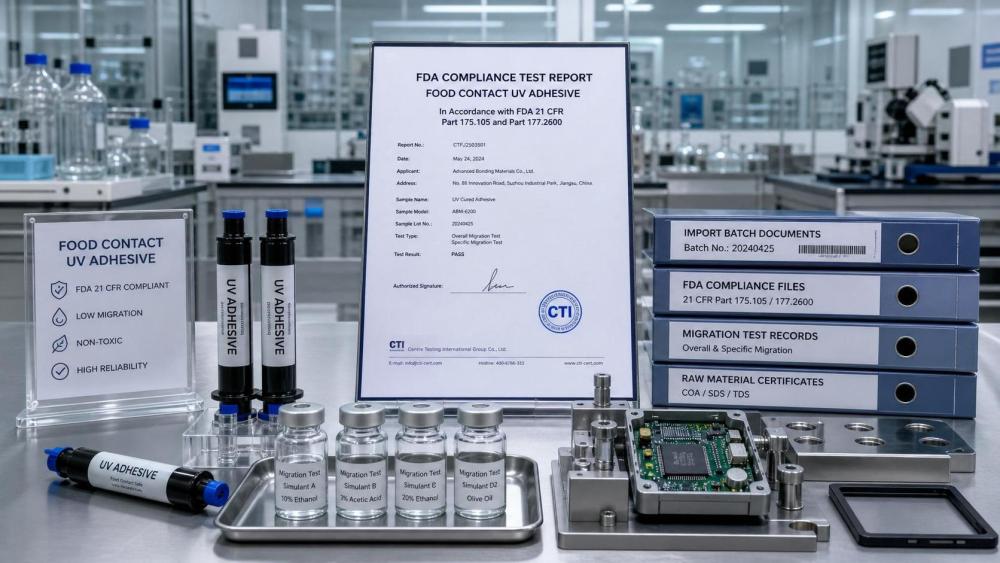
According to the provided information, the FDA began mandatory enforcement of the revised 21 CFR Part 175.250 UV-Cured Adhesives at 00:00 on June 26, 2026. The revision newly brings photoinitiator residues, including TPO-L and BAPO, and oligomer migration into the list of mandatory test items for food-contact UV adhesives.
The scope described in the input covers application scenarios including LED packaging, flexible circuit bonding, and medical sensor assembly. The same input states that, starting in Q3 2026, all imported batches must be accompanied by migration test reports issued by FDA-recognized laboratories using food simulants of 10% ethanol, 50% ethanol, and olive oil.
Where pressure is likely to appear across the chain
Import shipments and customs-facing documentation
From an industry perspective, import-oriented trading companies and exporters connected to the covered products are likely to feel the change first in documentation readiness. The immediate issue is not only whether the adhesive itself meets the revised testing scope, but whether each imported batch from Q3 2026 is supported by the required migration report from an FDA-recognized laboratory. That makes batch-level document completeness a practical checkpoint for shipment release and customer acceptance.
Procurement and approved supplier management
Procurement teams using food-contact UV adhesives in covered assembly processes may need to pay closer attention to supplier qualification files, test report availability, and the exact adhesive systems being sourced. Analysis shows that the rule change can affect purchasing decisions when buyers need evidence that the relevant photoinitiator residues and oligomer migration have been addressed under the specified simulants, especially where incoming material approval and delivery timing are closely linked.
Manufacturing and assembly planning
For processors and manufacturers involved in LED packaging, flexible circuit bonding, or medical sensor assembly, the main effect is likely to appear in pre-shipment compliance review and production scheduling rather than in a simple paperwork update. Observably, when a batch cannot move without the required report, production and export planning become more dependent on laboratory turnaround, document matching, and traceability between adhesive lots and finished imported batches.
Testing and certification-related service roles
Testing service providers and compliance support firms may also see a more operational role in this transition. The input confirms that reports must come from FDA-recognized laboratories, so the credibility, format, and applicability of test documentation become central issues for companies preparing imports. What deserves closer attention is whether internal teams and external service partners are aligned on report scope, covered substances, and the specific simulants cited in the rule change.
What companies should check now
Review whether current files match the new test scope
Analysis shows that companies should first verify whether existing compliance files for food-contact UV adhesives actually cover photoinitiator residues such as TPO-L and BAPO, as well as oligomer migration. Older technical files or supplier declarations may not automatically satisfy a requirement that is now described as mandatory under the revised rule.
Prepare Q3 batch documentation in a shipment-ready format
What deserves closer attention is the batch-based nature of the import requirement described in the input. Companies involved in imports should review whether test reports can be matched clearly to Q3 2026 batches and whether internal document control is ready to support trade, customer review, and possible regulatory checks without delay.
Check laboratory recognition and report applicability
Observably, the requirement is not limited to having a migration report in general; the report must come from an FDA-recognized laboratory and use the listed simulants of 10% ethanol, 50% ethanol, and olive oil. Companies should therefore examine not only whether testing has been completed, but whether the issuing laboratory and report content fit the requirement as stated.
Watch for downstream contract and delivery adjustments
From an industry perspective, this is also a contract and delivery issue. Buyers, distributors, and assembly contractors may need to review whether purchase specifications, incoming inspection criteria, tender attachments, or shipment release conditions now need to reference the revised test items and supporting reports. The input does not provide enforcement detail beyond the mandatory requirement, so this remains an area for close monitoring rather than a settled execution outcome.
Why this looks more like an execution signal than a distant policy note
Analysis shows that this development is better understood as a rule already in force rather than an early consultation-stage policy signal. The key reason is the combination of a stated enforcement start date and a batch-level import document requirement beginning in Q3 2026. At the same time, it is still appropriate to treat parts of the market response as under observation, because the provided information does not define how different customers, import checkpoints, or procurement systems will operationalize the requirement in practice.
Observably, the most important near-term question for the industry is not whether the rule exists, but how consistently it will be reflected in compliance reviews, sourcing decisions, and shipping documentation. That is why companies with affected assemblies should continue watching for wording changes in technical specifications, customer compliance requests, and supporting document expectations.
How this update is best understood for now
At this stage, the FDA action is best read as a concrete compliance change affecting food-contact UV adhesives used in certain electronic assembly-related applications, especially where imported batches must now carry migration reports meeting the stated conditions. The practical significance lies in testing scope expansion, batch documentation readiness, and tighter alignment between suppliers, laboratories, and import-facing teams. A measured reading is appropriate: this is a live execution requirement, but the full market impact will depend on how consistently it is applied across trade, procurement, and downstream customer controls.
Basis of this article and points still to verify
This article is based on the user-provided news title, event date, and event summary. For developments of this kind, source types typically relevant to later verification include official regulatory notices, releases from supervisory authorities, customs or trade administration information, industry association updates, standard-setting documents, and reporting by authoritative trade media.
No specific official source link was provided in the input, so the exact official publication path still requires follow-up verification. Observably, the items that remain worth monitoring include any further implementation detail, certification or testing interpretation, changes in tender or procurement documents, industry feedback, and how affected companies execute the batch-report requirement in practice.
Have questions about this sector analysis, or seeking best practices specific to your niche? Drop us a line below and let the senior consultants at APIM assist you.
We respect your privacy. Your information is strictly confidential.
Related News
- 00
0000-00
Do polyolefin hot melt adhesives bond well to polyethylene? - 00
0000-00
Korean Study Finds PLA Barely Degrades in Landfill After 320 Days - 00
0000-00
How to assess batch consistency from a thermal potting compounds supplier - 00
0000-00
How much weight can carbon fiber reinforced plastics save in cars? - 00
0000-00
Switching from PS to ABS Sheet Extrusion: Equipment Checks
Tag