




FDA Broadens Food-Contact Use for UV-Curing Adhesives
On June 27, 2026, the U.S. Food and Drug Administration updated 21 CFR Part 175.105 to expand food-contact permission for UV-curing industrial adhesives into temporary bonding and edge sealing for flexible electronic packaging. The update is worth close attention from adhesive suppliers, packaging and device manufacturers, and cross-border business teams because it clarifies a compliance path tied to specific chemistry and processing conditions, while also pointing to potential access to North American application areas such as medical wearables and smart labels.
What the FDA Update Formally Covers
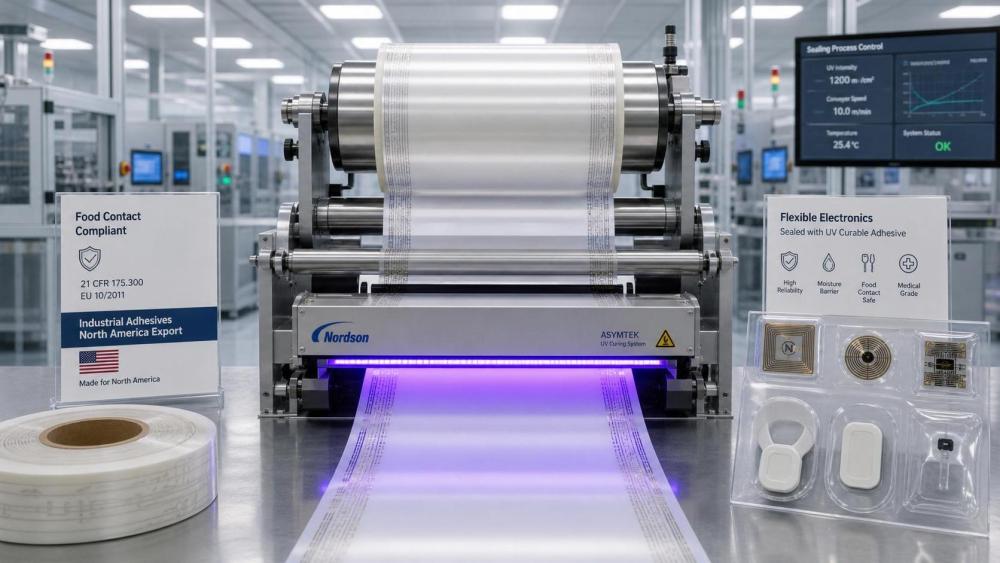
According to the provided information, the FDA revised 21 CFR Part 175.105 on June 27, 2026. The revision extends the food-contact authorization of UV-curing industrial adhesives to a defined use case: temporary bonding and edge sealing in flexible electronic packaging.
The permitted use is limited to specific acrylate and epoxy acrylate systems under heat-press conditions of no more than 121°C. The provided information also indicates that this update creates an important compliance route for Chinese UV-curing adhesive manufacturers seeking to expand into emerging North American channels including medical wearable devices and smart labels.
Why Different Parts of the Value Chain May Pay Attention
For adhesive manufacturers, compliance scope becomes more commercially relevant
From an industry perspective, suppliers of UV-curing industrial adhesives may be affected first because the update is tied directly to product formulation and use conditions. The main business impact is likely to appear in product positioning, customer qualification discussions, and documentation prepared for North American business development. What deserves closer attention is whether existing products actually match the specified acrylate or epoxy acrylate systems and the stated thermal processing limit.
For device and packaging manufacturers, application boundaries matter in practice
Manufacturers involved in flexible electronic packaging may focus on the fact that the authorization is linked to temporary bonding and edge sealing rather than unrestricted use. The effect is most likely to be felt in process validation, material selection, and communication between engineering, procurement, and compliance teams. The practical question is not only whether a material is UV-curing, but whether the intended application scenario fits the wording and conditions described in the update.
For export and channel teams, the update may reshape market-entry discussions
Companies pursuing North American opportunities in medical wearables and smart labels may view the rule change as a more concrete regulatory reference in customer conversations. The likely impact is on sales qualification, sample approval timing, and cross-border documentation review. Observably, the update does not remove the need for customer-side review; instead, it gives market participants a clearer basis for discussing whether a product can proceed into evaluation or sourcing.
What Companies Should Check Now
Match formulations against the authorized chemistry
The first practical step is to verify whether relevant products fall within the specific acrylate or epoxy acrylate systems referenced in the provided information. A broad claim around UV-curing capability alone is not enough for compliance communication.
Confirm process conditions against the temperature limit
The stated threshold of no more than 121°C under heat-press conditions is a key boundary. Companies should review whether target customer processes, qualification runs, or packaging steps remain within that condition before presenting a product as aligned with the updated scope.
Separate regulatory signal from immediate commercial readiness
Analysis shows that a rule update and a completed market entry are not the same thing. Teams handling sales, regulatory affairs, and customer support should distinguish between the existence of a compliance path and the additional work needed for specification review, customer acceptance, and transaction-ready documentation.
Prepare documents and communication for cross-border review
For suppliers targeting North American customers, attention will likely fall on product data, compliance statements, usage boundaries, and response speed during customer review. This is especially relevant where buyers may ask how the product fits the newly expanded application scenario.
How This Update May Be Best Interpreted
Observably, this development is more than a routine wording change because it identifies a new application scenario within a regulated framework. At the same time, it is more appropriate to understand this as a targeted regulatory signal rather than a completed market outcome. The update clarifies that certain UV-curing adhesive systems can be discussed within a defined food-contact compliance context for flexible electronic packaging, but actual business conversion will still depend on product fit, customer validation, and execution discipline.
Analysis also shows that the strongest near-term relevance may be for companies already positioned around medical wearables, smart labels, or adjacent flexible electronics uses. For the broader market, the rule change is still something to watch closely rather than treat as a universal shift across all UV-curing adhesive applications.
What This Means for the Market Right Now
At this stage, the FDA update is best read as a meaningful compliance clarification with practical implications for selected adhesive formulations and application scenarios. It does not by itself confirm demand, guarantee approvals across customer programs, or establish outcomes beyond the scope stated in the provided information. A neutral reading is that the change creates a clearer operating reference for suppliers and buyers working around flexible electronic packaging and food-contact considerations, while leaving room for continued verification in real projects.
About the Basis of This Article
This article is based on the user-provided news title, event date, and event summary concerning the FDA update issued on June 27, 2026. For this type of industry development, commonly relevant source categories may include official regulatory notices, company statements, industry association updates, authoritative media coverage, and standards-related documents. No specific official source link was provided in the input, so the exact official link still requires ongoing verification. Follow-up attention should focus on any subsequent official wording, interpretation, or implementation-related clarification tied to the updated rule scope.
Have questions about this sector analysis, or seeking best practices specific to your niche? Drop us a line below and let the senior consultants at APIM assist you.
We respect your privacy. Your information is strictly confidential.
Related News
- 00
0000-00
Do polyolefin hot melt adhesives bond well to polyethylene? - 00
0000-00
Korean Study Finds PLA Barely Degrades in Landfill After 320 Days - 00
0000-00
How to assess batch consistency from a thermal potting compounds supplier - 00
0000-00
How much weight can carbon fiber reinforced plastics save in cars? - 00
0000-00
Switching from PS to ABS Sheet Extrusion: Equipment Checks