




ECHA Tightens UV Adhesive Reporting From October 2026
On July 7, 2026, the European Chemicals Agency (ECHA) updated REACH Annex XVII to add three photoinitiators used in UV-curing industrial adhesives to a new restriction path. From October 1, 2026, imported adhesives containing Irgacure 819, TPO-L, or 907 will need prior SCIP notification and a complete SVHC declaration. This is immediately relevant for exporters, importers, formulators, compliance teams, and supply chain operators serving the EU market, because the change affects market access documentation rather than only product formulation.
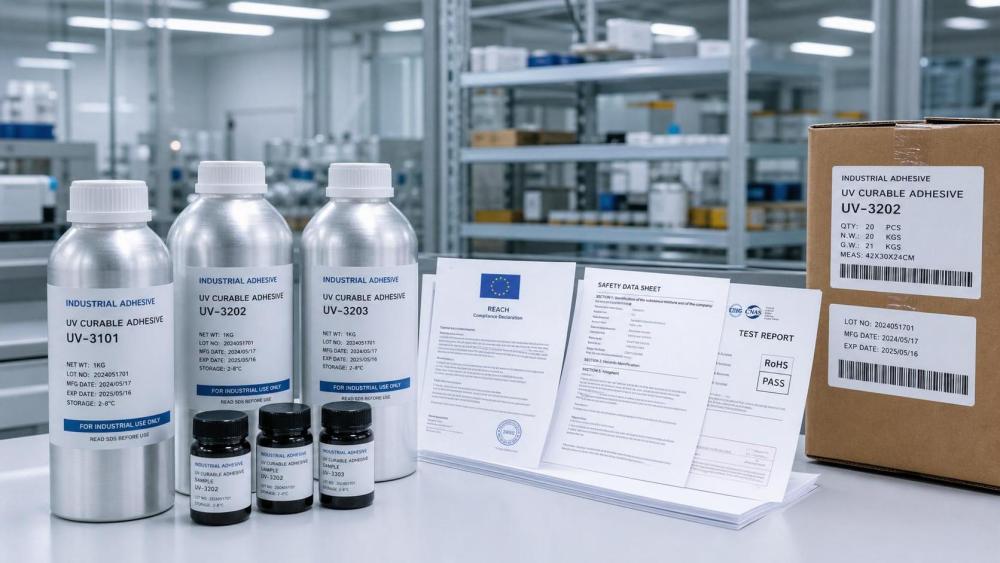
What the July 7 update formally changes
According to the information provided, ECHA urgently revised REACH Annex XVII on July 7, 2026 and placed Irgacure 819, TPO-L, and 907 on the restriction list for UV-curing industrial adhesives. The requirement takes effect on October 1, 2026. From that date, imported adhesive products containing these substances must be notified to ECHA through SCIP in advance and must be accompanied by a complete SVHC declaration. The provided information also states that non-compliant products may face customs delays and risk being barred from the market.
Where the pressure is likely to be felt first
Export shipments bound for the EU
From an industry perspective, direct trading companies and exporters are likely to feel the impact first because the new requirement is tied to import compliance into the EU. The main pressure point is shipment readiness: whether affected adhesive products can be supported by the required notification and declaration materials before customs clearance and customer delivery timelines are tested.
Formulation and raw-material traceability
Manufacturers and procurement teams may also be affected where product formulas include Irgacure 819, TPO-L, or 907. The issue is not only whether these photoinitiators are present, but whether their use is clearly identified in internal records and supplier documentation. What deserves closer attention is the handoff between raw-material sourcing, formulation management, and compliance review, because gaps in substance identification can quickly become documentation risks.
Importers, distributors, and fulfillment partners
EU-side importers, channel partners, and supply chain service providers may face operational exposure if documentation is incomplete at the point of entry. Observably, the business risk here is concentrated in customs processing, inventory turnover, and delivery commitments. Even where the product itself is unchanged, the administrative burden around acceptance and movement may become more demanding.
Downstream buyers and industrial users
Purchasing teams and downstream industrial users may need to pay closer attention to declarations received from suppliers. Analysis shows that this update can become a contract and qualification issue, especially where buyers require clear confirmation that imported UV-curing adhesives meet EU entry and disclosure expectations before use in production or project delivery.
What companies should review now
Check whether affected substances are present
The first practical question is whether any exported UV-curing industrial adhesive includes Irgacure 819, TPO-L, or 907. For companies with multiple SKUs or private-label supply arrangements, this review needs to cover actual formulation content and not only commercial product descriptions.
Confirm documentation readiness before October 1
Because the requirement is tied to prior SCIP notification and a complete SVHC declaration, companies should focus on whether current files are sufficient for submission and customer communication. This includes internal compliance records, supplier-provided substance information, and document consistency across sales, shipping, and regulatory functions.
Separate legal text from execution risk
Analysis shows that the formal rule change and real-world execution risk are not the same thing. A company may understand the new requirement in principle but still face disruption if product mapping, declaration preparation, or submission timing is incomplete. For that reason, the operational lead time between identifying affected products and preparing compliant paperwork deserves close attention.
Prepare for customer and partner communication
What deserves closer attention is external coordination. Exporters and suppliers may need to align in advance with EU importers, distributors, and customers on who handles notifications, what supporting documents are expected, and how shipment timing will be managed during the transition into the October 2026 enforcement date.
Why this looks bigger than a routine filing update
Observably, this is not just a narrow paperwork adjustment for one shipment category. It signals that compliance expectations around specific photoinitiators in UV-curing industrial adhesives are being drawn more directly into market-access control. Analysis shows that the near-term issue is administrative readiness, while the broader signal is that formulation transparency and substance-level traceability are becoming more central to EU-facing adhesive trade.
At the same time, it is more appropriate to understand this as an active regulatory development rather than a fully settled long-term market outcome. The confirmed facts are clear on the new filing obligation and enforcement date, but the wider commercial response across suppliers, buyers, and cross-border logistics still needs continued observation.
How this update is best understood at this stage
At this stage, the ECHA move should be read as a concrete short-term compliance change with potential longer-term implications for how UV-curing industrial adhesives are documented and supplied into the EU. The immediate issue is clear: products containing the named photoinitiators face a new reporting and declaration threshold from October 1, 2026. The wider industry meaning is still developing, but the direction of travel points toward tighter scrutiny of substance disclosure in this product segment.
Basis of this article and points for follow-up
This article is based on the user-provided news title, event date, and event summary. For developments of this kind, relevant source categories typically include official regulator notices, company disclosures, industry association updates, authoritative media coverage, and standards or compliance documents. A specific official source link was not provided in the input, so the underlying text and any later implementation details still require ongoing verification. Follow-up attention should remain on any further official wording, implementation clarification, and documentation expectations connected to the October 2026 enforcement date.
Have questions about this sector analysis, or seeking best practices specific to your niche? Drop us a line below and let the senior consultants at APIM assist you.
We respect your privacy. Your information is strictly confidential.
Related News
- 00
0000-00
Do polyolefin hot melt adhesives bond well to polyethylene? - 00
0000-00
Korean Study Finds PLA Barely Degrades in Landfill After 320 Days - 00
0000-00
How to assess batch consistency from a thermal potting compounds supplier - 00
0000-00
How much weight can carbon fiber reinforced plastics save in cars? - 00
0000-00
Switching from PS to ABS Sheet Extrusion: Equipment Checks