




ECHA Moves UV Adhesives Into SCIP Filing Scope
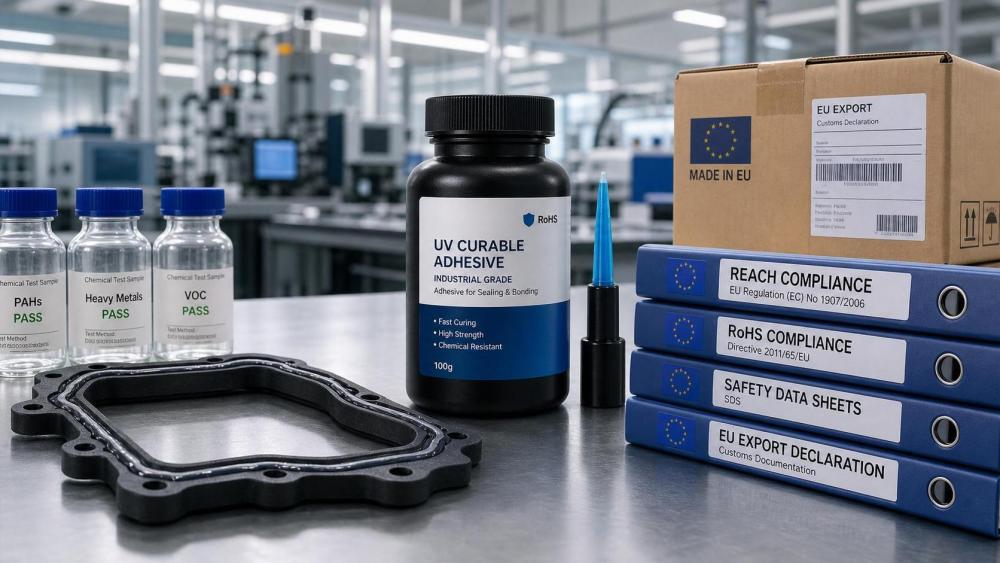
On July 1, 2026, the European Chemicals Agency (ECHA) released a draft amendment under REACH that places a new compliance focus on UV-curing industrial adhesives used for the EU market. The change centers on three widely used photoinitiators, TPO, 819, and ITX, together with their degradation products, and links their presence to mandatory SCIP database notification from October 1, 2026 before export to the EU. For adhesive manufacturers, composite material suppliers, and electronics or automotive OEMs using UV adhesives, this is worth close attention because the rule change reaches beyond formulation issues and into export declarations, supply chain documentation, and delivery preparation.
What the draft change formally introduces
The confirmed information is limited but clear on the main points. ECHA issued a REACH draft amendment on July 1, 2026. In that draft, three categories of commonly used photoinitiators in UV-curing systems, TPO, 819, and ITX, as well as their degradation products, were added to the SVHC candidate substance context described in the event summary. The same summary states that, from October 1, 2026, UV-curing industrial adhesives containing those substances must complete mandatory notification in the SCIP database before being exported to the EU. The event summary also confirms that this requirement directly affects overseas compliance declaration processes for adhesive manufacturers, composite material suppliers, and electronics and automotive OEMs using UV adhesives.
Where pressure is likely to appear across the business chain
Export-facing adhesive suppliers will face a new filing checkpoint
From an industry perspective, suppliers shipping UV-curing industrial adhesives to the EU are likely to feel the most immediate impact because the stated requirement is tied to pre-export SCIP notification. The effect is not only on product composition review, but also on whether export readiness now depends on identifying covered substances early enough to complete the required declaration workflow. What deserves closer attention is the connection between formulation knowledge and shipment execution: if substance status, degradation-product identification, or filing readiness is unclear, the risk shifts into order release, document preparation, and delivery scheduling.
Composite material suppliers may need tighter upstream substance visibility
Observably, composite material suppliers are drawn into the change because they may source, incorporate, or pass through UV-curing adhesive systems that fall within the described scope. Their exposure is likely to appear in procurement review, supplier communication, technical document collection, and customer-facing compliance responses. Even where they are not the original formulator, they may still need clearer evidence on whether the relevant photoinitiators or related degradation products are present in supplied materials intended for EU-bound applications.
OEM compliance teams may see the rule move into approval workflows
For electronics and automotive OEMs that use UV adhesives, the event summary points directly to overseas compliance declaration procedures. Analysis shows that this can affect internal approval steps tied to material selection, supplier onboarding, and export documentation alignment. Procurement, engineering, and compliance teams may need to check whether current material declarations and supporting technical files remain sufficient once SCIP notification becomes a mandatory pre-export condition for the covered adhesive products.
What companies should review before the October filing date
Substance screening should be matched to product scope
Analysis shows that companies first need to identify whether their UV-curing industrial adhesive products for the EU market contain TPO, 819, ITX, or the degradation products referenced in the event summary. This is not yet a broad recommendation about all product lines; it is more appropriately tied to the specific product scope described in the rule change and to shipments connected with the EU market.
Technical files and declaration materials may need closer alignment
What deserves closer attention is whether existing technical documentation is organized well enough to support a SCIP filing process before export. That may include material declarations, internal formulation records, supplier statements, and other compliance-supporting documents already used in export or customer submission workflows. Because the input does not provide detailed execution criteria, this should be treated as a practical preparation point rather than a confirmed final filing checklist.
Procurement and delivery planning should account for compliance timing
Observably, the October 1, 2026 trigger date can matter not only to regulatory teams but also to purchasing and delivery coordination. Where UV adhesives are part of larger production or overseas shipment plans, companies may need to review whether supplier qualification, order confirmation, and shipment release depend on having the relevant notification completed in time. The input does not confirm enforcement outcomes, so the more cautious reading is that companies should watch for timing pressure rather than assume a uniform market response.
Watch the official wording and downstream customer requirements
It is more appropriate to understand this event as a rule development with a clear operational signal, but one that still requires continued reading of official wording and customer-side implementation. Companies involved in EU exports should pay attention to how compliance language appears in procurement documents, technical submission requests, and customer declarations once the October timeline approaches.
How this should be read at the current stage
Analysis shows that this development is not just a chemical list update in isolation. It signals that substance status and digital compliance reporting are becoming more tightly connected in the export path for affected UV-curing industrial adhesives. At the same time, it should not be overstated as a fully settled market outcome. The input confirms a draft amendment and a stated mandatory SCIP notification date, but it does not provide fuller enforcement detail, implementation examples, or downstream market practice. For that reason, this is better understood as a concrete compliance signal with near-term operational implications, while parts of the practical execution still merit observation.
Why the market is likely to keep watching this change
The industry significance of this event lies in where the requirement lands: not only in regulatory interpretation, but in the handoff between formulation, supplier data, export compliance, and delivery readiness. For companies connected to EU-bound UV-curing industrial adhesives, the immediate issue is less about broad market conclusions and more about whether internal material knowledge and external declaration processes are sufficiently connected. The most balanced conclusion at this stage is that the development should be treated as an actionable compliance change with a defined timeline, while final execution details and market response still need to be monitored carefully.
Basis of this article and points still requiring verification
This article is generated from the user-provided news title, event date, and event summary. Source types commonly relevant to developments of this kind may include official announcements, regulator releases, trade or customs authority information, industry association updates, standard-setting documents, and reporting by authoritative industry media. A specific official source link was not provided in the input, so the exact source document should still be verified on an ongoing basis. Continued attention is also needed on later policy detail, certification or compliance interpretation, procurement document changes, bid or specification language, industry feedback, and how affected companies implement the requirement in practice.
Have questions about this sector analysis, or seeking best practices specific to your niche? Drop us a line below and let the senior consultants at APIM assist you.
We respect your privacy. Your information is strictly confidential.
Related News
- 00
0000-00
How does washing affect contamination in post-consumer recycled PP resins? - 00
0000-00
How does feedstock affect depolymerization equipment selection? - 00
0000-00
US Sets 213.44% Preliminary Antidumping Deposit on Chinese PTMEG - 00
0000-00
When should epoxy be used as a thermal interface material for semiconductors? - 00
0000-00
US Midterm Results Unlikely to Quickly Shift Recycled Plastics Market or Legislation