




ECHA Draft Targets UV Adhesives Ahead of October SCIP Filing
On July 5, 2026, the European Chemicals Agency (ECHA) released a draft revision under REACH that places four photoinitiators used in UV-curing industrial adhesives, TPO, 819, ITX and DBM, on the SVHC Candidate List and ties this development to a mandatory SCIP database notification requirement from October 1, 2026 for exports to the EU containing these substances. For UV adhesive manufacturers, exporters, and related compliance and supply chain teams, the issue is not only the substance listing itself, but also the short preparation window now facing companies shipping into the European market.
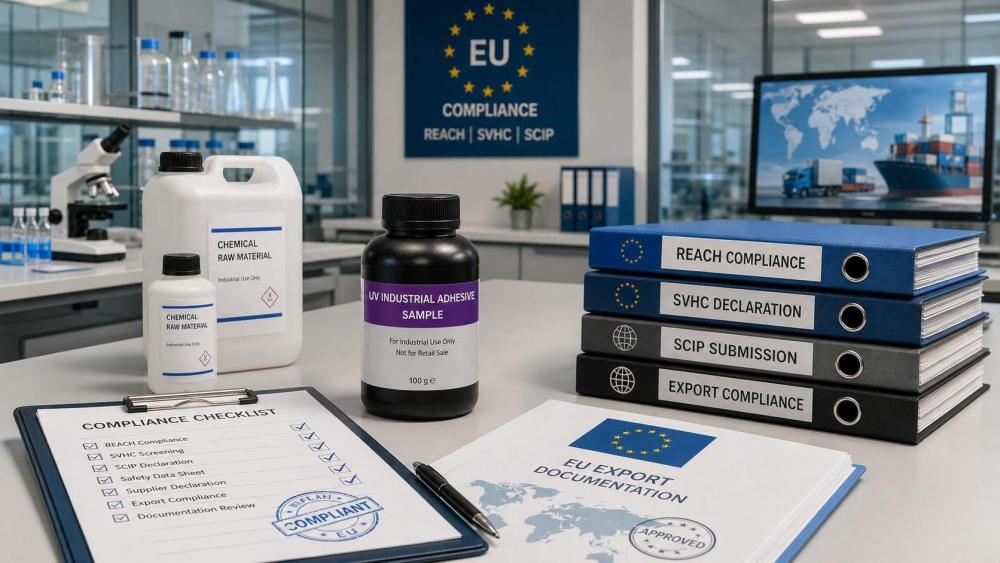
What the July 5 Draft Says
According to the information provided, ECHA issued a draft amendment to the REACH framework on July 5, 2026. In that draft, four photoinitiators, TPO, 819, ITX and DBM, were identified as SVHC candidate substances.
The same update states that from October 1, 2026, UV-curing industrial adhesives exported to the EU that contain these substances must complete mandatory notification to the SCIP database. The information provided also indicates that this leaves Chinese UV adhesive manufacturers and exporters with only 85 days to prepare for compliance.
Where the Immediate Pressure May Appear
Export-facing adhesive suppliers
From an industry perspective, companies directly exporting UV-curing industrial adhesives to the EU are likely to feel the earliest impact because the new requirement is tied to market access documentation and filing readiness. The main pressure point is whether affected products can be identified quickly and matched with the required SCIP notification work before shipment schedules are disrupted.
Manufacturing and formulation teams
For manufacturers, the issue may extend beyond trade paperwork. Analysis shows that formulation review, raw material identification, and internal product mapping could become immediate operational tasks, especially where these four photoinitiators are used across multiple adhesive grades. What deserves closer attention is whether internal product data is organized well enough to distinguish EU-bound products from non-EU business.
Procurement and upstream coordination
Raw material procurement and supplier management functions may also be affected because the requirement is substance-specific. Observably, any uncertainty around whether TPO, 819, ITX or DBM is present in a given formulation could slow downstream compliance preparation. In practice, this means procurement teams may need clearer material declarations and faster confirmation cycles with upstream suppliers.
Logistics, customer service and delivery planning
Supply chain service teams and customer-facing account staff may face a different kind of pressure: timing. With a limited preparation window, any delay in documentation, product classification or customer confirmation could affect delivery commitments into the EU. This makes communication across sales, compliance and logistics more important than usual for orders scheduled close to the October 1 start date.
What Companies Should Watch Closely Now
Track how the draft language is framed in official follow-up
Analysis shows that the current development should first be read through the exact scope described in official wording. Companies should pay close attention to whether subsequent official communications clarify product scope, filing boundaries, or implementation details linked to the SCIP notification obligation. The distinction between a draft regulatory move and operational execution requirements matters for day-to-day compliance decisions.
Identify affected products and customers first
What deserves closer attention is product screening by substance and destination market. For businesses with mixed export portfolios, the immediate practical question is which UV-curing industrial adhesives shipped to the EU contain any of the four named photoinitiators. Customer accounts, contract deliveries and pending shipments tied to the EU market are likely to be the first areas requiring review.
Prepare documents and internal workflows under tight timing
Observably, the 85-day window raises a documentation and process challenge as much as a regulatory one. Companies may need to verify formulation records, organize substance-related product information, and align internal approval flows so compliance work does not lag behind commercial delivery plans. This is especially relevant where technical, regulatory and sales teams usually work on different timelines.
Manage supplier and customer communication carefully
From an industry perspective, communication risk should not be underestimated. Suppliers may need to confirm material information more quickly, while customers in the EU may ask for clearer compliance status before accepting delivery. Companies should therefore watch contract timelines, supporting documents and response responsibilities across both upstream and downstream communication.
Why This Looks Like More Than a Short-Term Filing Issue
Analysis shows that this development can be read at two levels. In the short term, it is a concrete compliance deadline tied to exports of UV-curing industrial adhesives into the EU. In a broader sense, it also signals that specific substance scrutiny in this product segment is becoming more operationally relevant for market access.
It is more appropriate to understand this as a live regulatory development rather than a fully settled long-term outcome. The draft status means companies still need to follow how the requirement is expressed and enforced in official follow-up, but the October timing means waiting passively would create avoidable execution risk.
How the Market Is Likely to Read It for Now
At this stage, the industry significance lies less in abstract policy debate and more in the narrow time left for product review, filing readiness and shipment planning. For companies with EU-facing UV adhesive business, this is best understood as an immediate compliance signal with possible longer-term implications for formulation management and customer documentation.
A neutral reading is that the announcement does not by itself define every downstream outcome, but it clearly raises the importance of substance visibility and documentation discipline in this category. Continued monitoring is therefore warranted, especially for firms whose EU business depends on stable export continuity in the fourth quarter of 2026.
Basis of This Report
This article is based on the user-provided news title, event date, and event summary concerning ECHA, the REACH draft revision, the four named photoinitiators, and the October 1, 2026 SCIP notification requirement for affected UV-curing industrial adhesives exported to the EU.
For developments of this kind, relevant source types typically include official regulatory notices, company disclosures, industry association updates, authoritative media reporting, and standards or compliance-related documents. A specific official source link was not provided in the input, so the exact wording and subsequent updates still require ongoing verification. Further attention should focus on any official clarification of scope, implementation details, and follow-up compliance expectations.
Have questions about this sector analysis, or seeking best practices specific to your niche? Drop us a line below and let the senior consultants at APIM assist you.
We respect your privacy. Your information is strictly confidential.
Related News
- 00
0000-00
How does washing affect contamination in post-consumer recycled PP resins? - 00
0000-00
How does feedstock affect depolymerization equipment selection? - 00
0000-00
US Sets 213.44% Preliminary Antidumping Deposit on Chinese PTMEG - 00
0000-00
When should epoxy be used as a thermal interface material for semiconductors? - 00
0000-00
US Midterm Results Unlikely to Quickly Shift Recycled Plastics Market or Legislation