




ECHA Draft Puts UV Adhesive Substances Under New Notice Rules
On July 4, 2026, the European Chemicals Agency (ECHA) released a draft amendment under REACH that brings new compliance pressure to the UV-curing industrial adhesives trade. The draft adds three photoinitiator categories, TPO, 819, and ITX, along with their degradation products, to the SVHC Candidate List, and requires SCIP notification before export to the EU from October 1, 2026. For manufacturers in China, overseas distributors, and teams handling customs and market access, the immediate point of attention is not only substance status itself, but also how quickly documentation and shipment processes may need to align with the new requirement.
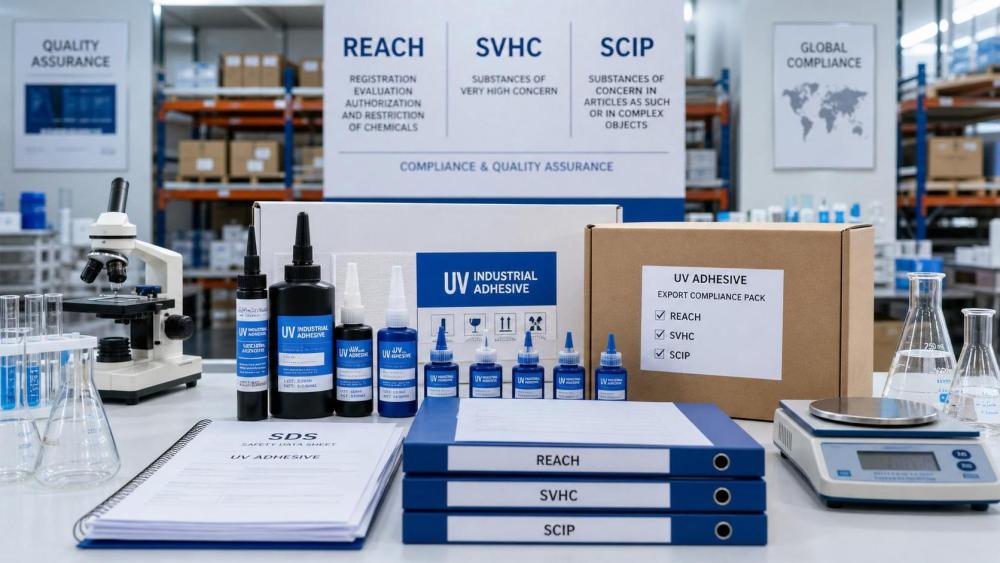
What the July 4 Draft Actually Introduces
According to the information provided, ECHA published a REACH draft amendment on July 4, 2026. The draft places three categories of photoinitiators used in this context, TPO, 819, and ITX, and their degradation products on the SVHC Candidate List.
The same draft also states that, from October 1, 2026, UV-curing industrial adhesives containing those substances must complete mandatory SCIP database notification before being exported to the EU.
The disclosed impact described in the source information is direct: the requirement affects compliance access and customs clearance processes for Chinese UV adhesive manufacturers and overseas distributors.
Where the Pressure May Appear First in the Supply Chain
Export-facing adhesive producers may face a shorter compliance window
From an industry perspective, manufacturers that sell UV-curing industrial adhesives into the EU may be the first group to feel the operational impact. The reason is straightforward: the rule described in the draft links product composition to a pre-export notification step. The business effect may therefore appear in formulation review, shipment release preparation, and export documentation readiness.
What deserves closer attention is whether affected product lines can be clearly identified in time and whether internal compliance files are complete enough to support SCIP notification before goods move.
Overseas distributors may need to recheck market-entry workflows
For distributors serving EU customers, the issue is not limited to sales continuity. Observably, the draft points to a potential change in access conditions before goods enter the EU market. That means distributor-side attention may shift toward inbound product screening, document collection, and coordination with suppliers on declaration timing.
The practical risk is that product movement and customs handling could become more sensitive to incomplete or delayed compliance information.
Supply chain and customs-facing teams may see tighter coordination demands
Teams responsible for cross-border fulfillment, customs preparation, and delivery scheduling may also be affected. Analysis shows that once notification becomes a pre-export requirement, compliance timing may become part of the shipment timetable rather than a separate regulatory matter handled later.
For these roles, the key change to watch is whether lead times, handoff points, and document checks need to be adjusted to avoid disruptions in clearance or delivery commitments.
What Companies Should Track Before October 2026
Follow the wording of the draft and any later official clarification
The current development is described as a draft amendment. What companies should monitor closely is how the official wording develops after the July 4 release, especially around the scope of covered substances, the treatment of degradation products, and the exact compliance expectations tied to export before October 1, 2026.
Identify exposed product lines and customer routes early
Businesses involved in UV-curing industrial adhesives should review which products sold into the EU may contain TPO, 819, ITX, or the degradation products referenced in the draft. The point here is not to assume every product is affected, but to map where exposure may exist across formulations, customer accounts, and shipment destinations.
Prepare supporting documents for SCIP-related workflow needs
Analysis shows that the draft matters in practice because it turns substance identification into an operational filing requirement. Companies should therefore focus on whether supplier information, composition records, and export-facing product files are organized well enough to support SCIP notification without delaying outbound shipments.
Align internal and external communication before orders are at risk
For manufacturers and distributors, customer communication may become a practical issue as much as a regulatory one. Procurement teams, compliance staff, sales teams, and logistics counterparts may need a common view of which products are affected, what information is required, and how this may influence delivery scheduling or customs processing.
Why This Looks Like More Than a Routine Update
Observably, this development should not be read only as a narrow substance listing update. It also signals that regulatory attention is moving into the transaction and shipment stage for certain UV-curing industrial adhesives entering the EU market.
At the same time, it is more appropriate to understand this as a live compliance development rather than a fully settled end state. The information provided refers to a draft amendment, so the market implication is already tangible, but the full practical interpretation still requires continued attention to official follow-up.
From an industry perspective, the importance of this news lies in the short timeline between the July 4 draft release and the October 1, 2026 notification requirement described in the input. That makes preparation cadence a near-term concern even while the broader regulatory picture still needs monitoring.
How the Market May Best Read This Stage
This update is best understood as a near-term compliance trigger with broader strategic significance. In the short term, it points to immediate work around product screening, filing readiness, and export process control. In the longer view, Analysis shows it may also serve as a signal that EU market access for industrial chemical products can become more documentation-intensive at the point of trade execution.
A cautious reading is therefore the most reasonable one: the impact is already relevant for affected exporters and distributors, but the industry should continue to distinguish between confirmed requirements in the disclosed draft and any later clarification that may shape implementation details.
Basis of This Article and What Still Needs Verification
This article is based on the user-provided news title, event date, and event summary. The core facts used here are limited to the July 4, 2026 timing, ECHA's release of a REACH draft amendment, the inclusion of TPO, 819, ITX and their degradation products in the SVHC Candidate List, and the stated October 1, 2026 SCIP notification requirement for affected UV-curing industrial adhesives exported to the EU.
For this type of industry update, relevant source categories usually include official regulatory notices, company disclosures, industry association updates, authoritative media reporting, and standard or compliance-related documents. A specific official source link was not provided in the input, so the exact document path and any later formal clarification still need ongoing verification.
What should be watched next includes any updated official wording, implementation detail around notification practice, and whether additional clarification emerges on how the requirement will be applied in actual export and customs workflows.
Have questions about this sector analysis, or seeking best practices specific to your niche? Drop us a line below and let the senior consultants at APIM assist you.
We respect your privacy. Your information is strictly confidential.
Related News
- 00
0000-00
Do polyolefin hot melt adhesives bond well to polyethylene? - 00
0000-00
Korean Study Finds PLA Barely Degrades in Landfill After 320 Days - 00
0000-00
How to assess batch consistency from a thermal potting compounds supplier - 00
0000-00
How much weight can carbon fiber reinforced plastics save in cars? - 00
0000-00
Switching from PS to ABS Sheet Extrusion: Equipment Checks