




ECHA Adds UV Adhesive Substances to SVHC Draft List
On July 2, 2026, a new compliance signal emerged for companies involved in UV-curing industrial adhesives destined for the EU market. According to the information provided, ECHA issued a draft amendment under REACH that would place four photoinitiators, TPO, 819, ITX, and BP-3, on the SVHC candidate list, while also requiring suppliers exporting these products to the EU to complete mandatory SCIP database notification from October 1, 2026. For exporters, importers, formulators, and purchasing teams, the practical significance lies less in the announcement itself and more in its direct connection to formulation review, technical documentation readiness, customs processing efficiency, and supplier verification.
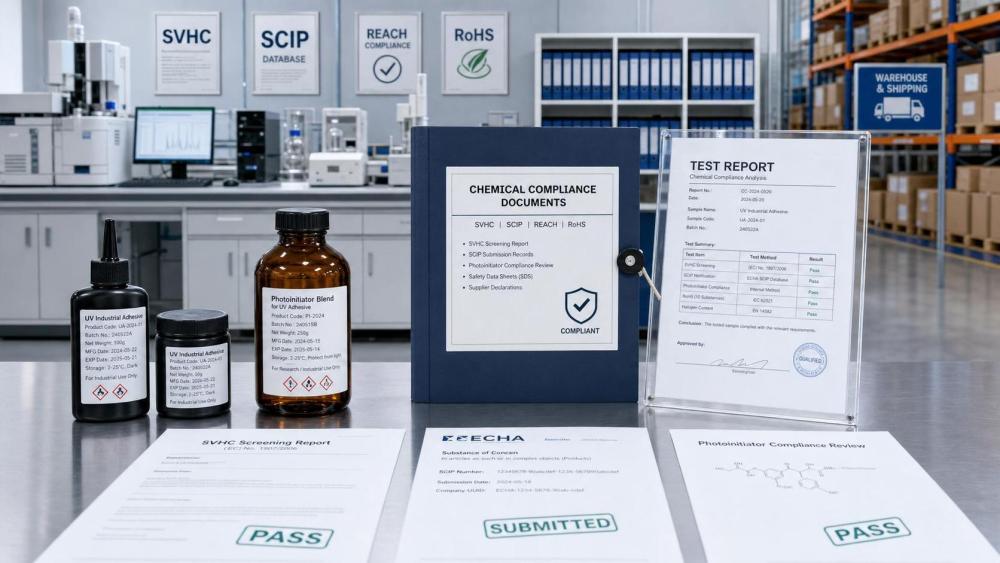
What the July 2 draft change actually sets out
Based on the supplied event summary, ECHA released a draft revision to the REACH framework on July 2, 2026. The draft adds four photoinitiators used in this product context, TPO, 819, ITX, and BP-3, to the SVHC candidate list.
The same draft also introduces a timing requirement tied to exports into the EU market: from October 1, 2026, suppliers of UV-curing industrial adhesives exported to the EU must complete mandatory notification in the SCIP database.
The confirmed operational effects described in the input are threefold: formulation compliance will be directly affected, technical document preparation will become more important, and customs clearance timing may be impacted. The input also states that importers need to verify supplier notification status in advance.
Where the pressure is likely to appear across the supply chain
Formulation and manufacturing teams face a direct compliance check
For manufacturers and formulators of UV-curing industrial adhesives, the rule change matters because the listed substances are linked to the product recipe itself. From an industry perspective, this means the first point of impact is not only external trade paperwork but also internal formulation review. Companies in this position need to pay close attention to whether existing product compositions involve TPO, 819, ITX, or BP-3, and whether supporting compliance files match the substances actually used in exported products.
Export and customs-facing functions may see document-driven delays
Exporters and supply chain teams are likely to feel the impact in shipment preparation and border-facing workflows. Analysis shows that once SCIP notification becomes mandatory for these EU-bound products, the quality and completeness of compliance documentation can affect how smoothly goods move through delivery and customs-related stages. What deserves closer attention is the connection between notification status and shipment timing, especially where documentation is prepared late or checked only after an order is ready to dispatch.
EU importers and purchasing functions will need earlier supplier checks
For importers and procurement teams, the supplied information already points to a practical shift: supplier notification status needs to be verified in advance. Observably, this changes supplier management from a commercial checkpoint into a compliance checkpoint. Buyers dealing with UV-curing industrial adhesives for the EU market should focus on whether suppliers can demonstrate SCIP completion and whether supporting technical files are ready before purchasing and shipping decisions are finalized.
What companies should review before the October deadline
Check whether affected substances appear in product formulations
Companies handling UV-curing industrial adhesives for EU export should start with a substance-level review of products that may contain TPO, 819, ITX, or BP-3. This is not yet a conclusion about market exclusion or product replacement; it is a practical compliance screening step tied directly to the reported draft change.
Prepare technical files with shipment use in mind
The event summary specifically highlights technical documentation readiness. Analysis shows that businesses should pay attention to whether product composition records, compliance statements, and related technical materials are internally consistent and available in time for trade use. In practice, weak document readiness can create pressure not only in compliance review but also in delivery scheduling.
Verify SCIP status earlier in the purchasing cycle
For importers and downstream buyers, the more immediate issue is timing. It is more appropriate to understand this as a need to move supplier verification forward rather than leaving it to the shipping stage. Where EU-bound supply depends on external manufacturers, procurement teams should focus on notification status before confirming supply arrangements.
Watch for further clarification in implementation language
Because the provided information refers to a draft amendment, companies should continue monitoring how the requirement is described in official follow-up materials and how it is reflected in transaction documents and customer requirements. The current information supports early preparation, but it does not provide a full execution playbook.
Why this looks like an execution signal, not just a policy headline
Analysis shows that the significance of this development lies in its operational linkage. The draft does not only point to a substance-listing issue; it also connects that issue to a dated SCIP notification requirement for EU-bound UV-curing industrial adhesives. That makes this more than a general regulatory update for legal teams. It is also a signal for product stewardship, export operations, purchasing review, and importer due diligence.
At the same time, it is more appropriate to understand this as a rule development with immediate preparation value rather than as a fully closed implementation picture. The supplied information confirms the direction and timing signal, but companies still need to watch for later wording, execution interpretation, and market-side responses.
How the market should read this development for now
The current update is best read as a targeted compliance change with practical consequences for EU-related adhesive trade. Its importance comes from the way substance listing, SCIP notification, technical documentation, and shipment readiness are brought into the same workflow. A measured reading is warranted: the event already provides a clear preparation trigger, but the full shape of implementation still deserves continued attention.
Basis of this article and what still needs verification
This article is generated from the user-provided news title, event date, and event summary. For developments of this kind, commonly relevant source types include official regulatory announcements, notices issued by supervisory authorities, customs or trade administration updates, industry association communications, standards-related documents, and reporting by authoritative trade media.
No specific official source link was provided in the input, so the exact official publication path still needs to be verified on an ongoing basis. Observably, the areas that merit further follow-up include detailed implementation wording, compliance interpretation in practice, changes in customer or tender documentation, market feedback, and how companies execute supplier notification and document preparation before the stated October 1, 2026 timeline.
Have questions about this sector analysis, or seeking best practices specific to your niche? Drop us a line below and let the senior consultants at APIM assist you.
We respect your privacy. Your information is strictly confidential.
Related News
- 00
0000-00
Do polyolefin hot melt adhesives bond well to polyethylene? - 00
0000-00
Korean Study Finds PLA Barely Degrades in Landfill After 320 Days - 00
0000-00
How to assess batch consistency from a thermal potting compounds supplier - 00
0000-00
How much weight can carbon fiber reinforced plastics save in cars? - 00
0000-00
Switching from PS to ABS Sheet Extrusion: Equipment Checks