




ECHA Adds UV Adhesive SVHCs, SCIP Filing Starts Oct 2026
On July 3, 2026, the European Chemicals Agency (ECHA) updated the SVHC Candidate List and brought a new compliance trigger into focus for UV-curing industrial adhesives. The change matters not only because four photoinitiators are now formally listed, but because importers and suppliers handling affected adhesive products will soon need to connect substance screening, SCIP notification, and SDS updates within a short implementation window ending on October 1, 2026. For exporters, buyers, formulators, and document-control teams, this is less a routine regulatory note than a practical signal that product data and delivery paperwork may need to move faster than before.
What the July 3 update confirms
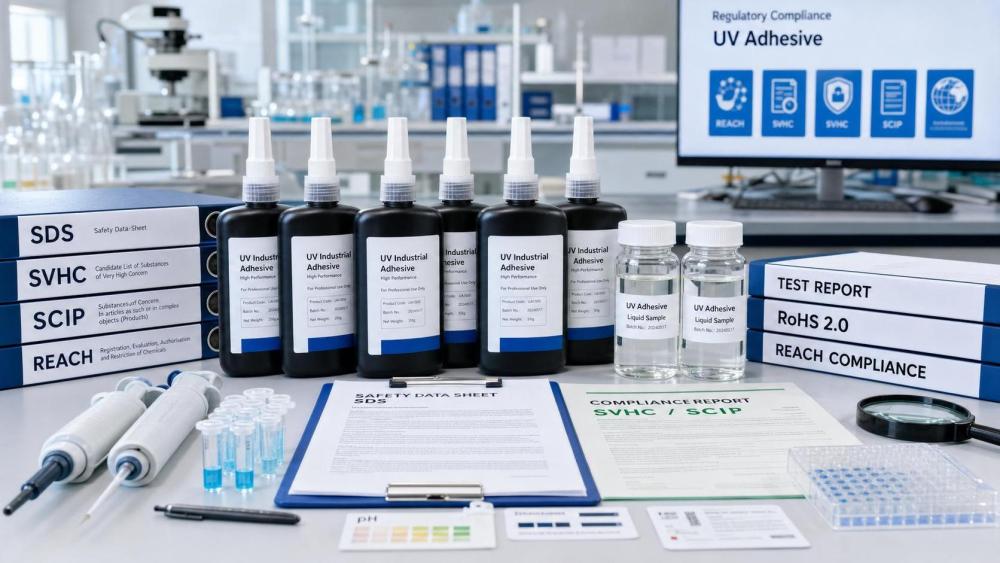
According to the provided information, ECHA released a new SVHC Candidate List update on July 3, 2026. In that update, four photoinitiators, TPO, 819, ITX, and DETX, were identified as substances of very high concern (SVHCs), with relevance to light-curing products including UV-curing industrial adhesives.
The same input states that from October 1, 2026, imported adhesives containing 0.1% or more of any one of these substances must be notified to ECHA through SCIP. It also states that downstream customers must receive updated Safety Data Sheets (SDS). The information provided further indicates that this requirement directly affects compliance preparation timelines and document delivery processes for global UV adhesive exporters.
Where the operational pressure is likely to appear
Export-facing adhesive supply may see earlier document checks
From an industry perspective, companies selling UV-curing adhesives into the relevant market may be affected first at the export and shipment-preparation stage. The reason is straightforward: once a product crosses the stated concentration threshold, SCIP notification and SDS updates become part of the practical readiness package around market access and customer delivery. What deserves closer attention is whether exporters have substance-level visibility early enough to avoid delays between order confirmation and document release.
Procurement teams may need tighter upstream material confirmation
For raw-material procurement and sourcing functions, the likely impact sits in supplier communication and composition confirmation. Analysis shows that buyers of photoinitiator-containing adhesive inputs may need more precise declarations from upstream suppliers in order to determine whether any listed substance reaches the 0.1% threshold in the imported adhesive. In practical terms, this turns purchasing from a price-and-lead-time exercise into a documentation-dependent process for affected product lines.
Manufacturing and formulation control may shift toward threshold management
For processors and manufacturers of UV-curing industrial adhesives, the main issue is not only formulation choice but also how composition data are organized for compliance use. Observably, if affected substances are present, the business impact may show up in product review, specification confirmation, and release documentation. The rule change therefore reaches beyond the lab and into product stewardship, customer file preparation, and shipment support.
Distributors and downstream service teams may face updated information duties
Channel operators and downstream service teams may also be affected because the provided information specifically mentions SDS updates for downstream customers. This means the commercial chain is not limited to filing alone; it also includes the controlled transmission of updated safety information. From a business-process angle, that can affect quotation attachments, delivery documentation, after-sales technical support, and traceability records tied to the adhesive product supplied.
What companies should review before the October trigger
Check whether affected product lines cross the stated threshold
Analysis shows that one immediate task is product screening against the four listed photoinitiators: TPO, 819, ITX, and DETX. For companies involved in importing or exporting UV-curing industrial adhesives, the first practical question is whether any product contains 0.1% or more of any one listed substance. Without that determination, later decisions on notification and customer documentation remain incomplete.
Align SCIP preparation with SDS revision workflows
What deserves closer attention is the connection between regulatory filing and customer-facing documents. The provided information links SCIP notification with SDS updates, which means businesses should not treat them as isolated tasks. Internal teams handling compliance, technical documentation, sales support, and order fulfillment may need a coordinated review path so that the data used for filing are consistent with the information sent downstream.
Watch for execution details in customer and market requirements
Because the input does not provide detailed implementation guidance beyond the core requirement, it is more appropriate to understand this stage as one that still requires close monitoring of execution language. Companies should pay attention to how customers, procurement documents, and trade-facing documentation begin to reflect the new requirement. This is especially relevant where supply decisions depend on declaration completeness, documentation timing, or acceptance of revised SDS files.
Review delivery timing and file handover discipline
Observably, the short period between the July 3 update and the October 1, 2026 compliance date places pressure on file preparation and handover discipline. For affected businesses, the issue may be less about broad strategic change and more about whether technical, commercial, and logistics teams can release accurate documents on time. Exporters and import-facing suppliers should therefore review how compliance files move through approval and customer delivery channels.
Why this looks like an execution signal, not just a list update
Analysis shows that this development is best read as more than a symbolic Candidate List expansion. The reason is that the provided information already ties the listing to a dated compliance consequence: from October 1, 2026, imported adhesives above the stated threshold must be notified through SCIP and supported by updated SDS communication downstream. That gives the market a concrete operational marker rather than a purely watch-list event.
At the same time, it would be premature to treat all downstream effects as settled. It is more appropriate to understand this as a clear execution signal with remaining room for observation around practical interpretation, customer responses, document expectations, and how quickly affected supply chains normalize the new workflow.
How the market is likely to read this development now
At this stage, the significance of the update lies in its direct effect on compliance timing and document readiness for UV-curing industrial adhesives involving the listed photoinitiators. The confirmed facts point to a near-term obligation that can influence trade preparation, procurement confirmation, and downstream information delivery. A neutral reading is that this is already a landed compliance change in principle, while the finer points of market execution still deserve continued attention.
Basis of this article and what still needs verification
This article is based on the user-provided news title, event date, and event summary. For events of this type, relevant source categories usually include official notices, regulatory agency publications, customs or trade authority information, industry association updates, standards-related documents, and reporting by established trade media. No specific official source link was provided in the input, so the exact official reference still needs to be verified on an ongoing basis.
Further observation is still needed on any detailed implementation language, certification or compliance interpretation in commercial practice, changes in tender or procurement documentation, market feedback from affected supply chains, and how companies execute the notification and SDS update requirements in day-to-day operations.
Have questions about this sector analysis, or seeking best practices specific to your niche? Drop us a line below and let the senior consultants at APIM assist you.
We respect your privacy. Your information is strictly confidential.
Related News
- 00
0000-00
Do polyolefin hot melt adhesives bond well to polyethylene? - 00
0000-00
Korean Study Finds PLA Barely Degrades in Landfill After 320 Days - 00
0000-00
How to assess batch consistency from a thermal potting compounds supplier - 00
0000-00
How much weight can carbon fiber reinforced plastics save in cars? - 00
0000-00
Switching from PS to ABS Sheet Extrusion: Equipment Checks