




ECHA Adds UV-328 and UV-327 to SVHC List
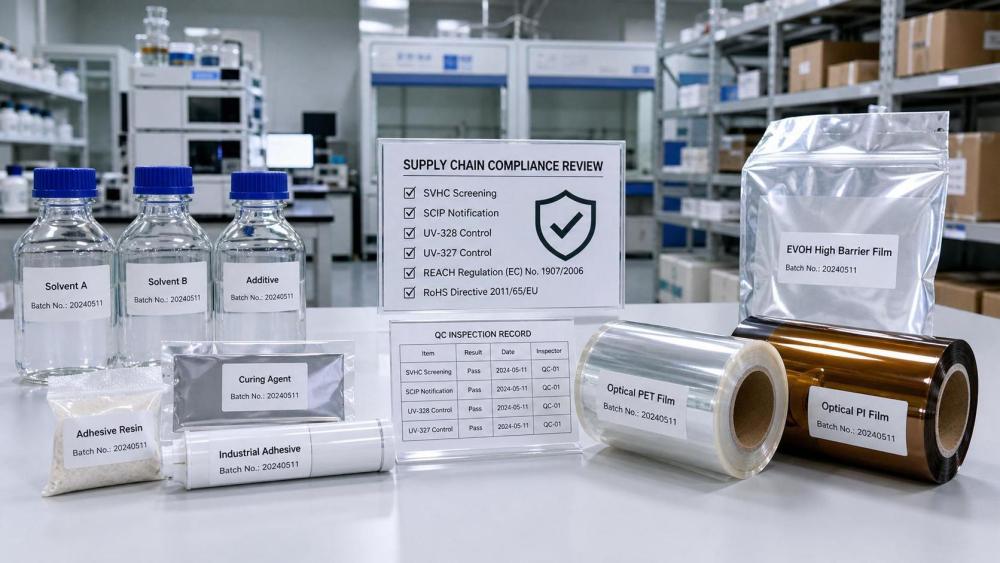
On July 17, 2026, the European Chemicals Agency (ECHA) added the UV absorbers UV-328 and UV-327 to the SVHC Candidate List, turning a regulatory update into an immediate supply-chain compliance issue. For suppliers of downstream articles containing these substances at or above 0.1% w/w, the change brings instant attention to SCIP notification duties and to the need to provide safe-use information to EU importers. The development is especially relevant for exporters tied to UV-curing industrial adhesives, optical PET/PI display films, EVOH high-barrier packaging, and other material applications where documentation timing and substance tracing now become a practical business concern.
What Has Changed as of July 17
According to the information provided, ECHA formally placed UV-328 and UV-327 on the SVHC Candidate List on July 17, 2026. As a result, suppliers of downstream articles containing either substance at concentrations of at least 0.1% w/w must immediately begin SCIP database notification and provide EU importers with information for safe use.
The supplied information specifically notes that the impact may extend to downstream products such as UV-curing industrial adhesives, optical PET/PI display films, and EVOH high-barrier packaging. It also states that the decision directly affects the compliance response window and technical document preparation schedule of related Chinese material exporters.
Where the Pressure Will Be Felt First
Export-facing material suppliers
From an industry perspective, suppliers serving the EU market are likely to feel the first impact because the regulatory change is tied directly to article content thresholds and notification obligations. The immediate business effect is not limited to formulation awareness; it also reaches shipment readiness, customer document requests, and the ability to explain substance status clearly to EU-side counterparties.
Processors and manufacturers using affected materials
For converters and manufacturers that incorporate these materials into finished or semi-finished articles, the issue is likely to center on whether the final article reaches the 0.1% w/w threshold. Analysis shows that the practical pressure point is substance identification across layered or composite products, especially where adhesives, optical films, or barrier materials are part of a broader bill of materials.
EU importers and downstream buyers
EU importers are directly relevant because they will expect safe-use information from suppliers once the articles fall within the stated threshold. What deserves closer attention is that importer communication may become more document-driven and time-sensitive, particularly where sourcing decisions or delivery schedules depend on whether suppliers can provide complete and consistent compliance information.
Supply-chain service and documentation functions
Observably, the burden does not sit only with commercial teams. Regulatory affairs, quality, documentation, and supply-chain coordination functions are also affected because SCIP notification and safe-use communication rely on aligned technical files. For many businesses, the operational challenge may lie in organizing internal data quickly enough to match external customer and market timelines.
What Companies Should Focus on Now
Check article-level substance thresholds
The first practical issue is whether relevant downstream articles contain UV-328 or UV-327 at or above 0.1% w/w. Companies involved in adhesives, optical PET/PI films, EVOH high-barrier packaging, and similar material routes should focus on product mapping at the article level rather than relying only on general material descriptions.
Prepare SCIP-related documentation without delay
Because the supplied information states that SCIP notification duties are triggered immediately, companies should prioritize the readiness of technical files, internal substance declarations, and article-related data needed for notification work. Analysis shows that timing matters here because documentation delays can quickly spill over into delivery coordination and importer communication.
Align communication with EU importers
Another immediate point is the obligation to provide safe-use information to EU importers. In practice, businesses should pay close attention to how this information is presented, who is responsible for issuing it, and whether the content is consistent across sales, compliance, and logistics teams. The distinction between having data internally and being able to present it clearly to customers is likely to matter.
Watch the compliance window for China-linked exports
The supplied information specifically highlights Chinese exporters of related materials, making response speed a key issue. It is more appropriate to understand this as a documentation and coordination deadline rather than a purely legal notice: the nearer-term pressure is likely to appear in export execution, customer follow-up, and technical file preparation cadence.
Why This Looks Like More Than a Routine Update
Analysis shows that this development should not be read only as a list change in isolation. At the operational level, it creates an immediate compliance task for articles meeting the stated threshold and pushes substance visibility deeper into the supply chain. That makes the update relevant not just to regulatory specialists, but also to commercial, sourcing, manufacturing, and export teams.
Observably, this is both a short-term compliance event and a longer-term signal. The short-term element is clear: affected suppliers must deal with SCIP notification and safe-use information now. The longer-term element is that the market may place more weight on traceability and documentation discipline in product categories where these UV absorbers are present. Even so, any broader market outcome still requires continued observation rather than firm conclusion.
How the Industry May Best Read This Stage
At this stage, the most reasonable interpretation is that the listing of UV-328 and UV-327 has already created a concrete compliance trigger for relevant articles, while its wider commercial effects will depend on how quickly companies can verify substance content and organize technical documentation. The update is therefore best understood as an immediate operational requirement combined with a regulatory signal that deserves continued monitoring across export-facing material chains.
Basis of This Article
This article is based on the user-provided news title, event date, and event summary concerning ECHA's July 17, 2026 addition of UV-328 and UV-327 to the SVHC Candidate List. For this type of development, source categories usually relevant to verification include official announcements, company disclosures, industry association updates, authoritative media reports, and standard or regulatory documents. A specific official source link was not provided in the input, so further verification remains necessary. Ongoing attention should focus on any subsequent official wording, implementation details, and practical compliance expectations affecting SCIP notification and importer communication.
Have questions about this sector analysis, or seeking best practices specific to your niche? Drop us a line below and let the senior consultants at APIM assist you.
We respect your privacy. Your information is strictly confidential.
Related News
- 00
0000-00
NAPCOR Report: US PET Bottle Recycling Rate Fell to 29% in 2025 - 00
0000-00
How does washing affect contamination in post-consumer recycled PP resins? - 00
0000-00
How does feedstock affect depolymerization equipment selection? - 00
0000-00
US Sets 213.44% Preliminary Antidumping Deposit on Chinese PTMEG - 00
0000-00
When should epoxy be used as a thermal interface material for semiconductors?