




ECHA Adds Two UV Adhesive Photoinitiators to SVHC List
On July 15, 2026, the European Chemicals Agency (ECHA) updated the SVHC Candidate List by adding TPO-L and BAPO, two photoinitiators used in UV-curing industrial adhesives. From August 15, 2026, articles containing these substances at or above 0.1% w/w will trigger communication obligations to downstream importers and notification requirements to the ECHA SCIP database. For exporters, buyers, and compliance teams connected to UV-curing adhesive supply chains, this matters because it shifts the documentation and delivery expectations tied to market access and procurement review.
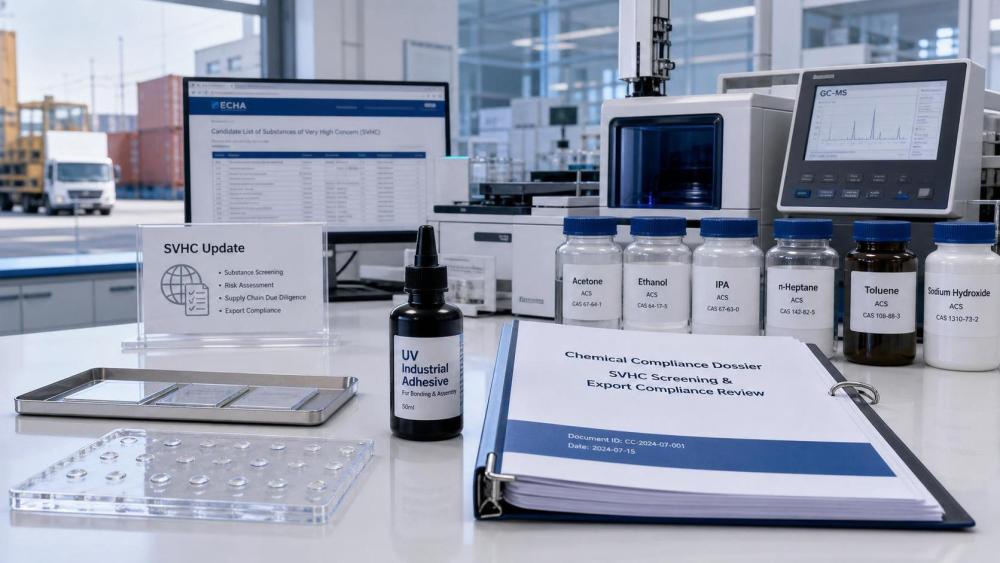
What the July 15 update confirms
The confirmed change is that ECHA added TPO-L and BAPO to the SVHC Candidate List on July 15, 2026. These two substances are identified in the provided information as photoinitiators commonly used in UV-curing industrial adhesives. The provided information also confirms that, starting on August 15, 2026, articles containing these substances at concentrations of at least 0.1% w/w must be communicated to downstream importers and notified to the ECHA SCIP database.
The same update is described as directly affecting the compliance pathway of Chinese exporters of UV-curing industrial adhesives, as well as the preparation of customer delivery documentation. Overseas buyers are also expected to update technical documentation and supplier audit checklists in response to this change.
Where the pressure will show up across the supply chain
Export documentation moves to the front of delivery readiness
From an industry perspective, exporters of UV-curing industrial adhesives may feel the impact first in contract execution and shipment preparation. The issue is not only product composition, but whether compliance-related files, substance declarations, and customer-facing documentation are ready in time for orders moving after the August 15 trigger date. What deserves closer attention is the possibility that document readiness becomes part of delivery acceptance, not just a background compliance exercise.
Procurement teams will need tighter supplier screening
For overseas buyers and sourcing teams, the change affects supplier qualification and technical review. Analysis shows that procurement functions may need to revise supplier questionnaires, technical file requests, and audit checklists to identify whether TPO-L or BAPO are present in relevant articles and whether the 0.1% w/w threshold is met. This can also affect how purchasing teams compare suppliers, especially where documentation quality becomes part of the purchasing decision.
Manufacturing and supply chain coordination may become more document-intensive
Manufacturers and supply chain service providers connected to export orders may need closer coordination between formulation review, material disclosure, and shipment support. Observably, the practical burden is likely to appear in internal handoffs: technical teams, compliance staff, sales personnel, and logistics support may all need the same substance status reflected consistently in customer files and submission-related records. The provided information does not define the full execution detail, but it clearly signals a more documentation-sensitive supply chain.
What companies should check before the August 15 trigger date
Review whether affected substances appear in relevant articles
Analysis shows that the first practical step is to identify where TPO-L and BAPO are used in products tied to UV-curing adhesive applications and whether any relevant article reaches or exceeds the 0.1% w/w threshold stated in the provided information. This is a screening task tied directly to the announced trigger, rather than a general compliance review.
Update customer-facing technical files and delivery packages
What deserves closer attention is the content of documents that accompany exports and customer approvals. The provided information explicitly points to customer delivery documentation, which means companies should check whether technical declarations, product information files, and related compliance materials need revision before shipment or onboarding discussions proceed. Where buyers rely on pre-approval files, document timing may matter as much as document accuracy.
Align supplier audit materials with the new disclosure expectation
For buyers and multi-tier supply chains, the announced change suggests that supplier audit checklists and technical document requests should be reviewed promptly. Observably, this is relevant not only for direct importers but also for intermediate supply partners that collect material data from upstream manufacturers. If screening templates do not reflect the new SVHC status, procurement and compliance reviews may lag behind the actual rule change.
Keep watching for execution language and market-side interpretation
The provided information confirms the trigger date and the basic notification obligation, but it does not provide broader implementation detail. It is more appropriate to understand this as a compliance change that is already actionable, while still requiring continued monitoring of how counterparties, procurement teams, and document reviewers apply it in practice. Companies should therefore track later official wording, customer requests, and any adjustments in bidding or technical review materials.
Why this looks like an execution signal, not just a watchlist item
Analysis shows that this development should be read less as a distant policy trend and more as an immediate execution signal for supply-chain communication. The reason is the short interval between the July 15 list update and the August 15 communication trigger described in the provided information. At the same time, it would be premature to treat all downstream market effects as settled. Observably, the core confirmed change is the compliance obligation itself, while the full commercial response will depend on how buyers and suppliers implement document checks and audit updates.
How the market should read this change for now
At this stage, the update is best understood as a concrete compliance development tied to substance disclosure and supply-chain communication, rather than as a broad market forecast. The confirmed effect is that certain UV-curing adhesive-related articles may now require additional downstream communication and SCIP notification from August 15, 2026. The broader business impact will likely depend on how quickly exporters, buyers, and supply-chain partners adjust technical files, screening steps, and delivery documentation.
Basis of this article and points still requiring verification
This article is based on the user-provided news title, event date, and event summary. For events of this type, relevant source categories often include official notices, releases from regulatory authorities, customs or trade administration updates, industry association communications, standards organization documents, and reporting by authoritative trade media. A specific official source link was not provided in the input, so the exact official publication path still needs to be verified on an ongoing basis.
Further observation is still needed on later implementation detail, interpretation in certification and compliance reviews, changes in bidding or procurement documents, industry feedback, and how companies execute the new communication and documentation requirements in practice.
Have questions about this sector analysis, or seeking best practices specific to your niche? Drop us a line below and let the senior consultants at APIM assist you.
We respect your privacy. Your information is strictly confidential.
Related News
- 00
0000-00
How does washing affect contamination in post-consumer recycled PP resins? - 00
0000-00
How does feedstock affect depolymerization equipment selection? - 00
0000-00
US Sets 213.44% Preliminary Antidumping Deposit on Chinese PTMEG - 00
0000-00
When should epoxy be used as a thermal interface material for semiconductors? - 00
0000-00
US Midterm Results Unlikely to Quickly Shift Recycled Plastics Market or Legislation