




ECHA Adds Three UV Adhesive Photoinitiators to SVHC List
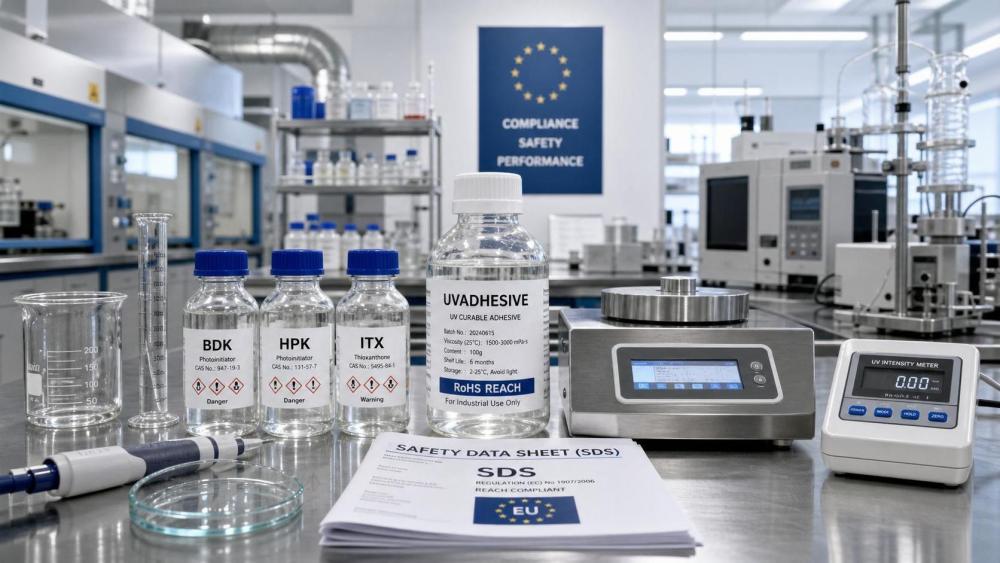
On July 10, 2026, the European Chemicals Agency (ECHA) added three photoinitiators used in UV-curing industrial adhesives to the SVHC Candidate List: BDK, HPK, and ITX. For companies selling into the EU market, this is not just a regulatory update but an immediate compliance issue, because stricter REACH supply chain communication, safety data sheet updates, and possible future authorization requirements now come into view. Chinese exporters of UV-curing industrial adhesives and overseas distributors serving EU customers are the groups most directly exposed, especially with formulation review and substitution validation needing attention before Q3 2026.
What ECHA Confirmed on July 10
According to the information provided, ECHA formally placed 2-benzyl-2-dimethylamino-4′-morpholinobutyrophenone (BDK), 1-hydroxycyclohexyl phenyl ketone (HPK), and isopropylthioxanthone (ITX) on the SVHC Candidate List on July 10, 2026. The confirmed consequence is that this listing triggers stricter obligations under REACH, including tighter supply chain notification requirements, updates to safety data sheets, and the possibility of eventual authorization requirements. The same information also makes clear that Chinese suppliers exporting UV-curing industrial adhesives to the EU, as well as overseas distributors handling those products, face direct compliance pressure and are expected to complete formulation assessment and substitution validation before Q3 2026.
Where the pressure is likely to appear first
Export suppliers facing immediate formulation review
From an industry perspective, exporters of UV-curing industrial adhesives to the EU are likely to feel the earliest impact because the listed substances are directly tied to product composition. The pressure is expected to show up in formulation screening, internal compliance checks, customer documentation, and the timing of substitution work. What deserves closer attention is whether existing products supplied to the EU rely on BDK, HPK, or ITX in a way that changes disclosure or marketability requirements.
Distributors caught between upstream data and EU customer demands
Overseas distributors may be affected because they sit between manufacturers and EU buyers. Their exposure is likely to center on product information flow, document accuracy, and communication with customers requesting updated compliance positions. Analysis shows that the operational burden here is less about manufacturing change itself and more about whether distributors can obtain timely substance and formulation information from suppliers and reflect that correctly in commercial and compliance documents.
Procurement and downstream users watching continuity risks
Buyers and downstream industrial users may also need to monitor this development because SVHC listing can affect product selection, approval workflows, and continuity of supply. Observably, the practical concern is not only whether a material remains available, but whether its compliance status changes the conditions under which it can be sourced, documented, or approved for continued use in EU-facing business.
What companies should focus on now
Check whether affected substances are present in EU-bound products
The first practical issue is product-level confirmation. Companies involved in UV-curing industrial adhesives for the EU market need to identify whether BDK, HPK, or ITX appear in formulations tied to current shipments, pending orders, or distributor stock. This is the starting point for any next compliance decision.
Prepare for document updates and supply chain communication
Because the provided information explicitly points to stricter REACH communication obligations and safety data sheet updates, companies should pay close attention to document control, version updates, and the consistency of information shared with distributors and customers. The immediate task is procedural as much as technical: data must be aligned across sales, regulatory, and supply chain functions.
Separate listing impact from future authorization risk
Analysis shows that companies should distinguish between what has already happened and what may develop later. The confirmed fact is SVHC Candidate List inclusion and the resulting tighter communication and documentation obligations. The possible future authorization requirement should be treated as a regulatory signal that deserves monitoring, not as a completed outcome.
Use Q3 2026 as an operational deadline, not a passive reference point
The provided information indicates that formulation assessment and substitution validation should be completed before Q3 2026. In practical terms, companies should treat this as a working deadline for technical review, supplier coordination, internal approval, and customer communication planning, especially where sales to the EU depend on uninterrupted compliance positioning.
Why this reads as more than a routine list update
Observably, this development is best understood as an immediate compliance trigger with longer-term regulatory implications. It is not yet proof of a final market outcome for every UV-curing adhesive product, but it does send a clear signal that formulations containing the listed photoinitiators now require closer scrutiny in EU-related business. From an industry perspective, the significance lies less in headline value and more in the fact that regulatory listing now intersects directly with documentation, substitution work, and commercial timing.
How to read the signal at this stage
At this stage, it is more appropriate to understand the update as a short-term operational change combined with a longer-term compliance signal. The short-term change is clear: affected companies must address supply chain notification, safety data sheet updates, and formulation review. The longer-term element still requires continued observation, especially around how authorization-related expectations may evolve. That makes this development important not because every consequence is already fixed, but because inaction could quickly turn a regulatory notice into a business delivery problem.
Basis of this article and what still needs verification
This article is based on the user-provided news title, event date, and event summary. For this type of industry update, relevant source categories typically include official notices, company disclosures, industry association information, authoritative media coverage, and standards-related documents. A specific official source link was not provided in the input, so the exact underlying publication should still be verified on an ongoing basis. What remains worth tracking is any subsequent official wording, downstream compliance interpretation, and practical implementation requirements connected to the listed substances in EU-bound UV-curing industrial adhesive supply chains.
Have questions about this sector analysis, or seeking best practices specific to your niche? Drop us a line below and let the senior consultants at APIM assist you.
We respect your privacy. Your information is strictly confidential.
Related News
- 00
0000-00
How does washing affect contamination in post-consumer recycled PP resins? - 00
0000-00
How does feedstock affect depolymerization equipment selection? - 00
0000-00
US Sets 213.44% Preliminary Antidumping Deposit on Chinese PTMEG - 00
0000-00
When should epoxy be used as a thermal interface material for semiconductors? - 00
0000-00
US Midterm Results Unlikely to Quickly Shift Recycled Plastics Market or Legislation