




ECHA Adds Three UV Adhesive Photoinitiators to SVHC List
On July 9, 2026, ECHA added three photoinitiators used in UV-curing industrial adhesives, ITX, MBI, and 4-PB, to the SVHC Candidate List. The change is not only a substance listing update; it also creates a near-term compliance trigger for imported adhesives containing these substances at or above 0.1% w/w from October 1, 2026, including SCIP notification and updated SDS communication to downstream users. For exporters, importers, and electronics and automotive assembly buyers, this is relevant because it directly affects substance review, procurement screening, and delivery-related documentation.
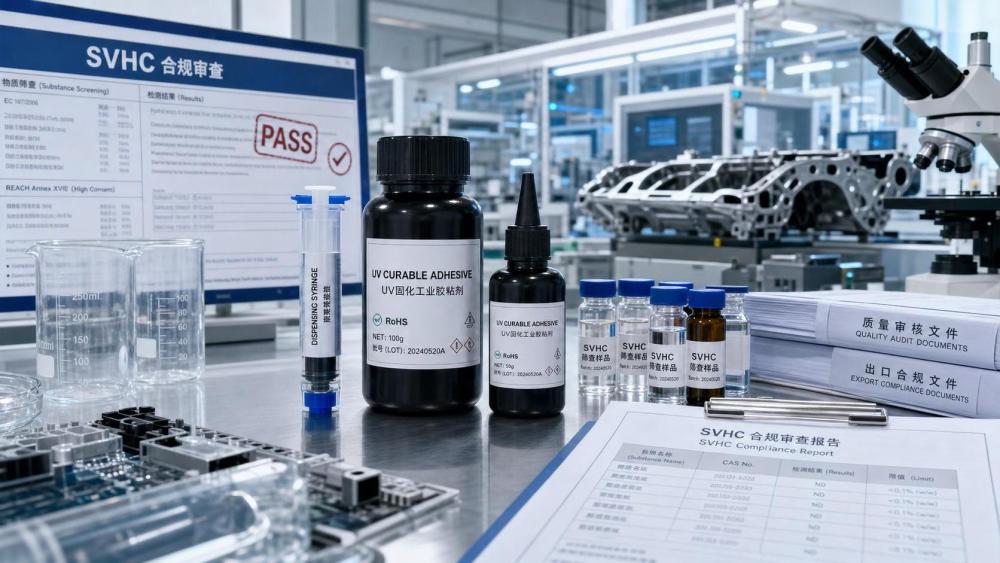
What the listing changes on the compliance side
The confirmed facts are as follows: ECHA formally placed isopropyl thioxanthone (ITX), 2-methyl-1H-benzimidazole-5-sulfonic acid (MBI), and 4-phenyldiphenyl ketone (4-PB) on the SVHC Candidate List on July 9, 2026. These three substances are described in the input as photoinitiators commonly used in UV-curing industrial adhesives. From October 1, 2026, imported adhesives containing any of these substances at a concentration of 0.1% w/w or higher must fulfill SCIP notification obligations and provide downstream users with updated versions of the SDS. The adjustment directly affects compliance purchasing decisions involving global UV-curing industrial adhesives exporters, importers, and end-use electronics and automotive assembly plants.
Where the pressure is likely to appear first
Export shipments will face tighter substance disclosure demands
From an industry perspective, exporters of UV-curing industrial adhesives may be affected first because the change is tied to substance content thresholds and document obligations. The practical impact is likely to appear in pre-shipment composition checks, customer declarations, technical file review, and the ability to support import-side SCIP-related compliance requests. What deserves closer attention is whether product data packages and SDS versions remain aligned with the listed substances and the October 1, 2026 timing.
Import-side compliance review becomes more document-sensitive
Importers may be affected because the rule change explicitly links imported adhesives with SCIP notification duties once the stated threshold is met. The business effect is likely to center on customs-facing compliance preparation, supplier communication, material screening, and record consistency across purchasing and regulatory files. Analysis shows that importers will need to pay closer attention to concentration declarations, updated SDS availability, and whether supplier documentation is sufficient for internal compliance review.
Electronics and automotive buyers may tighten sourcing filters
Procurement teams at downstream assembly plants may be affected because the update changes the compliance status of substances used in adhesive inputs and requires updated safety communication when the threshold is reached. The likely impact is not limited to purchasing; it can also reach approved vendor lists, incoming material review, and product selection decisions for UV-curing adhesive use in production. Observably, buyers may place more weight on supplier responsiveness, substance transparency, and document completeness before confirming orders or continuing supply.
Practical points companies should review now
Check substance mapping against the 0.1% w/w threshold
Analysis shows that one immediate task is to identify whether affected adhesive products contain ITX, MBI, or 4-PB at or above the stated threshold. This is a practical screening step rather than a conclusion about market impact, but it matters because the obligation described in the input is threshold-based and time-bound.
Prepare SDS updates and supporting files for customer requests
What deserves closer attention is document readiness. Since the input states that updated SDS must be provided to downstream users from October 1, 2026, companies involved in trade and supply should review whether their SDS versions, internal product files, and customer-facing compliance materials are consistent and current. If supporting test, composition, or technical documents are used in sales or qualification processes, they may also need internal cross-checking for consistency.
Review procurement and supplier qualification language
Observably, procurement teams may need to revisit supplier questionnaires, purchasing specifications, and incoming compliance checkpoints for UV-curing industrial adhesives. This should be understood as a practical response to a rule change rather than proof of a uniform market reaction. The main issue is whether existing sourcing language is adequate to identify products affected by the SVHC listing and the related notification and SDS obligations.
Watch for execution details in market-facing documents
From an industry perspective, companies should continue monitoring how this listing is reflected in customer requirements, tender documents, and downstream compliance requests. The input does not provide detailed enforcement practice or market implementation outcomes, so it would be premature to describe any single execution path as settled. At this stage, attention should remain on official wording, commercial document updates, and feedback from supply-chain counterparties.
How this development is best interpreted for now
Analysis shows that this development is better understood as an implemented compliance change with immediate operational implications, rather than as a distant policy signal. The reason is that the input provides both a confirmed listing date and a defined date from which specified obligations apply to imported adhesives meeting the threshold. At the same time, observably, the market impact still depends on how exporters, importers, and downstream buyers translate the rule into screening criteria, documentation requests, and procurement controls. That is why continued attention to execution language and industry feedback remains necessary.
What this means for the market at this stage
At this stage, the most balanced reading is that the ECHA listing creates a concrete compliance checkpoint for UV-curing industrial adhesives containing ITX, MBI, or 4-PB at the stated level, especially in cross-border supply and downstream purchasing. It is more appropriate to understand this as a rule change that has already moved into the implementation window, while some practical interpretation in procurement and supply-chain execution still warrants observation. The immediate significance lies less in broad market conclusions and more in document readiness, supplier transparency, and procurement-side compliance screening.
Basis of this article and points still to verify
This article is generated based on the user-provided news title, event date, and event summary. For developments of this type, commonly relevant source categories may include official notices, publications from regulatory authorities, trade or customs authority information, industry association updates, standards organization documents, and reporting by authoritative media. A specific official source link was not provided in the input, so that link should be further verified. It remains necessary to continue monitoring later details such as policy wording in practice, compliance interpretation, tender document changes, market feedback, and how companies implement the stated SCIP and SDS-related obligations.
Have questions about this sector analysis, or seeking best practices specific to your niche? Drop us a line below and let the senior consultants at APIM assist you.
We respect your privacy. Your information is strictly confidential.
Related News
- 00
0000-00
How does washing affect contamination in post-consumer recycled PP resins? - 00
0000-00
How does feedstock affect depolymerization equipment selection? - 00
0000-00
US Sets 213.44% Preliminary Antidumping Deposit on Chinese PTMEG - 00
0000-00
When should epoxy be used as a thermal interface material for semiconductors? - 00
0000-00
US Midterm Results Unlikely to Quickly Shift Recycled Plastics Market or Legislation