




ECHA Adds 3 UV Adhesive Substances to SVHC List
On June 30, 2026, the European Chemicals Agency (ECHA) released a draft amendment under REACH that puts new compliance pressure on UV-curing industrial adhesives supplied into the EU market. The development centers on IBOA, TMPTA, and the photoinitiator TPO-L, and it is especially relevant for exporters, downstream buyers, and procurement teams that rely on product access, substance disclosure, and documentation readiness in cross-border adhesive supply chains.
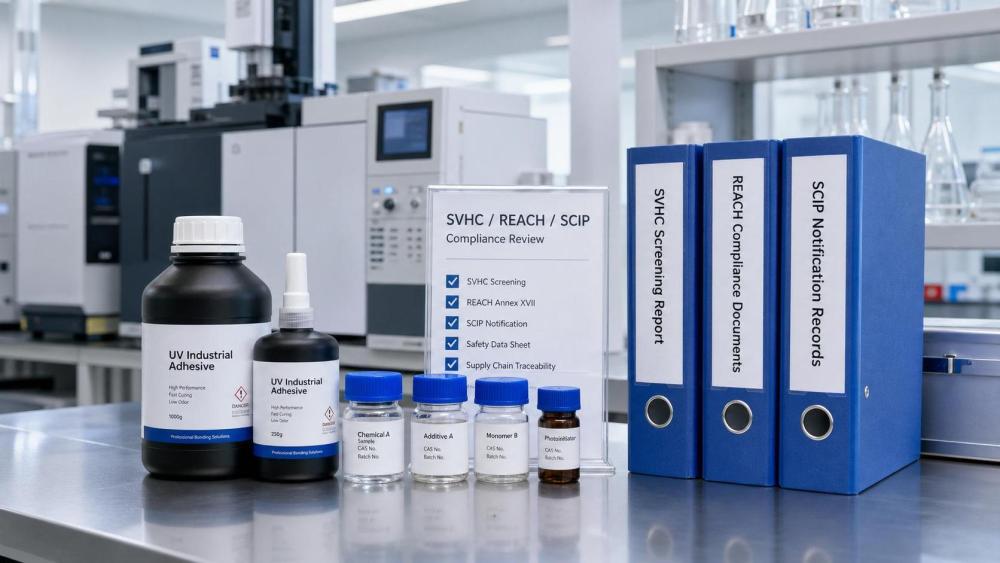
What the June 30 draft change confirms
According to the provided event information, ECHA on June 30, 2026 formally added isobornyl acrylate (IBOA), trimethylolpropane triacrylate (TMPTA), and photoinitiator TPO-L to the SVHC Candidate List through a draft revision under REACH.
The same update states that UV-curing industrial adhesives containing these substances must be submitted to the EU SCIP database from October 1, 2026.
The provided summary also makes clear that this change directly affects the EU compliance route for Chinese suppliers exporting UV adhesives and the access procedures used by downstream purchasers.
Where the immediate pressure is likely to appear
Export-facing adhesive suppliers will face a tighter market-entry process
From an industry perspective, companies selling UV-curing industrial adhesives into the EU may be affected first because the change is tied directly to substance status and mandatory SCIP notification. The main pressure point is not only formulation review, but also whether product documentation and declaration workflows can support continued customer onboarding and shipment preparation.
Procurement teams may raise supplier screening requirements
Observably, downstream buyers are likely to pay closer attention to whether relevant adhesive products contain IBOA, TMPTA, or TPO-L and whether SCIP notification obligations have been addressed. The impact may show up in supplier admission checks, document requests, and internal compliance review before purchasing decisions are finalized.
Supply chain and service partners may see more documentation coordination
What deserves closer attention is the operational layer around trade and delivery. Service providers involved in compliance support, product data handling, and order execution may need to coordinate more closely with manufacturers and buyers when substance information, declarations, or submission status becomes part of the transaction process.
What companies should watch now
Track how the official wording develops
Analysis shows that the current event is framed around a draft amendment released by ECHA on June 30, 2026. Companies should therefore watch subsequent official wording, implementation interpretation, and any clarifications that affect how the notification requirement is applied in practice.
Review affected product lines and formulations
For suppliers of UV-curing industrial adhesives, the practical starting point is to identify which products involve IBOA, TMPTA, or TPO-L. This matters because the compliance question is product-specific, and commercial exposure may differ across formulations, customer groups, and shipment destinations.
Prepare customer-facing compliance documents early
Observably, downstream access is likely to depend not only on whether a product is affected, but also on whether supporting documentation can be provided in time. Companies should focus on the readiness of declarations, internal substance tracking, and communication materials used in customer review and procurement approval.
Separate policy signal from execution readiness
It is more appropriate to understand this update as both a regulatory signal and a near-term execution issue. Even where companies already recognize the listed substances, the business risk may still arise from delayed notification, incomplete records, or misalignment between supplier statements and buyer compliance expectations.
Why this is more than a routine listing update
Analysis shows that the significance of this development lies in the combination of substance listing and a defined notification timetable tied to UV-curing industrial adhesives. That makes the event relevant not only for regulatory teams, but also for sales, procurement, and supply chain functions that depend on uninterrupted EU market access.
At the same time, it is not yet appropriate to overstate the final market outcome based only on the provided information. What can be said with confidence is that the regulatory direction is clear enough to justify immediate internal review, while the full business effect still depends on how companies, buyers, and service partners operationalize the requirement.
How this update is best understood at this stage
At this stage, the development is best understood as a near-term compliance change with broader long-term signaling value. In the short run, it points to concrete notification and documentation work before October 1, 2026. In a broader sense, it signals that UV-curing adhesive supply into the EU is facing closer scrutiny at the substance and data-reporting level. For industry participants, the sensible reading is neither alarm nor passivity, but disciplined attention to product scope, filing readiness, and downstream communication.
Basis of this article and points for continued verification
This article is based on the user-provided news title, event date, and event summary. The writing also refers to source types commonly associated with this kind of development, such as official regulatory notices, company disclosures, industry association updates, authoritative media reporting, and standard-related documents.
No specific official source link was provided in the input, so the exact primary link remains to be verified on an ongoing basis. The main follow-up points to watch are whether there are further official clarifications, whether the wording of the draft changes in subsequent releases, and how the SCIP notification requirement is implemented in actual supplier and buyer workflows.
Have questions about this sector analysis, or seeking best practices specific to your niche? Drop us a line below and let the senior consultants at APIM assist you.
We respect your privacy. Your information is strictly confidential.
Related News
- 00
0000-00
Do polyolefin hot melt adhesives bond well to polyethylene? - 00
0000-00
Korean Study Finds PLA Barely Degrades in Landfill After 320 Days - 00
0000-00
How to assess batch consistency from a thermal potting compounds supplier - 00
0000-00
How much weight can carbon fiber reinforced plastics save in cars? - 00
0000-00
Switching from PS to ABS Sheet Extrusion: Equipment Checks