




ECHA Adds 3 UV Adhesive Photoinitiators to SVHC List
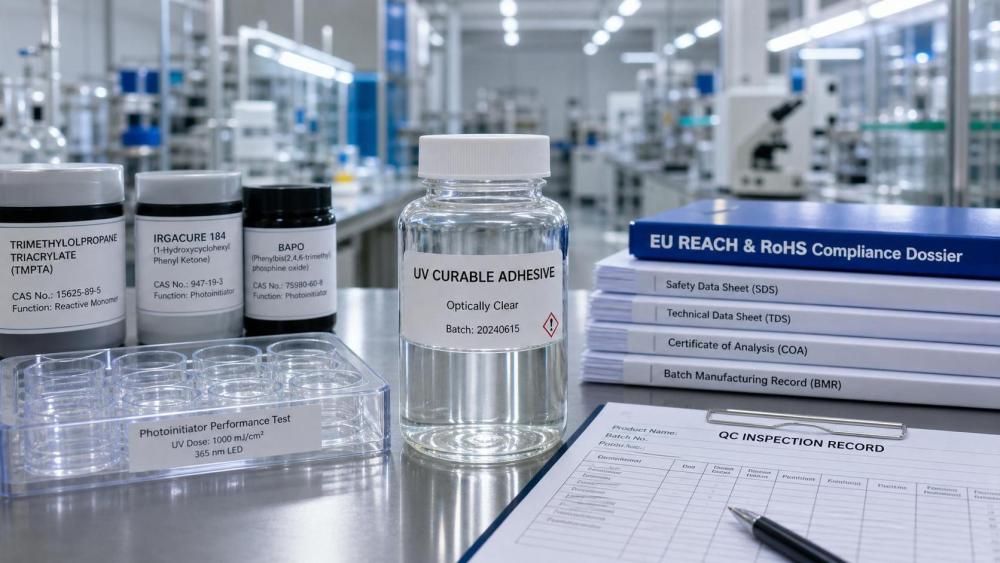
On July 8, 2026, the European Chemicals Agency (ECHA) updated the SVHC Candidate List to include three photoinitiators commonly used in UV-curing industrial adhesives: HMPP, HPK, and ITX. For companies exporting related products to the EU, the development deserves close attention because substances at or above 0.1% w/w trigger SCIP notification obligations under REACH from October 2026, which directly affects compliance preparation, technical documentation, and communication across the UV-curing industrial adhesives supply chain.
What Was Confirmed in the July 8 Update
The confirmed event is that ECHA added 2-hydroxy-2-methyl-1-phenylpropan-1-one (HMPP), 1-hydroxycyclohexyl phenyl ketone (HPK), and isopropyl thioxanthone (ITX) to the SVHC Candidate List on July 8, 2026. These substances are identified in the input information as commonly used photoinitiators in UV-curing industrial adhesives.
The confirmed regulatory point is that, under REACH, exported products containing these substances at a concentration of 0.1% w/w or higher must be notified to ECHA through SCIP. The input information further states that this change directly affects EU export compliance obligations and the timeline for technical documentation preparation for suppliers of UV-curing industrial adhesives.
Where the Immediate Pressure Is Likely to Fall
Export-facing adhesive suppliers will face a tighter documentation task
From an industry perspective, suppliers selling UV-curing industrial adhesives into the EU are the most directly exposed. The reason is straightforward: the update is linked to notification obligations and document readiness. The main impact is likely to appear in substance review, formula screening, and preparation of compliance files for affected products.
Manufacturers using UV-curing adhesive systems may need to recheck product composition
For processing and manufacturing companies that use UV-curing industrial adhesives in products shipped to Europe, the issue is not limited to the adhesive purchase itself. What deserves closer attention is whether the relevant photoinitiators are present at or above the stated threshold in the exported product, which can affect internal compliance review, supplier coordination, and product data collection.
Procurement and supply chain teams may see longer confirmation cycles
Procurement, regulatory, and supply chain service functions may also be affected because this type of regulatory update often turns into a documentation and confirmation exercise across multiple parties. In this case, the practical pressure is likely to center on obtaining updated substance information, confirming material content, and aligning delivery schedules with compliance paperwork for EU-bound orders.
What Companies Should Watch Now
Check whether relevant products cross the 0.1% w/w threshold
The first practical question is whether exported products contain HMPP, HPK, or ITX at or above 0.1% w/w. This is the threshold specifically identified in the input information as triggering SCIP notification, so it is the starting point for any internal review.
Prepare technical files before the October 2026 notification point
The input information highlights technical documentation lead time as a direct issue. Analysis shows that companies should treat this not only as a regulatory interpretation matter, but also as a documentation scheduling issue, especially where formulation data, declarations, and internal approvals are handled by different teams or external suppliers.
Align customer communication with compliance status
For businesses serving EU customers, a key operational point is how compliance status is communicated during quotation, order confirmation, and delivery. Observably, the update may affect customer requests for declarations or additional technical records, so sales and account teams need messaging that matches the latest verified compliance position.
Monitor whether official wording or implementation details evolve
It is also worth separating the confirmed obligation from possible follow-on interpretation. The confirmed facts in the input establish the listing and the notification trigger, but companies should continue watching for any further official clarification on how the requirement is applied in practice to affected export products and documentation workflows.
How This Update May Be Best Understood
Analysis shows that this is more than a routine list revision for companies involved in UV-curing industrial adhesives and related EU exports. The immediate consequence described in the input is procedural: compliance obligations and technical file timing are now more pressing. At the same time, it is more appropriate to understand this as a concrete regulatory signal rather than a fully concluded market outcome, because the operational effect will depend on product composition, export exposure, and how quickly companies can complete documentation checks.
A Short-Term Compliance Trigger With Longer-Term Meaning
In practical terms, this development is best read as a near-term compliance change with broader implications for supply chain discipline. It does not by itself confirm a wider market result, but it does create a clear checkpoint for adhesive suppliers, manufacturers, and EU-facing trade teams. The most balanced reading at this stage is that the update requires immediate review of affected products while also warranting continued observation of implementation details and downstream customer requirements.
Basis and Verification Status
This article is based on the user-provided news title, event date, and event summary. For this type of development, commonly relevant source categories may include official regulatory notices, company compliance communications, industry association updates, authoritative media reporting, and standards-related documents.
A specific official source link was not provided in the input, so the precise official reference should still be continuously verified. Follow-up attention should remain on any later official wording, implementation clarification, and practical compliance expectations affecting EU-bound UV-curing industrial adhesive products.
Have questions about this sector analysis, or seeking best practices specific to your niche? Drop us a line below and let the senior consultants at APIM assist you.
We respect your privacy. Your information is strictly confidential.
Related News
- 00
0000-00
How to assess batch consistency from a thermal potting compounds supplier - 00
0000-00
How much weight can carbon fiber reinforced plastics save in cars? - 00
0000-00
Are flame retardant industrial materials subject to RoHS restrictions? - 00
0000-00
How to choose speciality films for high-barrier food packaging - 00
0000-00
NAPCOR Report: US PET Bottle Recycling Rate Fell to 29% in 2025