




Potting Compounds for LED Drivers: Preventing Heat and Moisture Failures
Potting Compounds for LED Drivers: Preventing Heat and Moisture Failures
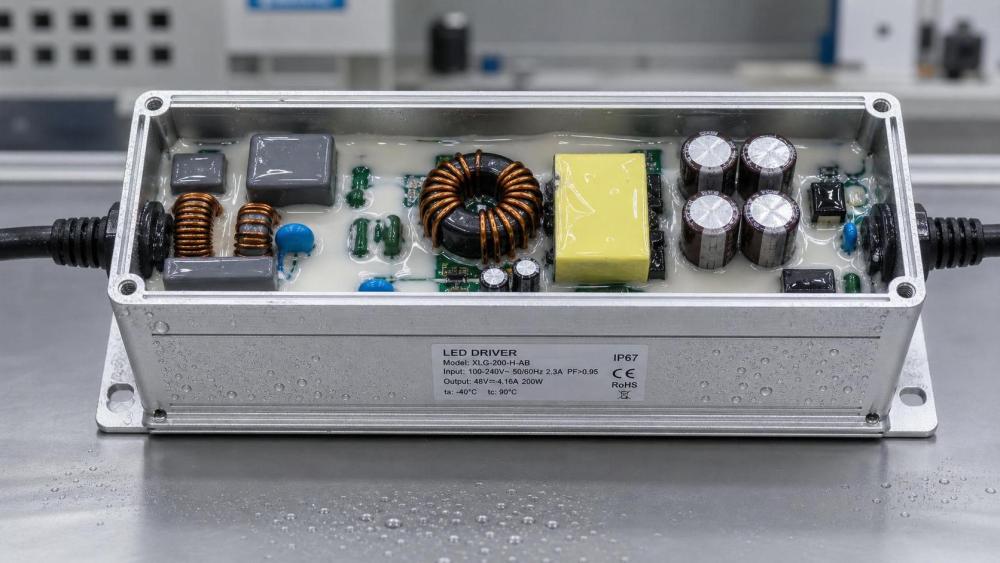
Potting compounds for LED drivers do much more than fill empty space inside a housing.
They protect circuits from moisture, reduce corrosion risk, improve insulation, and help manage thermal stress over time.
When that material is poorly selected, LED driver failures often appear earlier than expected.
In practice, the damage usually starts with trapped heat, water ingress, cracking, or chemical incompatibility.
That is why potting compounds for LED drivers should be chosen around the real operating environment, not only price.
For indoor fixtures, the balance may focus on insulation and process efficiency.
For outdoor systems, humidity, condensation, salt exposure, and thermal cycling become much more important.
A reliable LED driver needs the potting material to support both protection and stable heat transfer.
This is where many selection mistakes happen.
Why LED Drivers Fail Under Heat and Moisture
LED drivers operate in compact spaces with power conversion, switching activity, and continuous temperature rise.
If the potting layer blocks heat instead of moving it outward, internal hotspots can build quickly.
Capacitors, transformers, and semiconductors are usually the first parts to suffer.
Moisture creates a different path to failure, but the result is just as serious.
Water vapor can lead to leakage current, corrosion, insulation breakdown, and unstable electrical output.
In outdoor lighting, tunnels, parking structures, or industrial plants, condensation is often more damaging than direct splashing.
Potting compounds for LED drivers must therefore resist moisture ingress while staying mechanically stable.
The challenge is that heat and moisture problems often interact.
Repeated heating and cooling can create expansion stress, small cracks, and weak interfacial bonding.
Once that happens, moisture finds a way in more easily.
What Good Potting Compounds for LED Drivers Need to Deliver
A strong material choice starts with function, not chemistry alone.
The best potting compounds for LED drivers usually combine several properties at the same time.
- Reliable electrical insulation under high humidity
- Stable thermal conductivity for heat dissipation
- Low shrinkage during cure
- Adhesion to metals, plastics, and coated circuit surfaces
- Resistance to cracking during thermal cycling
- Processability that fits production speed and fill geometry
This combination matters because one strong property cannot compensate for a weak overall system.
For example, a very hard material may seal well at first.
But if it cannot absorb thermal expansion differences, long-term reliability drops.
On the other hand, a very soft compound may reduce stress.
Yet it may not provide enough structural support or chemical resistance in harsher conditions.
Comparing Material Options
Most potting compounds for LED drivers fall into three practical groups: silicone, polyurethane, and epoxy.
Each one solves heat and moisture risks differently.
Silicone systems are often preferred when thermal cycling is severe.
Their flexibility helps reduce stress around sensitive parts and solder joints.
Polyurethane can offer a practical middle ground for many driver assemblies.
Epoxy may still be effective, but only when thermal mismatch is carefully evaluated.
How Thermal Conductivity Changes Real Reliability
A common misunderstanding is that any filled potting material will solve heat problems.
That is not always true.
Potting compounds for LED drivers need thermal conductivity that matches the actual power density and enclosure design.
If the driver runs hot, a low-conductivity compound can trap heat inside the package.
If the material is too heavily filled, viscosity may rise and create voids during dispensing.
Voids are especially dangerous because they reduce both heat transfer and moisture protection.
In real production, thermal management should be checked with the full assembly.
That includes housing material, wall thickness, component spacing, and expected ambient temperature.
A lab data sheet alone cannot confirm field performance.
Moisture Control Is More Than Water Resistance
Moisture failure is rarely caused by one dramatic leak event.
More often, it comes from slow exposure, humid storage, breathing cycles, and seasonal condensation.
That means potting compounds for LED drivers should be judged on several moisture-related factors.
- Water absorption behavior
- Adhesion retention after humidity aging
- Resistance to ionic contamination and corrosion
- Performance after temperature and humidity cycling
- Compatibility with seals, housings, and connector materials
This also affects manufacturing control.
If substrates are contaminated, damp, or poorly prepared, even a strong compound can fail early.
Surface cleanliness, cure completeness, and air release all influence final moisture performance.
Frequent Selection Mistakes
Many LED driver issues can be traced back to a few repeated decisions.
- Choosing by hardness only, without checking thermal expansion behavior.
- Using a moisture-resistant material that lacks enough heat transfer capability.
- Ignoring cure shrinkage in tightly packed electronics.
- Skipping compatibility checks with plastics, coatings, and wire insulation.
- Evaluating potting compounds for LED drivers only under room temperature conditions.
- Treating dispensing and degassing as secondary process details.
These mistakes usually look minor at the beginning.
Later, they show up as field returns, flicker, corrosion, short life, or unstable output.
A Practical Evaluation Checklist
A more reliable selection process is usually straightforward.
The key is to test potting compounds for LED drivers against actual use conditions.
- Define maximum operating temperature and expected thermal peaks.
- Map exposure conditions such as humidity, outdoor use, salt, dust, or chemicals.
- Check thermal conductivity, dielectric strength, viscosity, and cure profile together.
- Run thermal cycling and damp heat testing on full assemblies.
- Inspect for cracks, voids, delamination, corrosion, and output drift after testing.
- Confirm production consistency with real dispensing equipment and cycle times.
This method gives a clearer picture than comparing supplier claims side by side.
It also reduces the risk of approving a material that looks good only on paper.
Final Takeaway for More Stable LED Driver Protection
Potting compounds for LED drivers are a reliability decision, not a simple fill material choice.
The right formulation helps control heat, block moisture, protect insulation, and extend service life.
The wrong one can quietly raise internal stress and shorten product performance.
For better results, match the compound to the driver design, environment, and production process as one system.
That approach is usually the most effective way to prevent heat and moisture failures before they reach the field.
Have questions about this sector analysis, or seeking best practices specific to your niche? Drop us a line below and let the senior consultants at APIM assist you.
We respect your privacy. Your information is strictly confidential.
Related News
- 00
0000-00
How does washing affect contamination in post-consumer recycled PP resins? - 00
0000-00
How does feedstock affect depolymerization equipment selection? - 00
0000-00
US Sets 213.44% Preliminary Antidumping Deposit on Chinese PTMEG - 00
0000-00
When should epoxy be used as a thermal interface material for semiconductors? - 00
0000-00
US Midterm Results Unlikely to Quickly Shift Recycled Plastics Market or Legislation