




A spacecraft potting compound can meet mechanical and electrical requirements yet still release volatile substances that contaminate sensitive optics, detectors, or thermal-control surfaces.
For quality control and safety teams, selecting low-outgassing materials means looking beyond supplier compliance claims and checking whether test specimens represent the proposed production process.
ASTM E595 data provide screening evidence through total mass loss and collected volatile condensable materials. Neither result independently establishes suitability for a particular spacecraft assembly.
The practical approval question is whether the exact formulation, cure schedule, and subsequent handling produce acceptable contamination risk under the mission’s actual operating conditions.
This guide explains the reported figures, the documentation supporting them, and the additional checks needed before approving potting materials for flight hardware or sensitive assemblies.
What Does an ASTM E595 Result Actually Tell You?
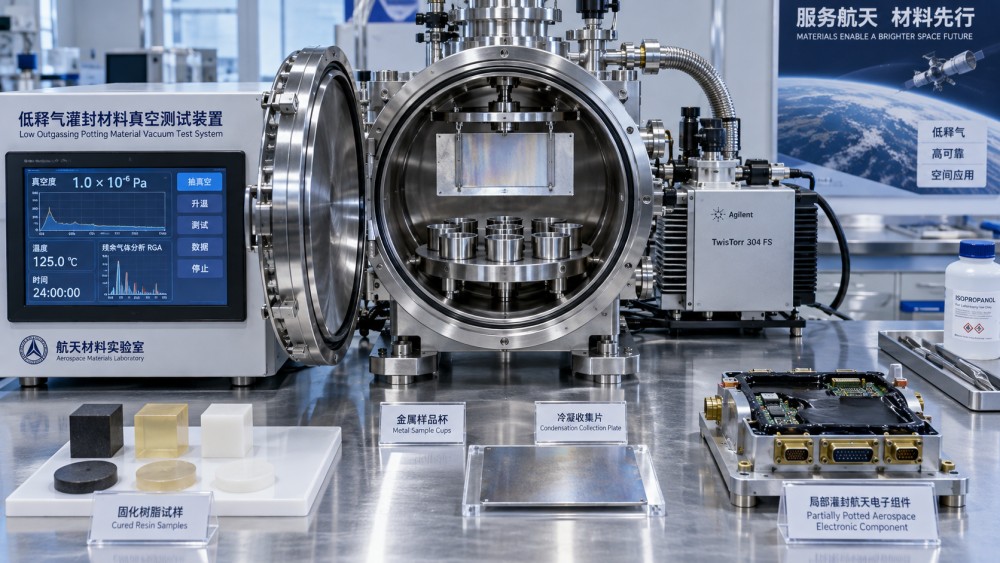
ASTM E595 measures mass loss and condensable emissions from a material exposed to a defined vacuum and temperature environment under controlled laboratory conditions.
In the standard screening arrangement, specimens undergo approximately 24 hours at 125°C under vacuum. A collector maintained near 25°C captures some released condensable material.
The test vacuum is typically below 5 × 10⁻⁵ torr. Review the applicable standard edition and laboratory report for exact conditions and procedural requirements.
These conditions allow comparison between tested materials. They do not reproduce every spacecraft temperature profile, exposure duration, component geometry, or contamination transport pathway.
A passing result therefore supports material screening. Flight approval still requires the applicable project criteria, representative processing evidence, and assessment of sensitive nearby surfaces.
For potting compounds, this distinction matters because large cast volumes, confined spaces, and uneven heating can create cure conditions different from small laboratory specimens.
Read TML and CVCM Together Before Making a Decision
Total mass loss, or TML, expresses the specimen’s mass reduction during testing as a percentage of its initial mass, following the prescribed weighing procedure.
Collected volatile condensable materials, or CVCM, expresses material deposited on the collector as a percentage of the initial specimen mass, rather than collector mass.
TML indicates how much mass leaves the specimen. CVCM identifies the fraction captured on a collector at the specified temperature under that test arrangement.
Frequently used spacecraft screening limits are TML ≤ 1.0% and CVCM ≤ 0.10%. These are common acceptance criteria, not universal mission approval rules.
Some projects apply stricter limits, additional contamination requirements, or different treatment of water-related mass loss. Always identify the governing specification before interpreting compliance.
Where water vapor regained, or WVR, is reported, read its definition carefully. WVR measures moisture regained after controlled reconditioning; it is not condensable contamination.
Does the Tested Sample Match Your Production Potting?
A low-outgassing claim is only as useful as the specimen description supporting it. Start by matching the manufacturer, product designation, and formulation revision.
Check resin and hardener identities, mixing ratio, fillers, pigments, and permitted additives. Similar product names can conceal changes that affect cure behavior and emissions.
For two-part systems, confirm whether the ratio is specified by weight or volume. Substituting one basis for another can leave significant unreacted constituents.
Next, compare the reported cure schedule with your manufacturing traveler. Record time, temperature, post-cure, and any conditioning performed before specimens entered the test.
A result obtained after an elevated-temperature post-cure does not automatically support an assembly receiving only a room-temperature cure, even when both appear mechanically solid.
Also examine specimen thickness and preparation. A thin test coupon may cure more uniformly than a deep encapsulation around heat-sensitive components or enclosed cavities.
Verify the Report Behind the Supplier’s Compliance Claim
Request the complete test report whenever approval consequences justify it. A technical data sheet often omits preparation details needed to establish relevance to flight hardware.
The report should identify the test laboratory, test date, method edition, material description, specimen preparation, conditioning, and measured results with their reporting precision.
Look for deviations from the standard procedure and explanations of unusual observations. Missing cure details or an unidentified material batch should trigger clarification before approval.
Where available, review individual specimen results rather than only averages. Variation can reveal inconsistent preparation or show that a nominal pass has little margin.
Laboratory accreditation can strengthen confidence when its scope covers the relevant testing. Accreditation alone cannot establish that the tested specimen represents your manufacturing configuration.
Public outgassing databases, including NASA resources, can help locate historical evidence. Match each entry’s material identity and preparation details before treating it as applicable.
Interpret Borderline Results Without Inventing a Safety Margin
Consider two hypothetical potting compounds tested using comparable preparation. Material A reports TML of 0.72% and CVCM of 0.03%; Material B reports 0.95% and 0.09%.
Both satisfy the frequently used screening limits stated earlier. Material B, however, has less numerical margin and warrants closer review of variability and process controls.
That comparison does not establish Material A as the better engineering choice. Adhesion, thermal expansion, electrical performance, and component compatibility still affect assembly reliability.
For borderline data, request the laboratory’s measurement uncertainty information where available. Avoid assuming that a rounded reported value proves comfortable separation from the limit.
Use the project’s acceptance rules for uncertainty and rounding. Do not create an informal tolerance that converts a failing measurement into an acceptable result.
If results differ between reports, investigate formulation, cure, conditioning, and laboratory conditions first. Averaging incompatible results can obscure the reason for the disagreement.
When Does Passing E595 Still Leave Contamination Risk?
A spacecraft assembly can satisfy material screening criteria while exceeding an instrument’s contamination allowance. The consequence depends on emission sources, transport paths, and receiving surfaces.
Optical coatings, infrared detectors, star trackers, and thermal-control surfaces can be sensitive to deposited films. Their allowable contamination may require more restrictive material choices.
The collector temperature matters because condensation depends on temperature and chemical composition. Species uncollected at approximately 25°C may deposit on colder flight surfaces.
Conversely, warmer operating surfaces may collect a different fraction of emitted species. E595 CVCM should not be interpreted as a universal deposition percentage.
Installed material quantity also matters. For perspective, 0.05% of 200 grams equals 0.1 gram; this arithmetic illustrates scale, not predicted deposition on an instrument.
Assess actual deposition through the project’s contamination analysis and, where needed, additional testing. Geometry, venting, temperature history, and exposure duration influence the outcome.
Control Cure, Bakeout, and Handling as Approval Conditions
Once a material is selected, turn the tested preparation into controlled manufacturing instructions. Otherwise, purchasing an approved formulation may still produce an unqualified assembly.
Control mixing accuracy, mixing completeness, working time, and degassing according to the approved process. Vacuum degassing can remove bubbles but does not replace adequate cure.
Verify temperatures at representative locations when thick sections or thermally sensitive hardware complicate curing. Oven settings alone may not establish the material’s actual thermal exposure.
A bakeout may reduce releasable volatiles, but its effectiveness depends on temperature, duration, pressure, and geometry. Qualify the chosen process instead of assuming improvement.
Keep pretest conditioning distinct from manufacturing bakeout. A test performed after special laboratory conditioning may overstate the performance of hardware that skips equivalent preparation.
After processing, control storage, cleanliness, packaging, and exposure time. Moisture uptake or contamination from nearby materials can change the condition presented to final integration.
Build a Practical Approval Checklist for Quality and Safety Teams
Use a documented approval sequence that connects screening evidence to production controls. The objective is a traceable decision that another reviewer can reproduce.
First, define the applicable limits and contamination-sensitive locations. Record whether the project requires TML, CVCM, permitted water corrections, or additional mission-specific evidence.
Second, establish material identity and report relevance. Resolve formulation differences, incomplete cure descriptions, and unsupported database matches before relying on the numerical results.
Third, assess manufacturing feasibility. Confirm that required curing or bakeout temperatures will not damage electronics, distort housings, or compromise other bonded materials nearby.
Fourth, record residual gaps and their disposition. Additional testing should address a specific uncertainty, such as colder receiving surfaces or a materially different cure schedule.
Finally, connect approval to change control. Supplier reformulation, hardener substitution, altered post-cure, or additional processing aids should trigger review against the approved evidence.
- Approved product designation, formulation revision, and component identities.
- Traceable test report with relevant specimen preparation and results.
- Applicable acceptance limits and documented decision rules.
- Controlled mixing, cure, post-cure, and handling instructions.
- Assembly-specific contamination assessment and resolved evidence gaps.
- Defined responsibilities for supplier changes and process deviations.
Keep Vacuum Cleanliness Separate from Chemical and Electrical Safety
Low-outgassing materials are not automatically safe to handle, electrically suitable, or resistant to every spacecraft environment. These requirements need their own supporting evidence.
Review safety data sheets for uncured resin and hardener hazards. Establish ventilation, protective equipment, spill response, and waste handling appropriate to the actual formulation.
Potting depth can also influence cure exotherm. Follow supplier guidance and validate larger pours where heat buildup could damage components or create handling hazards.
For electrical applications, verify dielectric properties, insulation resistance, and compatibility with conductors and components. E595 results do not demonstrate those characteristics or their durability.
Thermal cycling, adhesion, mechanical stress, radiation exposure, and repairability may require separate evaluation. Select evidence according to the assembly’s requirements and expected failure consequences.
The approval decision should therefore combine contamination performance with manufacturing reliability and worker protection. Each conclusion needs evidence suited to the question being answered.
Approve the Material and the Process Together
Reading ASTM E595 data correctly starts with three questions: what was measured, how the specimen was prepared, and which acceptance requirements govern the application.
For spacecraft potting, credible approval connects TML and CVCM results to the exact formulation, achievable cure conditions, controlled handling, and the mission’s contamination sensitivity.
Treat a passing report as strong screening evidence when it represents your configuration. Resolve process differences and mission-specific gaps before releasing hardware for integration.