




How to select low-shrinkage epoxy resin systems for encapsulation
Low cure shrinkage is a useful screening property for epoxy encapsulants, but it is not a reliable ranking of assembly stress. A rigid, highly filled formulation can shrink less than a flexible alternative yet transfer more load to a ceramic component, wire bond, or solder joint. The better choice is the system that keeps deformation and interfacial stress within acceptable limits throughout curing, cooling, and service.
Selecting epoxy resin systems for encapsulation therefore requires more than comparing shrinkage percentages. The decisive variables are when shrinkage occurs relative to gelation, how stiffness develops, the thermal expansion mismatch between materials, and whether the compound can fill the actual geometry without voids or excessive heat generation.
Define the failure that low shrinkage must prevent
“Low shrinkage” is not an application requirement until it is connected to a measurable outcome. Encapsulating a precision sensor may require limiting zero-point drift. A transformer may need protection against cracking and insulation failure. An optical assembly may be sensitive to displacement, while a circuit board may be vulnerable to bending or component damage.
These applications cannot use the same acceptance criterion. Define the allowable dimensional change, electrical drift, component strain, or interfacial damage before requesting candidate materials. Also establish the encapsulation depth, narrowest clearance, substrate materials, operating temperature range, and maximum permissible component temperature during cure.
Geometry deserves particular attention. A thin coating can release heat and deform differently from a deep casting. A component bonded on all sides experiences different constraint from one surrounded by a compliant layer. Sharp corners, thickness transitions, and large bonded areas can concentrate loads even when the resin’s bulk shrinkage is low.
Make supplier shrinkage figures comparable
A shrinkage value without its measurement conditions is insufficient for material selection. Suppliers may report volumetric cure shrinkage, linear dimensional change, or mold shrinkage. These describe different measurements and should not be placed in the same comparison column without qualification.
For small, isotropic dimensional changes, linear shrinkage is approximately one-third of volumetric shrinkage. That approximation does not establish how a constrained, filled encapsulation will deform. Filler orientation, adhesion, and assembly geometry can make dimensional changes nonuniform.
Density measurements can support a volumetric shrinkage calculation, but liquid and cured densities must be referenced to the same temperature, with mass loss and voids controlled. Otherwise, apparent shrinkage can include thermal effects or measurement artifacts rather than chemical contraction alone.
Request the exact formulation, mix ratio, cure schedule, post-cure, specimen size, and test method behind each value. Confirm that the result applies to the complete filled resin–hardener system being supplied, not an unfilled base resin or a related grade. A room-temperature cure result is not directly equivalent to a heated cure followed by measurement after cooling.
Separate chemical shrinkage from locked-in stress
Before gelation, the liquid can accommodate much of its volume change through flow. After a continuous network forms, further shrinkage becomes increasingly constrained by adhesion and surrounding components. As stiffness develops, the material’s ability to relax stress also changes.
This explains why total shrinkage alone can mislead. Two formulations with similar total contraction can produce different residual stresses if their gelation, modulus development, and relaxation behavior differ. A slower reaction may allow more accommodation, but a long cure does not automatically guarantee low stress.
Cooling adds another load. Epoxy, metal housings, ceramics, glass, and circuit-board materials expand and contract at different rates. The relevant quantity is the mismatch in coefficient of thermal expansion, or CTE, over the actual temperature interval. CTE and modulus change around the glass transition temperature, Tg, so one room-temperature value cannot describe the entire service cycle.
As a screening concept, constrained stress increases with stiffness and unaccommodated strain. It is not adequately predicted by multiplying room-temperature modulus by a datasheet shrinkage percentage. Cure history, viscoelastic relaxation, local geometry, and temperature-dependent properties all affect the result.
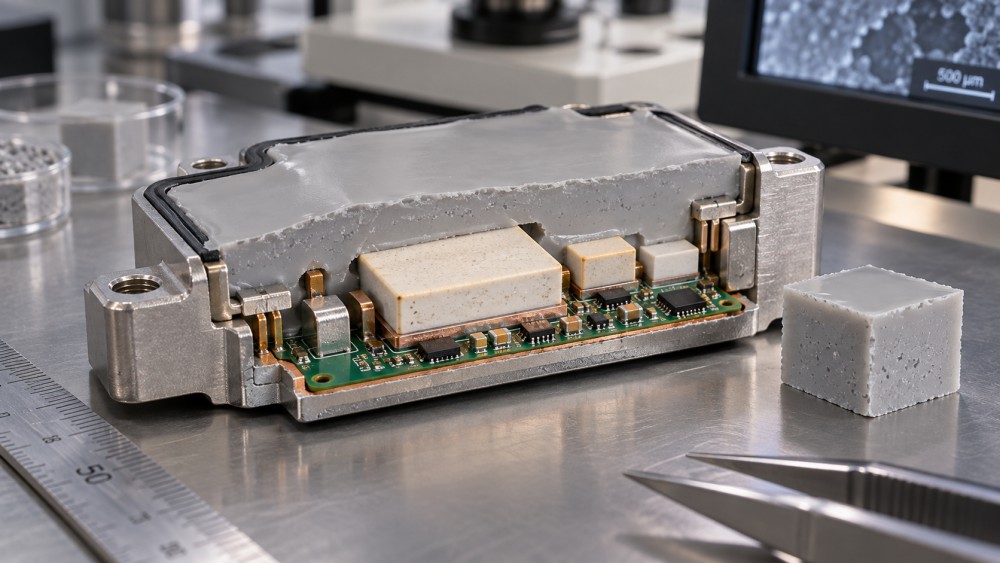
Ask for modulus as a function of temperature, CTE below and above Tg, and the Tg measurement method and cure history. Dynamic mechanical analysis can help reveal stiffness changes and relaxation behavior. Tg is not a maximum continuous-use temperature, and a high Tg is not automatically beneficial when stress relief is the dominant requirement.
Choose the formulation strategy around the assembly
Filled systems: reduced contraction with processing consequences
Mineral fillers reduce the proportion of reactive resin in a given volume. Appropriate fillers can also lower CTE, making filled epoxies attractive for dimensionally stable encapsulation. However, greater filler loading can increase viscosity and stiffness, creating a trade-off between lower contraction and greater load transfer.
Compare filler content by volume where possible. Equal weight percentages do not mean equal filler volume fractions when filler densities differ. Particle size distribution and shape also influence packing, flow, settling, and the ability to enter small clearances.
Silica-filled formulations can be suitable where low thermal expansion is important. Thermally conductive fillers may support heat removal, but thermal conductivity, electrical insulation, viscosity, and stress must be evaluated together. A highly filled compound that leaves voids beneath components may perform worse than a less-filled material that wets the assembly completely.
Filled systems also need handling validation. Sedimentation during storage or dispensing can produce different filler concentrations at the beginning and end of a run. Specify supplier-approved remixing procedures and confirm that pumps, mixers, and dispensing nozzles can maintain composition without excessive wear or blockage.
Flexible and toughened systems: distinguish compliance from crack resistance
Flexible segments and other formulation modifications can reduce modulus and help accommodate differential movement. This can be valuable around fragile components or dissimilar substrates, even when the formulation does not offer the lowest measured shrinkage.
Toughness and flexibility are not interchangeable, however. A toughened epoxy may resist crack propagation without becoming sufficiently compliant to protect a strain-sensitive device. Evaluate modulus, fracture behavior, adhesion, and temperature dependence separately rather than using elongation at break as a universal stress indicator.
Plasticization or flexibilization can also change Tg, creep, chemical resistance, and moisture response. A compliant material that permits excessive movement at operating temperature may solve cure stress while creating a dimensional-stability problem.
Reactive diluents and hardeners: assess the complete system
Lower viscosity can improve wetting and filling, but a reactive diluent is not merely a processing aid. It changes network formation and can affect shrinkage, Tg, modulus, and chemical resistance. Compare final cured properties rather than assuming that a thinner mixture is an equivalent, easier-processing version of the same material.
Hardener selection likewise changes reaction rate, gelation, heat release, and final network properties. Neither an amine-cured nor an anhydride-cured system can be declared the better low-stress choice on chemistry alone. The necessary cure temperature, moisture sensitivity, component compatibility, and achievable conversion determine suitability.
Treat the cure schedule as part of the selected material
A resin qualified under one cure schedule is not automatically qualified under another. Raising temperature can shorten processing time but can also accelerate reaction, increase internal temperature, and increase the cooling interval over which contraction develops. Lower-temperature curing may reduce thermal exposure but leave incomplete conversion or require a subsequent post-cure.
A staged cure can help manage heat generation and network development. Its effectiveness must be demonstrated in the intended geometry. A schedule developed on a small laboratory specimen may behave very differently in a large casting because heat generation scales with reacting volume while heat removal depends on geometry and boundary conditions.
Measure temperature inside representative encapsulations, including the thickest region, rather than relying only on oven air temperature. Differential scanning calorimetry can characterize reaction behavior and residual cure, but it does not replace an assembly-scale exotherm test.
Post-cure can improve conversion and stabilize properties, while also producing further chemical contraction and another thermal cycle. Qualification should include the complete thermal history, including later manufacturing steps that heat the encapsulated assembly.
Check that processing will preserve the intended properties
Viscosity should be measured at the dispensing temperature and over the relevant working time. A single initial viscosity value does not show whether the mixture will reach a narrow gap before gelation. Filled systems may also exhibit shear-dependent flow, making nozzle conditions and dispensing pressure important.
Define a practical processing window using the actual batch size, mixing equipment, transfer time, and fill sequence. Supplier pot life values obtained in a specified container are not guaranteed working times in a reservoir, hose, or deep casting.
Vacuum degassing and vacuum-assisted filling can reduce entrapped air, but pressure, temperature, and exposure time need validation for the formulation. Surface moisture, contamination, and poor wetting can still cause interfacial defects. Strong bulk properties do not compensate for an inadequately prepared substrate.
Adhesion itself requires balance. Weak adhesion can permit delamination and moisture pathways; strong adhesion can transfer greater stress into a fragile component. Where necessary, a locally compliant interface or assembly design change may be more effective than pursuing a still lower bulk shrinkage value.
Validate candidates using the failure mechanism
Screen candidates against non-negotiable limits before ranking their shrinkage: component temperature tolerance, gap-filling capability, insulation requirements, chemical compatibility, and achievable cure. Then compare the remaining systems using identical preparation and measurement conditions.
Representative test assemblies should preserve the features that govern stress and heat flow: encapsulation thickness, component spacing, substrate combinations, corner geometry, and surface preparation. Simple cast bars remain useful for material characterization, but they cannot reproduce every constraint in the finished assembly.
Measure outcomes directly linked to the original requirement:
- Dimensional movement, warpage, or component strain after cure and cooling.
- Sensor offset, electrical performance, or insulation behavior before and after encapsulation.
- Cracking, interfacial separation, and void distribution using inspection methods suited to the geometry and materials.
- Property retention after thermal cycling, humidity exposure, or operating-temperature dwell representative of service.
Keep thermal cycling distinct from thermal shock: different transition rates and dwell times impose different conditions. Record cure profiles, material conditioning, mix accuracy, and specimen history so that failures can be traced to formulation, processing, or design.
The final selection should be supported by an acceptance window, not just a preferred datasheet. Specify the approved formulation and ratio, handling conditions, dispensing limits, cure profile, and assembly-level performance criteria. A defensible low-shrinkage epoxy selection is the system that repeatedly protects the assembly within those limits—not simply the one with the smallest published contraction figure.
Have questions about this sector analysis, or seeking best practices specific to your niche? Drop us a line below and let the senior consultants at APIM assist you.
We respect your privacy. Your information is strictly confidential.
Related News
- 00
0000-00
How does washing affect contamination in post-consumer recycled PP resins? - 00
0000-00
How does feedstock affect depolymerization equipment selection? - 00
0000-00
US Sets 213.44% Preliminary Antidumping Deposit on Chinese PTMEG - 00
0000-00
When should epoxy be used as a thermal interface material for semiconductors? - 00
0000-00
US Midterm Results Unlikely to Quickly Shift Recycled Plastics Market or Legislation