




How to Select Epoxy Resin Systems for Electrical Insulation
Choosing epoxy resin systems for electrical insulation is rarely a simple material selection exercise. Electrical reliability, heat resistance, curing behavior, manufacturability, and compliance all interact, and a weak decision in one area can undermine the whole design.
That is why epoxy resin systems for electrical insulation remain a major topic across electronics, industrial equipment, automotive electrification, power distribution, and encapsulated components. The resin is not only a barrier to voltage. It also becomes part of the product’s thermal, mechanical, and production strategy.
From APIM’s broader view of advanced polymers and industrial materials, epoxy selection fits a familiar pattern. Material choice must connect formulation, processing, application risk, and supply chain reality, rather than relying on a datasheet headline.
What an epoxy insulation system actually includes
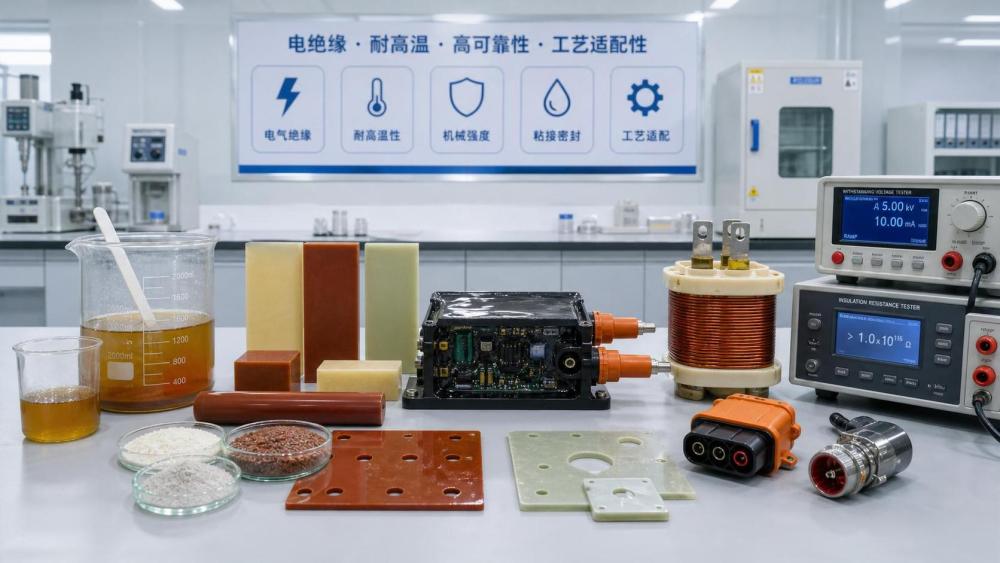
The insulation system is usually more than base resin. It often includes hardener, catalyst, fillers, flexibilizers, flame-retardant additives, and processing aids. In many products, these ingredients define performance more than the resin family alone.
For electrical use, epoxy resin systems for electrical insulation are commonly selected for potting, encapsulation, impregnation, casting, coil protection, transformer parts, sensors, connectors, and printed circuit assemblies. Each use case imposes a different balance of dielectric, thermal, and mechanical demands.
A rigid casting compound for switchgear does not behave like a low-viscosity impregnation resin. A thermally conductive potting compound for power electronics also differs from a clear adhesive-grade epoxy used in sensors.
Why selection has become more demanding
The market is asking insulation materials to do more at once. Voltages are rising in mobility and energy systems. Components are shrinking in consumer electronics. Thermal loads are increasing in compact assemblies. Qualification pressure is also getting tighter.
In practical terms, epoxy resin systems for electrical insulation now sit between electrical safety requirements and production economics. A system may test well in the lab, yet still fail because of voids, poor filler dispersion, long cure cycles, or mismatch with substrate expansion.
This is also where APIM’s structured approach to materials becomes useful. The important question is not only which chemistry performs best, but which formulation remains stable under actual manufacturing conditions and long service exposure.
The first filter is the real operating environment
Selection should begin with the service profile, not the supplier catalog. Voltage stress, frequency, peak temperature, cycling range, humidity, chemical exposure, vibration, and expected lifetime all shape the right answer.
In dry indoor equipment, dielectric strength and processability may dominate. In under-hood electronics or outdoor power applications, thermal aging, moisture resistance, and crack resistance become more important.
A useful screening table is below.
Electrical properties should be read as a package
It is common to focus on dielectric strength first, but that is only one indicator. Insulation resistance, dielectric constant, dissipation factor, tracking resistance, arc resistance, and partial discharge behavior may be equally important.
For example, a formulation with strong initial dielectric strength may still perform poorly if moisture uptake raises dielectric loss during service. In high-voltage designs, long-term resistance to partial discharge can outweigh short-term test numbers.
This is one reason epoxy resin systems for electrical insulation should be evaluated using end-use test logic. A single impressive property rarely predicts field durability by itself.
Thermal behavior often decides service life
In many assemblies, the epoxy must retain electrical integrity while managing heat generated by the device. That makes thermal class, glass transition temperature, decomposition resistance, and thermal conductivity central selection criteria.
Filled formulations are often chosen when heat dissipation matters. Alumina, silica, aluminum nitride, or boron nitride can improve thermal performance. However, fillers also affect viscosity, sedimentation, cure shrinkage, and electrical behavior.
A thermally conductive system is not automatically the best system. Higher filler loading may complicate dispensing, vacuum processing, or fine-gap penetration. The gain in heat flow must be weighed against process stability.
Mechanical compatibility cannot be treated separately
Electrical insulation fails mechanically more often than many teams expect. Shrinkage during cure, brittle fracture, poor adhesion, and expansion mismatch with copper, ferrite, aluminum, or engineered plastics can open leakage paths.
In compact devices, a slightly more flexible epoxy may outperform a higher-modulus alternative because it tolerates cycling better. In rigid cast parts, stiffness and dimensional retention may matter more.
Process conditions are part of the material decision
Epoxy resin systems for electrical insulation should be screened against the actual production route. Pot life, viscosity profile, mixing ratio sensitivity, degassing behavior, gel time, exotherm, and post-cure requirements all affect manufacturability.
A resin that performs well in small-batch testing may become difficult in high-volume dispensing. Likewise, a filled system may separate during storage or require tighter temperature control than the process currently provides.
This matters beyond the lab. APIM regularly frames material performance together with process discipline because inconsistency in compounding, handling, and curing can erase the advantages built into the formulation.
- Check whether the resin is designed for casting, potting, impregnation, or bonding.
- Confirm workable viscosity at the real plant temperature, not only at standard lab conditions.
- Review cure time against takt time, oven capacity, and rework limits.
- Ask how sensitive the system is to moisture, ratio error, and trapped air.
Certification, flame performance, and documentation
For many applications, technical suitability is only half the decision. The material may also need UL recognition, RoHS and REACH alignment, flame-retardant performance, or sector-specific approval documents.
In electrical and electronics markets, epoxy resin systems for electrical insulation are often filtered by compliance requirements before detailed comparison even begins. That can narrow options quickly, especially for export programs.
The deeper issue is document quality. A complete technical data package should include cure conditions, thermal limits, electrical testing methods, storage guidance, and batch consistency information. Sparse documentation usually signals future qualification delays.
Common selection mistakes
Several mistakes appear repeatedly across sectors.
- Selecting by dielectric strength alone, while ignoring long-term thermal aging.
- Choosing the lowest viscosity without checking filler settling or cured toughness.
- Assuming flame-retardant versions behave identically to non-FR grades.
- Overlooking adhesion to metals, ceramics, or engineering plastics used nearby.
- Approving a lab sample before validating mixing, dispensing, and cure variability.
- Treating supply continuity as a purchasing issue rather than a qualification risk.
These errors show why epoxy resin systems for electrical insulation should be reviewed as an integrated material system, not a single-property purchase item.
A practical way to narrow the options
A structured comparison normally works better than broad supplier screening. Start with the application envelope. Then reduce candidates by processing fit, compliance status, and evidence from similar field use.
A short decision framework can help:
- Define voltage, temperature range, lifetime target, and exposure risks.
- List process constraints such as viscosity window, cure cycle, and dispensing method.
- Check electrical, thermal, and mechanical properties together.
- Verify standards, approvals, and data completeness.
- Run validation on representative geometry, not only coupons.
- Compare second-source feasibility and regional supply support.
That approach aligns with how APIM organizes material intelligence: performance, processing, application fit, and supply chain context should be visible in the same decision process.
Where to focus next
The best choice of epoxy resin systems for electrical insulation usually emerges after the application profile becomes precise. Once the duty cycle, geometry, substrates, and qualification path are clear, weak options drop away quickly.
The next step is to build a comparison sheet that combines electrical performance, thermal behavior, cure profile, filler system, compliance documents, and supply reliability. That turns resin selection into a controlled evaluation rather than a reactive purchase.
For programs moving between design review and sourcing review, that level of structure is often what prevents late-stage material changes, avoidable retesting, and field reliability surprises.
Have questions about this sector analysis, or seeking best practices specific to your niche? Drop us a line below and let the senior consultants at APIM assist you.
We respect your privacy. Your information is strictly confidential.
Related News
- 00
0000-00
Do polyolefin hot melt adhesives bond well to polyethylene? - 00
0000-00
Korean Study Finds PLA Barely Degrades in Landfill After 320 Days - 00
0000-00
How to assess batch consistency from a thermal potting compounds supplier - 00
0000-00
How much weight can carbon fiber reinforced plastics save in cars? - 00
0000-00
Switching from PS to ABS Sheet Extrusion: Equipment Checks