




Epoxy Resin Insulation Properties: How Moisture Affects Dielectric Strength
Moisture can reduce the electrical reliability of cured epoxy even when its dry-state dielectric strength is high. Absorbed water can lower resistivity, increase dielectric loss, and change the conditions under which breakdown occurs. The magnitude of those changes depends on the resin–hardener system, cure quality, fillers, interfaces, temperature, and exposure history—not simply on the material’s reported water absorption.
The practical consequence is that a dry dielectric-strength value cannot establish suitability for humid service. A credible assessment needs moisture-conditioned electrical measurements and, where relevant, testing of the actual potted or encapsulated assembly. Bulk breakdown, surface leakage, and discharge at internal defects are different failure mechanisms; one test does not adequately represent all three.
What a dielectric-strength value actually establishes
Dielectric strength describes the electric field at which a specimen breaks down under specified test conditions. It is commonly expressed in kilovolts per millimetre, calculated by dividing breakdown voltage by specimen thickness. That calculation does not make the result an intrinsic constant independent of specimen geometry.
Thickness, electrode shape, voltage waveform, rate of voltage increase, test temperature, surrounding medium, and conditioning all influence the result. A thin, uniformly cured laboratory specimen and a thick casting around sharp conductor edges can therefore behave differently, even when made from the same formulation.
Dielectric strength must also be distinguished from other epoxy resin insulation properties:
- Volume resistivity characterizes resistance to current flow through the material.
- Surface resistivity characterizes resistance to current flow along its surface under defined electrode and environmental conditions.
- Relative permittivity describes the material’s dielectric response and affects electric-field distribution within an assembly.
- Dissipation factor, or tan δ, describes dielectric loss under alternating voltage and depends on frequency and temperature.
A moisture-conditioned epoxy can develop higher leakage current or greater dielectric loss without showing an equally dramatic reduction in short-duration breakdown strength. Conversely, a localized interface defect can cause premature failure while bulk resistivity remains acceptable. These measurements complement rather than replace one another.
How water changes the cured epoxy network
Cured epoxy is a crosslinked polymer, but it is not an impermeable moisture barrier. Water can diffuse through the network and interact with polar groups, including hydroxyl groups generated during curing. Its distribution and mobility depend on network chemistry and the available free volume.
Absorbed water can increase charge-carrier mobility, particularly where ionic residues are present. Residual catalysts, contaminants, or extractable species can become more electrically significant when moisture facilitates their movement. This is one reason formulations with similar total water uptake may exhibit different wet-state resistivity.
Water also contributes to polarization and dielectric loss. Under alternating voltage, increased loss can generate additional heat. The significance depends on voltage, frequency, temperature, and the assembly’s ability to dissipate heat. A loss measurement at one frequency should not be extrapolated uncritically to a different operating regime.
Plasticization is another important mechanism. Moisture can lower the glass-transition temperature and alter stiffness and molecular mobility. If the wet-state glass-transition temperature approaches the operating temperature, the material can become more compliant, changing stresses around conductors, fillers, and bonded surfaces. The resulting electrical consequences depend on whether those changes relieve stress or promote separation and defects.
Not all absorbed water has the same local environment. Water associated with polar sites and water accumulated around interfaces can affect the material differently. Consequently, there is no universal conversion from water absorption percentage to dielectric-strength reduction.
Interfaces can matter more than average moisture content
In a filled potting compound or encapsulated component, moisture does not interact only with the polymer network. It also encounters filler surfaces, conductor interfaces, substrate boundaries, pores, and cracks. Poorly bonded regions can provide preferential ingress routes or locations for moisture accumulation.
Swelling during absorption and contraction during drying can stress these interfaces. Thermal cycling adds differential expansion between epoxy, metal, ceramic, and other embedded materials. If adhesion deteriorates, a small interfacial separation can become electrically important long before the casting shows visible damage.
Gas-filled voids are particularly relevant under high-voltage AC or repetitive pulse stress. Differences in permittivity can concentrate electric field in such voids, allowing partial discharge under appropriate conditions. Moisture-related debonding can create or enlarge these defects, although moisture does not produce a simple, universal change in partial-discharge inception voltage.
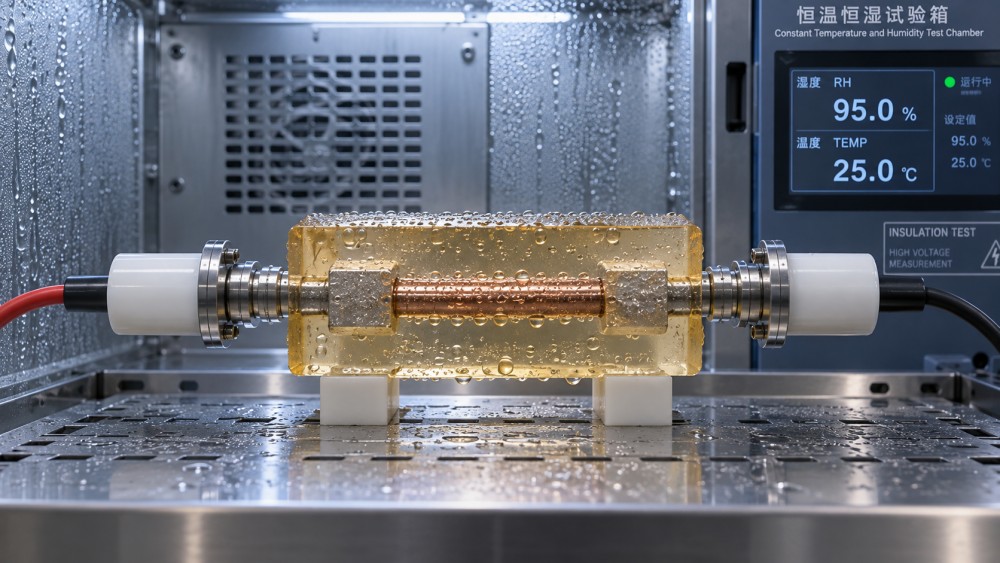
Surface exposure creates a separate problem. A condensed water film, especially with dissolved contamination, can provide a conductive path between terminals. Leakage, dry-band arcing, and tracking may then become more important than through-thickness breakdown. High bulk dielectric strength does not compensate for inadequate creepage distance or an exposed, contaminated interface.
Failure location is therefore essential evidence. A puncture through the bulk, a flashover along the surface, and discharge-driven erosion around an embedded conductor should not be grouped together as identical “dielectric failures.” Each points toward a different corrective action.
Why formulation and cure history change moisture sensitivity
The resin and hardener jointly determine network polarity, crosslink structure, and residual chemistry. Broad labels such as “amine-cured” or “anhydride-cured” are insufficient to rank wet-state insulation performance. Formulation details and the achieved cure state remain decisive.
An incorrect mix ratio or incomplete cure can leave unreacted species and a less developed network. Post-curing can improve conversion and thermal performance where the formulation requires it, but it does not make epoxy waterproof. Comparisons are meaningful only when specimens are prepared using documented mixing, curing, and post-curing conditions.
Fillers create additional trade-offs. They can change thermal expansion, heat transfer, shrinkage, and the amount of polymer present. At the same time, they introduce interfaces. Their surface treatment, cleanliness, dispersion, and wetting can affect moisture-conditioned performance. Increasing filler loading is not automatically a route to better electrical insulation.
Processing defects can outweigh a modest difference in resin chemistry. Entrained air, incomplete filling beneath components, contaminated substrates, and poor adhesion all introduce weaknesses that a homogeneous test plaque may not reproduce. Degassing and controlled dispensing help address these risks, but the resulting assembly still needs verification.
Conditioning must represent the exposure being evaluated
“Tested after humidity exposure” is incomplete information. Relative humidity, temperature, exposure duration, specimen thickness, and the interval between conditioning and measurement determine what the result means.
Moisture absorption develops over time. Under an ideal diffusion-controlled approximation, the time required to reach a comparable moisture state scales with the square of the diffusion distance. A thin plaque may therefore approach equilibrium much sooner than a thick encapsulation. Identical conditioning duration does not establish identical internal moisture content.
Elevated temperature can accelerate ingress, but it can also change the material. Further curing, chemical degradation, or interfacial damage may occur alongside absorption. An accelerated exposure cannot be converted directly into service life without demonstrating that the relevant mechanisms remain representative.
Measurements should distinguish testing while conditioned, testing after cooling, and testing after drying. Cooling a humid specimen can introduce condensation; leaving it in laboratory air can allow moisture loss. Either change can alter the result before the electrical test begins.
Use standards to define methods, not to imply universal acceptance
ASTM D149 and IEC 60243-1 provide established methods for determining electrical strength of solid insulating materials at commercial or power frequencies. A report should identify the applicable method, specimen thickness, electrodes, voltage procedure, surrounding medium, temperature, and conditioning. Citing the standard number alone does not establish comparability.
ASTM D570 and ISO 62 address water absorption in plastics. They help characterize uptake under defined conditions, but neither establishes the electrical performance retained after absorption. Gravimetric results also need interpretation if exposure causes leaching: a measured mass change can reflect both water uptake and loss of soluble material.
ASTM D257 provides methods for DC resistance and conductance measurements of insulating materials. ASTM D150 addresses AC loss characteristics and permittivity. Measurement voltage, electrification time, frequency, temperature, and moisture condition should be recorded as appropriate, because these variables can affect the reported properties.
IEC 60068-2-78 covers steady-state damp-heat testing, while IEC 60068-2-30 addresses cyclic damp heat. These environmental methods can support conditioning or assembly evaluation, but electrical acceptance criteria must come from the applicable product requirements or a justified engineering specification.
Where internal discharge is relevant, IEC 60270 provides a basis for charge-based partial-discharge measurement. Where surface tracking is a concern, IEC 60112 addresses comparative and proof tracking indices under prescribed conditions. Neither a partial-discharge result nor a tracking index substitutes for the complete application-specific insulation assessment.
The applicable edition and product-standard requirements should be identified in the test plan. Material test methods do not, by themselves, establish an allowable operating voltage or certify a finished assembly.
Build the comparison around retained performance
A useful evaluation compares specimens made from the same batch and cure schedule in defined dry and moisture-conditioned states. Water uptake, dielectric strength, resistivity, and dielectric loss should be linked to the same exposure history rather than assembled from unrelated datasheet values.
One useful comparison is retained dielectric strength:
Retention (%) = moisture-conditioned dielectric strength ÷ reference dry dielectric strength × 100.
This ratio is meaningful only when the electrical test conditions are otherwise comparable. It must be considered alongside the absolute conditioned value: strong percentage retention does not guarantee adequate insulation margin. Breakdown scatter also matters, so qualification should use multiple specimens and report variability rather than only the highest result.
Testing after controlled re-drying can help separate reversible absorption effects from persistent damage. Recovery of resistivity or dielectric loss suggests a reversible contribution. Persistent deterioration can indicate chemical change, cracking, or interfacial damage. Recovery after drying does not establish safe operation while wet.
Material-level comparisons should then be checked against representative assemblies. Include relevant conductor edges, minimum insulation thickness, bonded interfaces, and production processing. For humid high-voltage service, measurements such as leakage current, partial discharge, or withstand performance may reveal weaknesses that plaque breakdown testing misses.
Translate the evidence into an insulation decision
The acceptance criterion should follow the dominant service risk. A non-condensing enclosure calls for evidence of bulk property retention at the relevant temperature. A component exposed to condensation needs particular attention to surface paths and contamination. A high-voltage encapsulation requires scrutiny of voids, interfaces, and local field concentration as well as bulk strength.
Do not calculate an allowable operating voltage by multiplying a datasheet dielectric-strength value by wall thickness. Short-duration breakdown data do not account fully for long-term stress, geometry, manufacturing variability, or moisture-assisted degradation. Voltage margins and insulation dimensions must be established through the applicable design requirements and validated performance.
The decisive evidence is not the highest dry-state number. It is a documented, repeatable margin under representative moisture, temperature, and electrical conditions, supported by a process that produces sound interfaces and consistent cure. Without that evidence, dry-state dielectric strength remains a screening property—not proof of service reliability.
Have questions about this sector analysis, or seeking best practices specific to your niche? Drop us a line below and let the senior consultants at APIM assist you.
We respect your privacy. Your information is strictly confidential.
Related News
- 00
0000-00
How does washing affect contamination in post-consumer recycled PP resins? - 00
0000-00
How does feedstock affect depolymerization equipment selection? - 00
0000-00
US Sets 213.44% Preliminary Antidumping Deposit on Chinese PTMEG - 00
0000-00
When should epoxy be used as a thermal interface material for semiconductors? - 00
0000-00
US Midterm Results Unlikely to Quickly Shift Recycled Plastics Market or Legislation
Tag