




Which Sealants Resist Both Water and Fuel in Automotive Use?
Fluorosilicone (FVMQ), fluorocarbon elastomer (FKM), nitrile-based sealants, and certain polysulfide systems are the most credible choices where an automotive joint faces both water and fuel. The best material is determined by the actual fluid, whether exposure is splash or continuous immersion, joint movement, temperature, substrate, and cure conditions. A sealant that remains intact around rainwater or coolant residue may still soften, swell, or lose adhesion after contact with gasoline, diesel, ethanol-blended fuel, or fuel vapor.
For flexible external or under-hood joints exposed to moisture plus occasional fuel contact, fluorosilicone is often considered first because it retains silicone-like flexibility over a broad temperature range while resisting many petroleum-based fuels better than conventional silicone. For fuel-wetted locations, FKM-based compounds and specialized nitrile or polysulfide sealants are usually stronger candidates. Polyurethane and epoxy products can work in selected assemblies, but neither material family should be treated as automatically suitable for direct fuel immersion.
Material Families That Handle Water and Fuel Exposure
Why Conventional Silicone Often Fails Near Fuel
Standard RTV silicone has excellent resistance to water, weather, and elevated temperature, so it is commonly used on valve covers, exterior lamp housings, electrical enclosures, and cooling-system-related joints. Its weakness is hydrocarbon fuel exposure. Gasoline and fuel vapors can cause ordinary silicone to swell, soften, lose tensile strength, or detach from the substrate. The joint may appear satisfactory after assembly and fail only after a period of fuel contact.
Fluorosilicone changes that balance. Its fluorinated polymer structure improves resistance to fuels, lubricants, and oils while preserving elastic behavior. This makes it useful where a seal must accommodate vibration, thermal cycling, or small joint movement. It is especially relevant where fuel exposure is intermittent rather than where the sealant forms a permanent barrier against continuously immersed, highly aggressive fuel.
The distinction matters because fuel chemistry is not fixed. Gasoline may contain oxygenates and detergent packages; diesel may include biodiesel content; fuel vapor has different effects from liquid immersion; and a component beside a hot engine sees more chemical stress than a similar component in a protected cabin area. A material described broadly as “fuel resistant” should be matched against the actual fuel formulation and service temperature rather than selected from that phrase alone.
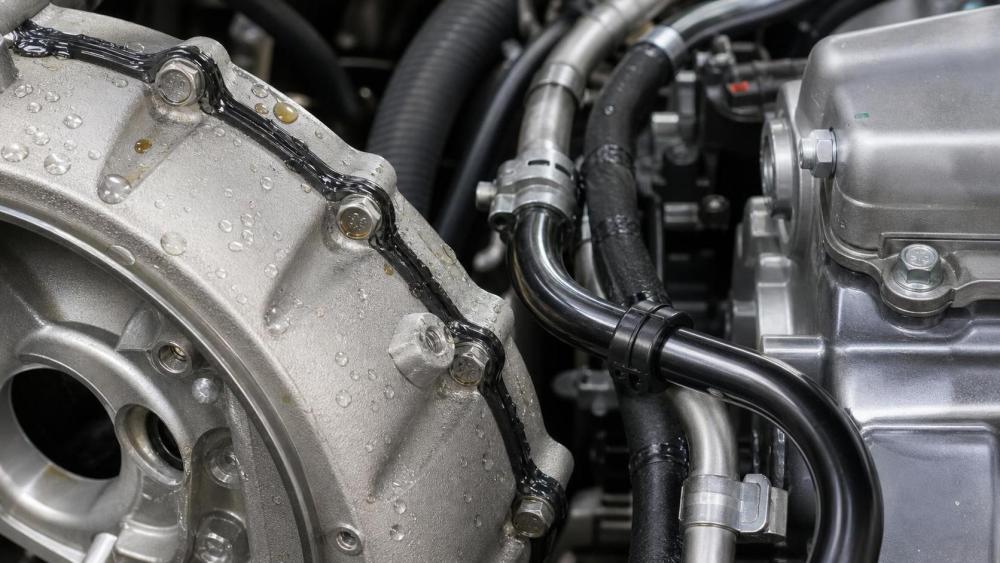
Where FKM and Nitrile Systems Fit Better
FKM is among the strongest elastomer options for automotive fuel resistance, particularly when heat, hydrocarbons, engine oil, and fuel vapor occur together. It is frequently used as a molded seal, O-ring, or gasket material rather than a cartridge-applied liquid sealant. When a liquid-applied product is needed, an FKM-modified or fluoroelastomer-based formulation may offer appropriate resistance, provided it is designed for the intended joint geometry and cure process.
FKM is a sensible direction for static fuel-system interfaces, fuel-pump modules, injector-related components, tank fittings, and high-temperature sealing locations. Its chemical resistance does not remove the need to examine mechanical behavior. A rigid flange that remains dimensionally stable calls for a different formulation from a wide joint subject to repeated flexing. Compression set, elongation, tear resistance, and adhesion to the mating surfaces still determine whether the seal remains leak-free.
Nitrile rubber, commonly identified as NBR, has long been used where petroleum oil and conventional fuel resistance are needed at a practical cost. Nitrile content improves resistance to hydrocarbons, but the tradeoff may include reduced low-temperature flexibility or reduced resistance to ozone and outdoor weathering. In an exposed underbody location, an NBR-based sealant can age from heat, road splash, and ozone even if its fuel resistance is adequate.
Hydrogenated nitrile rubber, or HNBR, improves heat and ozone performance relative to many conventional nitrile compounds. It can be valuable where fuel and oil contact combine with elevated under-hood temperatures. Product-level qualification remains necessary because the final behavior depends on plasticizers, fillers, cure system, and solvent content, not only the polymer named on a technical sheet.
Polysulfide Sealants for Persistent Hydrocarbon Exposure
Polysulfide sealants are often selected for joints where long-term resistance to hydrocarbons, moisture, and weathering is more important than fast handling. Their chemistry has a well-established role in fuel-resistant sealing, particularly for metal assemblies where a durable, flexible barrier is required. They can be relevant to fuel tank seams, access covers, enclosure joints, and related assemblies that do not require a hard structural bond.
These materials are not interchangeable with silicone or polyurethane. Their cure profile may be slower, and mixing ratio control is important in two-part grades. Inadequate mixing can leave soft regions that appear cured at the surface but have poor chemical resistance through the bead. Surface contamination is equally damaging: fuel residue, machining oil, mold-release compounds, and corrosion products can create a weak bond line that fails before the sealant body degrades.
Polyurethane and Epoxy: Useful, but Only Within Defined Boundaries
Polyurethane sealants adhere well to many coated metals, plastics, and composites and tolerate movement better than rigid epoxies. Their resistance to water is often good after full cure, which makes them common in body sealing and exterior automotive assemblies. Fuel is the limiting condition. Some grades withstand incidental splashes or short exposure, while others swell or lose adhesion under sustained contact with gasoline, diesel, or fuel vapor.
Polyurethane should therefore not be used for a fuel-wetted tank seam, filler-neck interface, or submerged joint unless the product documentation expressly addresses that service. The term “automotive polyurethane” describes a broad group of products, not a shared fuel-resistance level. Moisture-cure systems also need adequate curing time and bead depth control. A thick bead installed in a cold or dry environment may remain incompletely cured beneath the skin, leaving it vulnerable when exposed to fluid.
Epoxy sealants are appropriate when the assembly is rigid and the joint must resist fuel, water, and chemical cleaning fluids without significant movement. They are often suitable for threaded fittings, metal housings, small crack repairs, and bonded interfaces that are mechanically supported by the component design. Their weakness is brittleness. Thermal expansion differences between aluminum, steel, glass-filled nylon, and other automotive substrates can crack an epoxy bond line during repeated temperature cycling.
A flexible fuel-resistant sealant is usually preferable where vibration, pressure pulses, or dissimilar-material movement is expected. Conversely, a soft elastomeric sealant is a poor substitute for a rigid adhesive where the joint needs structural load transfer. Chemical compatibility and joint mechanics must be evaluated together.
Fuel Type Changes the Selection
“Fuel resistant” is incomplete without identifying the fuel. Gasoline, diesel, kerosene, ethanol-blended gasoline, and biodiesel-containing diesel do not affect sealants in the same way. Ethanol-containing fuels can be particularly demanding because they introduce polarity and can carry water. A sealant that resists non-oxygenated gasoline may show greater swelling, extraction of additives, or adhesion loss in an ethanol blend.
Water exposure also has several forms. Rainwater and wash water mainly challenge external weathering and adhesion. Condensation in a sealed enclosure adds prolonged humidity. Coolant leaks introduce glycol and corrosion inhibitors. Water present in fuel can create a mixed chemical environment at the bottom of a tank or at a stagnant interface. A formulation should be assessed against the combined environment where that condition is realistic, rather than against separate water and fuel claims made under unrelated test conditions.
Read Product Data Beyond the Word “Resistant”
A chemical-resistance statement is meaningful only when paired with exposure conditions. Look for the fluid named, its concentration or blend, temperature, exposure duration, and whether the result concerns immersion, splash, vapor, or intermittent contact. A sealant may retain its volume in a fluid while its bond to aluminum or polyamide weakens. Another may remain bonded but lose enough elasticity that thermal cycling opens a leak path.
Useful information includes volume change, hardness change, tensile retention, elongation retention, peel or lap-shear adhesion after exposure, and compression-set behavior for gasket-like materials. For field-applied sealants, also examine cure mechanism, skin time, through-cure depth, application temperature, and whether primer is required for the intended substrate. These parameters affect the installed seal as much as its base chemistry.
- Static flange with fuel contact: FKM-based materials, selected nitrile systems, or fuel-rated epoxies are often appropriate when movement is low.
- Flexible cover or enclosure joint: Fluorosilicone provides useful elasticity where moisture and occasional petroleum exposure occur together.
- Tank seam or long-lived hydrocarbon barrier: A qualified polysulfide or dedicated tank-sealing system is generally more suitable than ordinary RTV or body-seam polyurethane.
- Painted metal or plastic body joint near a possible spill zone: A polyurethane can be acceptable only when its fuel splash resistance, adhesion, and cure conditions are confirmed for that assembly.
Installation Errors That Resemble Material Failure
Many apparent chemical failures begin with installation. A bead applied over fuel film, oil, silicone residue, or cleaning-solvent residue may lose adhesion rapidly. Solvent wiping is useful only when the surface is then allowed to dry completely; moving contamination across the joint can be worse than leaving a visible dry surface untouched. Abrasion or controlled surface activation may be required on low-energy plastics, but aggressive abrasion can damage coatings or expose corrosion-prone metal.
Joint design also controls survival. A thick, unconfined bead can tear under vibration even when the chemistry is correct. A very thin bead may not bridge surface texture or flange distortion. For flexible sealants, bond-line geometry should allow extension and compression without concentrating strain at a sharp edge. For gasket compounds, excessive clamp load can squeeze out the material and leave an insufficient film after thermal cycling.
Do not expose the assembly to fuel before the specified cure is complete. Surface skin formation is not full cure, especially in moisture-cure products and deep sections. Premature fluid contact can interfere with cure, extract uncured constituents, and produce a seal that later looks intact but lacks cohesive strength.
Practical Selection Direction
Choose fluorosilicone when flexibility, water resistance, and resistance to incidental fuel or oil exposure are required in a temperature-cycling automotive location. Move toward FKM, HNBR, specialized nitrile, or polysulfide chemistry when the seal will see repeated or continuous fuel contact. Reserve polyurethane for areas where fuel exposure is limited and explicitly supported by the formulation, and use epoxy only where the joint is stable enough for a rigid cured material.
The final selection should be based on the complete system: fuel composition, temperature, contact mode, joint movement, substrate finish, bead geometry, cure schedule, and the consequences of a leak. A sealant that survives water and fuel in a laboratory coupon may still fail in service when the joint design or installation process imposes stresses outside those conditions.
Have questions about this sector analysis, or seeking best practices specific to your niche? Drop us a line below and let the senior consultants at APIM assist you.
We respect your privacy. Your information is strictly confidential.
Related News
- 00
0000-00
Do polyolefin hot melt adhesives bond well to polyethylene? - 00
0000-00
Korean Study Finds PLA Barely Degrades in Landfill After 320 Days - 00
0000-00
How to assess batch consistency from a thermal potting compounds supplier - 00
0000-00
How much weight can carbon fiber reinforced plastics save in cars? - 00
0000-00
Switching from PS to ABS Sheet Extrusion: Equipment Checks