




What matters most when selecting polyurethane adhesives for automotive assembly
Meta Title: What matters most when selecting polyurethane adhesives for automotive assembly
If you are comparing polyurethane adhesives for automotive assembly, the biggest mistake is judging them by bond strength alone. In real vehicle programs, the better adhesive is the one that matches the substrate, survives thermal cycling and vibration, fits the production window, and stays consistent from pilot builds to volume manufacturing. A strong lab result can still become a weak production choice if cure speed, surface sensitivity, gap tolerance, or process control are overlooked.
That is usually where technical evaluations get difficult. One team is focused on mechanical performance, another is worried about line speed, and procurement wants supply reliability without adding cost risk. A sensible selection process has to hold those concerns together, because an adhesive that works on a test coupon does not automatically work on a vehicle platform.
Start with the joint, not the adhesive brochure
Many selection problems begin with the wrong question. Instead of asking “Which polyurethane adhesive is best?”, ask “What is this joint required to do over its full service life?” That changes the conversation immediately.
In automotive assembly, polyurethane systems may be considered for bonding metal to plastic, composite to metal, interior assemblies, body components, battery-adjacent structures, glazing-related parts, insulation layers, and vibration-damping assemblies. Those are very different duty conditions. A joint inside the cabin, protected from fluids and severe heat, can tolerate a different adhesive profile than a bonded assembly near the engine compartment or underbody.
Before comparing products, define five basics clearly:
- What substrates are being joined, including coatings, primers, or surface treatments
- What loads the joint will see: peel, shear, impact, fatigue, or mixed loading
- What environmental exposure matters most: heat, humidity, salt, oils, cleaners, or UV
- What gap the adhesive must fill and how much dimensional variation the parts have
- What production constraints exist: open time, fixture time, application method, and takt time
Without that definition, teams often compare datasheets that are not really comparable.
What usually matters most in polyurethane adhesives for automotive assembly
If I had to reduce the decision to one practical rule, it would be this: choose the adhesive that creates the most reliable process window for the actual joint design. Mechanical properties matter, but they only matter after the adhesive can be applied, cured, and controlled consistently on the line.
That said, several criteria repeatedly decide whether a polyurethane system succeeds or fails.
1. Substrate compatibility is the first gate
Polyurethane adhesives are often chosen because they can bond a wide range of materials while retaining flexibility. That makes them attractive for mixed-material vehicles. But “wide range” does not mean universal compatibility.
Surface energy, contamination, mold release residues, conversion coatings, painted surfaces, and composite resin chemistry all affect adhesion. Bonding to bare steel is one question. Bonding to e-coated metal, aluminum, SMC, polycarbonate blends, or reinforced thermoplastics is another. In practice, the issue is not whether initial adhesion is possible. The issue is whether adhesion remains stable after humidity, thermal cycling, and fluid exposure.
A common evaluation mistake is testing only freshly prepared panels under ideal lab conditions. If the production environment includes variable cleaning quality or aged substrates, your test plan needs to reflect that.
2. Flexibility can be more valuable than peak strength
Technical teams sometimes overvalue maximum tensile or lap shear numbers. For automotive use, that can be misleading. Polyurethane adhesives are often selected because they absorb movement, distribute stress, and tolerate vibration better than more rigid systems in certain assemblies.
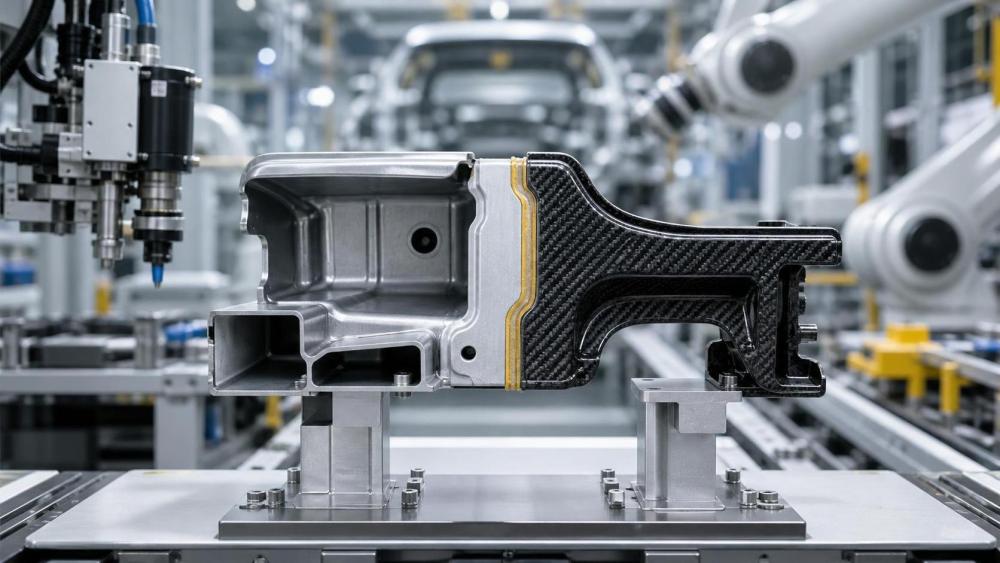
When joining dissimilar materials, differences in thermal expansion can create constant stress in the bond line. A stiffer adhesive may look impressive in a static test and still lose performance over time if it cannot accommodate movement. Polyurethane’s ability to stay resilient under dynamic conditions is often the real advantage.
This matters especially in assemblies that experience repeated door slams, road vibration, thermal expansion mismatch, or local impact loading. If the joint sees peel and flex, a slightly lower strength material with better toughness and elongation may be the smarter choice.
3. Cure behavior has direct manufacturing consequences
Two polyurethane adhesives can look similar on paper and behave very differently in production. Technical evaluators should pay close attention to:
- Open time or working time
- Fixture time
- Full cure profile
- Sensitivity to moisture and ambient conditions
- Mix ratio control for two-component systems
If assembly requires repositioning, bead continuity, or larger bond areas, very short open time can create scrap risk. If fixture time is too long, throughput suffers. If cure depends heavily on ambient moisture or temperature, the process may become unstable between seasons or across plants.
This is one reason experienced teams do not treat cure speed as a simple “faster is better” issue. The right cure profile is the one that fits the line without narrowing the process window too much.
Heat, chemicals, and aging: where many shortlist decisions change
Short-term adhesion is easy to overestimate. Long-term durability is where the real selection work happens.
Automotive assemblies face repeated heat exposure, humidity, freeze-thaw cycles, road salt, cleaners, oils, plasticizers, and mechanical fatigue. Not every polyurethane formulation handles these stressors equally well. One grade may be adequate for interior trim bonding but unsuitable for structural or semi-structural applications exposed to elevated temperature and aggressive fluids.
Ask suppliers for data tied to realistic aging conditions, not only room-temperature results. Thermal aging, humidity aging, cyclic climate testing, and retained properties after environmental exposure are more useful than isolated headline numbers.
Another point that gets missed: the substrate can degrade before the adhesive does, or the interface can fail while both bulk materials still look acceptable. That is why failure mode analysis matters. Cohesive failure, adhesive failure, and substrate failure do not tell the same story.
4. Surface preparation requirements should match plant reality
An adhesive that needs tightly controlled abrasion, plasma treatment, special primer use, and narrow cleanliness limits may still be the right choice, but only if the plant can support that discipline. Otherwise, its theoretical performance is not very meaningful.
For technical assessment, it helps to separate three questions:
- What surface preparation gives the best possible result?
- What is the minimum preparation needed for acceptable production performance?
- How sensitive is the adhesive to variation?
The third question is often the most important. In automotive programs, robustness usually beats perfection. If one adhesive gives slightly lower peak performance but remains stable across realistic process variation, it can be the better manufacturing decision.
Do not ignore joint design and dispensing method
Adhesive selection cannot be isolated from bead geometry, bond-line thickness, flange design, clamping method, and dispensing equipment. Polyurethane systems can offer useful gap-filling behavior, but excessive bond-line thickness or poor geometry may still create cure inconsistency, trapped air, or weak edges.
Likewise, a material that works well in manual application may behave differently in automated dispensing. Viscosity stability, sag resistance, pumpability, and mixing quality matter more as production scales.
A practical review should include the equipment team early. If the adhesive requires tighter metering control, static mixer replacement frequency, or temperature conditioning, that becomes part of the real cost and risk of ownership.
5. Supply stability and batch consistency belong in the technical review
Some teams leave supply questions to procurement too late. That is a mistake for industrial adhesives. Batch-to-batch consistency, shelf life, packaging format, storage conditions, and regional supply support all affect plant performance.
Even a qualified adhesive can become a problem if viscosity drifts, pot life varies, or material handling requirements do not fit the site. For global vehicle programs, dual-region support and technical service responsiveness may matter almost as much as product chemistry.
This is where a structured materials intelligence source can help. Platforms such as APIM are useful not because they replace qualification testing, but because they help teams compare adhesive behavior, substrate considerations, processing requirements, and supplier positioning in a more organized way before lab and plant trials begin.
Common selection mistakes that slow down automotive adhesive projects
Several patterns show up again and again:
- Using room-temperature bond strength as the main screening metric
- Assuming success on one substrate means success on all coated or modified versions of that substrate
- Underestimating the effect of production humidity and temperature on cure
- Qualifying on ideal lab surfaces rather than realistic plant conditions
- Ignoring how adhesive flexibility affects fatigue life in mixed-material joints
- Choosing a product that is too process-sensitive for the available manufacturing controls
None of these are unusual mistakes. They happen because adhesive choice sits between materials science and manufacturing reality. A product can look right to design engineering and still be wrong for plant execution.
A workable decision path for technical evaluators
If you are narrowing options, keep the process simple and evidence-based.
First, define the application class clearly: cosmetic attachment, sealing-plus-bonding, semi-structural, or structural support. Then identify the real environmental loads and the expected service temperature range. After that, screen for substrate compatibility and process fit before moving into full mechanical validation.
Once you have a short list, test the adhesives under conditions that resemble actual production and service. Include aged substrates if relevant, realistic bond-line variation, and environmental exposure after cure. If the program is sensitive to cycle time, include dispensing and fixture trials early rather than late.
A short answer many teams find useful is this: the best polyurethane adhesives for automotive assembly are not the ones with the highest published strength, but the ones that maintain adhesion, flexibility, and repeatable curing across your real substrates, your real plant conditions, and your real durability targets.
That is also the point where selection becomes a business decision, not only a lab decision. Scrap risk, takt time, rework difficulty, and supplier support can outweigh small differences in headline performance.
For teams still comparing candidates, the next step is usually not asking for more marketing literature. It is building a tighter validation matrix: substrate set, surface condition range, curing window, environmental aging, and failure mode review. Once those are clear, the right polyurethane system usually stands out quickly.
FAQ
Are polyurethane adhesives always the best choice for mixed-material automotive bonding?
No. They are often strong candidates because of flexibility and adhesion range, but some joints may be better served by epoxy, acrylic, or other systems depending on stiffness, cure profile, and environmental demands.
How important is surface preparation when evaluating automotive polyurethane adhesives?
It is critical. Many apparent adhesive failures are actually interface problems caused by contamination, poor cleaning, or inconsistent surface condition.
Should technical teams prioritize one-component or two-component polyurethane systems?
That depends on the process. One-component systems can simplify handling, while two-component systems may offer more control over cure speed and performance. The right choice depends on line design and application needs.
Can a high-strength adhesive compensate for poor joint design?
Usually not. Poor flange geometry, uncontrolled bond-line thickness, or unfavorable peel loading can undermine even a strong adhesive system.
Image Placeholder List
- — Suggested placement: after the section discussing flexibility, dynamic loading, and thermal expansion mismatch. Suggested image content: cross-section or schematic comparing bonded automotive joints under vibration and thermal movement. Suggested alt text: “Key evaluation factors for polyurethane adhesives in automotive assembly joints.”
Internal Link Anchor Text Suggestions
- structural adhesive selection for mixed-material automotive parts: guide page or topic hub
- how substrate surface treatment affects industrial bonding: technical article
- polyurethane vs epoxy adhesive in vehicle assembly: comparison page
- automotive composite bonding material guide: application-focused article
- adhesive curing behavior and production line control: process engineering resource
External Authority Source Suggestions
- automotive OEM or Tier 1 supplier material specification documents
- adhesive manufacturer official technical data sheets and application guides
- industry association or recognized test standard documentation for adhesive durability and environmental testing
Have questions about this sector analysis, or seeking best practices specific to your niche? Drop us a line below and let the senior consultants at APIM assist you.
We respect your privacy. Your information is strictly confidential.
Related News
- 00
0000-00
Do polyolefin hot melt adhesives bond well to polyethylene? - 00
0000-00
Korean Study Finds PLA Barely Degrades in Landfill After 320 Days - 00
0000-00
How to assess batch consistency from a thermal potting compounds supplier - 00
0000-00
How much weight can carbon fiber reinforced plastics save in cars? - 00
0000-00
Switching from PS to ABS Sheet Extrusion: Equipment Checks